
Resident generated news about Lakewood, Colorado
Resident generated news about Lakewood, Colorado
False Allegations Lead To Election Free Speech Harassment
Lakewood confiscated political yard signs without warning or discussion less than a week before election day. Whole neighborhoods were denuded of signs, angering residents who argue they were properly placed. Days later, residents pushed back, protesting for free speech at a city ward meeting. City Council members unjustly accused the protesters of electioneering, even while conducting similar discussions within electioneering limits themselves. Police were called. No electioneering was found. No apologies were issued to free speech, “Vote Yes” advocates for any of these incidents.
Confiscating Yard Signs
Lakewood zoning code states yard signs must be set back 2 feet from the sidewalk or right-of-way. Many residents do not know about this provision because signs are placed in many locations they are not supposed to be. Lakewood does not enforce this code unless someone complains.
In this case, code enforcement confiscated “Vote Yes” signs throughout Wards 1 and 2. Although a few “Vote No” signs were taken, many more “Vote Yes” signs were removed.
There were also reports, including video evidence, of individuals removing “Vote Yes” signs and replacing them with “Vote No” signs. Meanwhile, a single incident involving a “Vote No” flyer being replaced was acknowledged and apologized for by the “Vote Yes” side. That contrast in response further escalated tensions.
Most Drastic Enforcement Option Taken
Many of the yard signs were placed by knowledgeable campaigners who measured the proper distance for placement, which was 2 feet from the right-of-way. However, Lakewood reportedly used a 3-foot standard rather than a 2-foot standard, leading to over-confiscation.
With no hearing or discussion, there was no way for this discrepancy to be solved.
Residents were given no warning and no opportunity to correct the problem. Instead, code enforcement staff confiscated the signs, depriving residents of their First Amendment rights.
Resident education and encouraging code compliance were options not taken. This is a drastic contrast to other enforcement actions in Lakewood, such as prolific drug use that the City of Lakewood conveniently overlooks rather than penalizes despite constant resident complaints.
Fake Speech
The same day Lakewood was confiscating signs, a “Vote No” campaign mailer arrived that mimicked an informational mailer sent by the Green Mountain Water and Sanitation District (GMWSD). The new mailer took advantage of the confusing ballot language and capitalized on the respect GMWSD has built to lure voters to their side.
Although honest mistakes have been made by both sides, the “Vote No” campaign has conducted many such misrepresentations on purpose, often accusing the grassroots group of what they themselves are guilty of. For example, both sides accuse the other of being “special interest” but only the Make Lakewood Liveable committee has hundreds of thousands of dollars to prove special interest funding.
Last-Minute Change and Electioneering Concerns
The confiscated signs and attacks against the grassroots residents led some people to bring signs to the Ward 1 meeting on April 4, 2026. This proved challenging because an hour before the meeting was to be held, it was moved from the normal venue to the Lakewood Library. The library has a drop-in ballot box.
Both ballot boxes and polling places have special rules to protect fair elections, although they differ between boxes and polling places. In some cases, people cannot advocate for a position near the ballot box. Holding advocacy signs or conducting meetings on the issues violate what is called electioneering law.
However, the Ward 1 Council Members, Jeslin Shahrezaei and Glenda Sinks, concluded their meeting would be allowed. Councilor Sinks specifically told residents it would be ok if it was in the building, rather than outside.
This is false, you cannot conduct electioneering inside a public room in a polling place.
Although the Ward 1 Councilors were not concerned about their meeting, they were very concerned about people with signs. This inconsistency added to frustration among attendees.
Police Called
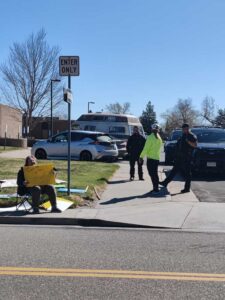
Council Member Jeslin Shahrezaei hadn’t even made it into the library before she accused two residents of electioneering. The two residents were standing in the parking lot talking, with signs present but not actively demonstrating. Shahrezaei said signs were not allowed at a polling place and the residents were electioneering.
One resident involved was this author, Karen Morgan. Upon disagreeing with Shahrezaei, Morgan suggested Shahrezaei call in a complaint. Shahrezaei replied that she would. Less than an hour later, two police cars arrived to crack down on the three people waving signs. The picture above shows how non-threatening the scene appeared. Most other residents were inside the building discussing zoning with the Ward 1 Councilors.
Oh, the irony of being accused of what your accuser is doing.
Baseless Accusations
The police officers were friendly, the free speech/zoning protestors were friendly. There were no problems with police-resident interactions.
Police measured 100 feet from both the ballot box and the building. Demonstrators were outside that boundary, meaning no electioneering occurred. Indeed, due to timing and the fact that this is only a city election, there is no applicable law for electioneering in these circumstances anyway. The whole accusation was baseless from the beginning.
Despite this, the accusations and police presence had a chilling effect. Some participants reported feeling intimidated, particularly when others photographed them and questioned their compliance.
Free speech was stifled once again

Officers measured multiple areas and found no violations, including during the initial interaction before the meeting. All the signs were outside of the ballot box protected area. Driving through the parking lot and accidental exposure is protected. (One of the demonstrators had background with property assessments and knew the distances involved.)
Residents appreciated the professionalism of the officers, though some noted the contrast with other city issues that receive limited enforcement attention.
No Apologies
This isn’t the first time Council Member Shahrezaei has made accusations without evidence. Unfortunately, these stories are propagated as truth for long periods without apology for jumping to conclusions.
Not one apology for false accusations has been made. The city did not apologize for pursing the most drastic level of enforcement. Not one person has removed their endorsement from the committee responsible for fake news attacks. When asked, they say they aren’t responsible for what the committee does, thereby enabling and encouraging future attacks and misrepresentations.
The combination of sign confiscation, misleading materials, and public accusations has left some residents feeling discouraged from civic participation. They report stress, loss of personal property, and a diminished sense of trust in the process.
More broadly, these experiences risk deterring community members from engaging in local government, leaving fewer voices in the conversation and weakening public participation over time.