Resident generated news about Lakewood, Colorado
Resident generated news about Lakewood, Colorado

Meeting Move Raises Questions
Holy Shepherd Lutheran Church says they did not ask to relocate the Ward 1 meeting that ended with police being called on residents on Saturday, April 4.
Despite the holiday weekend, the room reserved for the city was open. The meeting remained on the church’s calendar. In fact, church staff reportedly did not even know about the change until the following day, when they discovered a note left on the door.
Ward 1 City Councilors say they remember the church not being available in 2025 and offer apologies for the mix-up.
Conspiracy Theory or Fact
Inexplicable changes that result in calling the police on residents make residents ask questions. Many residents have lost trust in City Council. People did not want to petition a referendum but Council did not listen about zoning. People were forced to campaign for a special election when Council could have repealed. They were forced to endure accusations of being misinformed and undemocratic.
None of that engenders trust.
Therefore, when Council Members Glenda Sinks and Jeslin Shahrezaei made sudden changes to the meeting, residents took a hard look to see if the facts aligned. The facts do not align, leaving residents with a choice:
- Trust Council explanations that last year the meeting changed so this year the meeting needed to change, or;
- Believe that Councilors moved the meeting in order to make protesting difficult and entrap residents.
The Ballot Box Factor
Central to the entrapment theory is that the new meeting place, the Lakewood Library, was a ballot drop box location, unlike the original church location.
Under some circumstances, protesting or demonstrating cannot be conducted near a ballot box. Advocating for votes or holding a meeting is not allowed in polling places. These actions are called electioneering, which can be illegal under various state and municipal electioneering laws.
When the meeting was moved, a free speech protest that was organized late Friday night, was also moved to the library. Mayor Pro Tem Shahrezaei made false accusations of electioneering before the protest had even gotten set up.
But was the meeting moved to result in accusations? Or were tensions just high on both sides?
Reasons for Change Don’t Add Up
The Ward 1 meeting was originally scheduled at Holy Shepherd Lutheran Church at 9:30 a.m. On that day, at 8:40 a.m., some residents received a message from Councilor Glenda Sinks that reads, “Apologies. Due to the holiday, our ward meeting place is now at Lakewood Library. Thanks, Glenda.”
On its face, the explanation seemed reasonable. Easter weekend often brings scheduling conflicts, and few would question a last-minute adjustment.
However, Lakewood resident and accountability super-sleuth, Lenore Herskovitz called the church directly and learned that the church did not instigate the change. So what made anyone think it was necessary to move the meeting? Just 24 hours earlier, the city had still listed the church as the meeting location in its public report.
Residents Ask Questions
Lakewood resident Jeri Coffey showed up at the church that Saturday and found business as usual. A Bible study group was meeting. The room designated for the Ward meeting sat empty.
Coffey reports that she stayed to notify residents of the change. “At least a dozen folks like myself had not received any communication of the change. The parking lot looked deserted and was empty of cars, which is unusual 20-30 before the meeting start time, so people may have turned away without getting out of their car….thinking it must have been canceled.”
These details raise an obvious question: if the church was available, why move the meeting at all? Did Shahrezaei and Sinks check the church, like Coffey did, before moving the meeting?
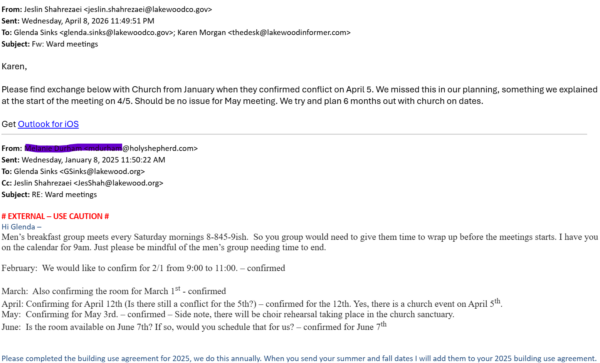
The Ward 1 Councilors say they remembered the problem in the past. As you can read in the email below, in 2025, the April 5th meeting was rescheduled to April 12. April 4th was not mentioned. Something triggered the Councilors to check the date and this email seemed to confirm that they needed to move.
Lakewood Library Available
Scrambling to find a last-minute meeting room is an unusual situation for Councilors who plan meetings six months in advance. Although it did not cause the Councilors to double check their email, it caused one resident to double check when the library arrangements were made. She learned that a reservation cannot be made at the last minute, and in the end, people just showed up. By chance, space was available, allowing the meeting to proceed for a limited time.
Councilors Endorsing Misinformation
For some residents, the controversy did not begin with the meeting. It was the latest in a series of escalating tensions surrounding zoning changes and the activities of the Make Lakewood Liveable (MLL) campaign. Most City Council Members endorsed the MLL campaign and did not retract that endorsement regardless of any questionable activity.
Democrat residents felt betrayed to see themselves repeatedly referred to as MAGA. The many grassroots volunteers see their efforts disrespected by claims of being special interest.
The intrepid Lenore Herskovitz followed up on these concerns and explained as follows:
“On Thursday of last week I contacted my Ward 1 councilors Jeslin Shahrezaei and Glenda Sinks asking if they were going to do a follow-up on concerns by attendees at last month’s combined Ward 1 and 2 meeting regarding provocative but unsubstantiated accusations in Make Lakewood Livable flyers. The next day I was told they would not. Both councilors, in separate responses, tried to discourage me from bringing it up at the upcoming meeting. Jeslin said it was so close to the election that most people had already voted while Glenda basically said I should stick to the topic of zoning. This reaction was concerning in light of the sign removal and now I’m being dissuaded from talking about the flyers.”
Distribution is Endorsement
Councilors have stated that they are not responsible for creating election materials.
But for some residents, that distinction does little to resolve concerns. Distribution, they argue, still signals endorsement.
As one resident put it, “They may not craft the message, but they are happy to distribute it.”
The result is a growing perception that misinformation is not only circulating but being implicitly validated by those in office.
“We are more divided than ever”
In the aftermath of the Ward 1 meeting, the broader impact may be less about logistics and more about trust.
Herskovitz captured that sentiment in a public reflection (emphasis added):
“Glenda spoke a great deal about finding “common ground” and “healing” after she stood in front of this group laughing and apologizing for the venue mix-up due to the holiday. Is the common ground that we should mislead each other? What lesson did people take away from this meeting? Divisiveness was certainly exacerbated by the previous week’s activities [yard sign pulling and misinformation flyers]. It is perfectly acceptable for some of our council members to want to retain the zoning that they passed. What is questionable is that they endorse a group that deliberately sets out to incite anger and negative feelings towards many of their own constituents. We are more divided than ever and the actions of the Ward 1 councilors on Saturday widened that gap. It is doubtful that we will see acknowledgment or an apology for that.”
The Lingering Question
It is absolutely possible a last-minute memory triggered panic to get a meeting relocated. In a perfect world, with trust on both sides, there would be no question of what happened. And no question of accepting apologies offered in good faith. But whether intentional or not, the decision altered the tone and trajectory of the meeting.
And for many residents, one question remains difficult to ignore:
Was this simply a scheduling misstep, or something more deliberate?
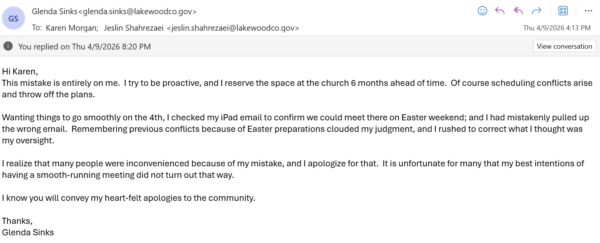
Council Member Glenda Sinks offers the following apology, reading in part, “I realize that many people were inconvenienced because of my mistake, and I apologize for that. It is unfortunate for many that my best intentions of having a smooth-running meeting did not turn out that way.”