Resident generated news about Lakewood, Colorado
Resident generated news about Lakewood, Colorado
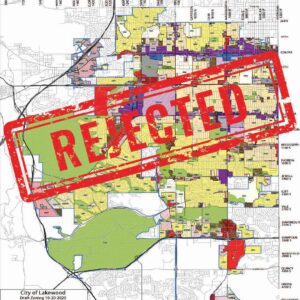
Residents Reject City Council Zoning
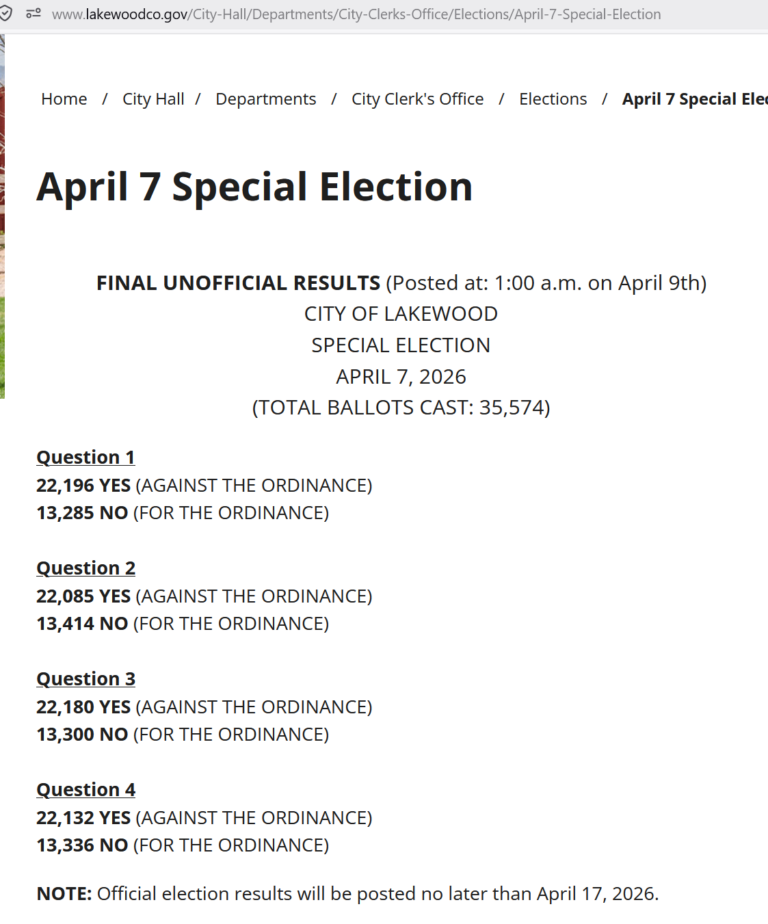
No one asked Lakewood residents if they wanted city-wide rezoning for urbanized high-density until April 7, 2026. On that day, Lakewood residents answered this question with a resounding “No.” The discussion lasted for years and culminated in an ongoing disconnect between residents and their elected representatives.
How it Started
The sweeping zoning changes affecting every neighborhoods were de-emphasized for years.
Rezoning started with no details. Lakewood contracted a company to write a new zoning code in July, 2024, but this wasn’t a discussion, just quietly completed.
City Council then passed a resolution on December 9, 2024, stating the city will have a “zoning rewrite that is bold, imaginative, embraces innovation, and the diversity of needs for the full City of Lakewood.” City Councilors who approved the high-density resolution were Strom, Mayott-Guerrero, Stewart, Rein, Shahrezaei, Labure, Nystrom, Low, I. Cruz, and Sinks.
Those early high-density, low-discussion votes set the stage for approving radical new zoning.
After that, City Council discussed minor details for months. Finally, in July, 2025, Lakewood residents could see a pre-amended version of the zoning code that to be voted on weeks later.
Why People Were Upset
By this time, Lakewood City Council had betrayed the trust of its residents one time too many. Two concurrent citizen-led initiatives, Belmar Park and Whippoorwill near Youngfield, had demonstrated that densification was not in line with residents desire to maintain the existing neighborhood characteristics. Residents were watching City Council closely and by June, 2025, were calling for action.
The reason for the eventual repeal are included in that original, 2024 resolution. It states that Lakewood will include “Strategies that target the full range of housing needs compatible in scale and form with existing neighborhoods.”
As residents soon figured out, it is impossible to have the full range of housing needs, from high-density to low-density, and still maintain the existing neighborhoods.
What followed was months of grassroots activism against City Council Members.
Two residents stepped up to publicly start a referendum petition, John Frogge and Karen Miller. This gave residents a rallying point that led to an April 7th special election on zoning. It was a citizens repeal, a basic protection guaranteed in the Constitution against government overreach.
Officials Pushback
Lakewood City Council and their supporters decried a citizen referendum as undemocratic, saying residents should support their elected officials no matter what. In Lakewood, City Council is 100% left-leaning but the same argument is being made against citizen initiatives in red states. Politicians are fighting back against their constituents, just like former Lakewood City Council Member, now Colorado Representative, Rebekah Stewart fought to limit citizen initiatives in 2025. Lakewood City Council have already supported state legislation that undermines the election win.
Lakewood passed a resolution of support for the new zoning, which is in-line with their prior support for the zoning. What was surprising was the large number of special interests, Council Members and elected officials, including Council Members, actively campaigning for the issue, as opposed to the low number of resident supporters.
By this time, 14 months after the initial high-density resolution was passed, two Councilors had changed their mind on supporting the measure. When a new resolution came, Council Members that supported the “Vote No” position included: Strom, Rein, K. Cruz, Black, Shahrezaei, Sinks, I. Cruz, Low and Furman.
Representative Disconnect
The disconnect between residents and their representatives did not end with the election. In fact, blame is still being assigned to voters who are accused of being misinformed, over-represented or old and rich.
News sources get the message wrong. The vote was not to stop all condos and multi-family units. The vote was to stop converting single-family housing into multi-family.
Many Lakewood residents support the idea of converting unused commercial buildings into multi-family units, especially if the new building matched the existing footprint.
Under the old zoning, which was upheld in the vote, developers will now be forced to consider some of those options if they want to build, rather than taking over residential property that has cheaper property taxes.
Resident Hard Work Pays Off
The election was almost a 2-1 win for residents, against the Council’s plans. Without big names, without big money, and without the bully pulpit of City Council, residents had to work ten times as hard to get their message out. And it worked.
There were: yard signs aplenty with many unique messages.
Door knockers and phone calls until the last minute.
Ceaseless strategy sessions.
And unending research. Truly unending. Residents posted new information constantly to nextdoor.com, which became a hub for the community. If the desire was to hide a radical agenda under a boring zoning discussion, score a win for residents who saw through it. They learned more than they wanted to know about zoning in their desire to protect Lakewood character.
The hope now is that Council Members will acknowledge the results, and listen to resident wishes. So far, that has not happened but residents are still ready for the next fight.