
Resident generated news about Lakewood, Colorado
Resident generated news about Lakewood, Colorado
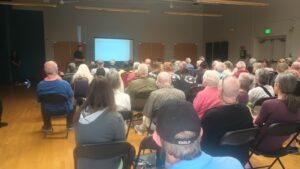
City Staff Pull Wildfire Code Recommendation Following Resident Feedback
Lakewood proposed, then later retracted, the adoption of a new wildfire resiliency code. Lakewood said the new code was needed to satisfy Colorado Senate Bill 23-166 but the staff memo suggested adopting much more extreme measures than required. The broad impact and high cost led to opposition from the community, which is detailed below. City staff are now developing a new recommendation that will be brought forward when ready, to replace the proposal that was pulled.
Why is it Necessary
Senate Bill 23-166 mandates that cities adopt wildfire mitigation standards for areas designated as Wildland Urban Interface (WUI). Both the State of Colorado and Jefferson County developed suitable standards and maps of the WUI that were ready to be adopted. The difference is that Jefferson County significantly increased the state standards. Lakewood proposed adopting the stricter Jefferson County plan which would impact more residents.
Going Beyond What’s Necessary
Both the state and county plan center around Bear Creek Lake Park and Hayden-Green Mountain Park as grassfire-prone areas. The code mitigation requirements focus on what residents should do to protect their property, rather than changes the city may make to these park areas, leading to questions of government overreach.
For example, the state plan is mostly contained to the grassfire areas, the Jefferson County plan would impact adjacent suburban residential areas, affecting hundreds of homes in Wards 1, 4 and 5.
City staff argued that aligning with Jefferson County’s stricter approach would create consistency across jurisdictions, simplify hazard identification, and establish uniform mitigation standards in wildfire-prone areas.
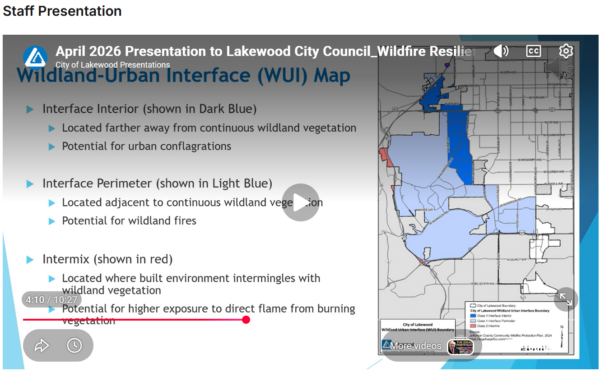
To justify the stricter, more expensive standards, Lakewood said the Jefferson County plan took longer to develop, used more information, and included more local experts. West Metro Fire Captain Dan Wenger emphasized how much better the Jefferson County plan was. He showed a video of how fast fire can spread from house to house to show what a scary situation it is.
The Lakewood Board of Appeals also approved the adoption of Jefferson County’s plan by unanimous vote of members Dennis Mateski, Diana Vollmer, Douglas Porter, Jason Summers, John Barnhart and Keith Peetz.
No argument was made that this was a home rule issue. Lakewood defers to state rules in all circumstances.
Fears of Expensive Mandates for Existing Homes
Just like the increased map area, Jefferson County’s standard increased mitigation measures over the state plan.
Building officials were granted inspection discretion to look for any work completed without a permit at any time in the past and would require the homeowner to redo the work with a permit. Residents believed this was effectively retroactive enforcement.
Homes in the affected areas would have to harden structures to make property more fire resilient. This could include removing all vegetation within 5 feet of a structure and employing special building materials.
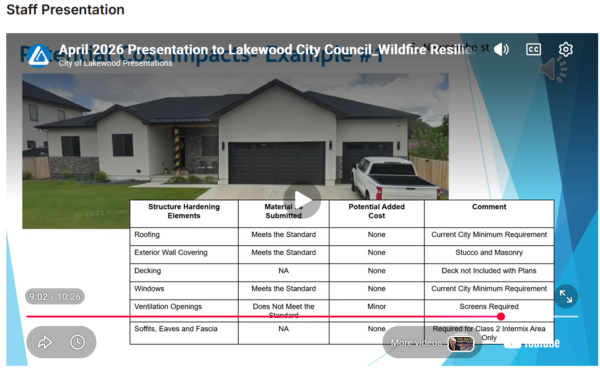
Bringing a property up to code would be an expensive proposition, fully funded by property owners. City staff argue that most houses already meet the standards and no costly work will be required, raising the question why the new code is needed in that case. The slide below came from the cost analysis starting at minute nine of the staff presentation.
Vegetation Removal
A particularly controversial element involved defensible space requirements that could require removal of vegetation within five feet of structures. Critics argued such standards could dramatically alter neighborhood character by replacing mature landscaping with gravel, concrete, or sparse vegetation.
Many residents framed the issue as conflicting directly with Lakewood’s identity as a greener alternative to more urbanized parts of the Denver metro area.
“We live in Lakewood because we want green space instead of concrete and rocks like downtown Denver,” one resident stated during public comment.
Others tied the proposal to broader frustration over city policies that make housing unaffordable or encouraging higher housing density. Some residents argued that lessons from the Marshall Fire demonstrated that tightly spaced homes can facilitate rapid fire spread, making continued densification appear inconsistent with wildfire mitigation goals.
When one resident asked a Lakewood official why Lakewood isn’t including zoning changes that would require increased space between buildings, Lakewood replied that wasn’t part of the recommended standard.
Concerns Regarding Mapping and Scientific Accuracy
The wildfire hazard mapping itself was questioned because so much of suburban neighborhoods was included. Grasslands in Lakewood were classed the same as forests elsewhere in Jefferson County.
Residents pointed to the experience of the Falcon Fire Protection District, where Fire Chief Trent Harwig publicly declined to adopt the state wildfire map earlier this year because it classified vastly different landscapes under the same wildfire intensity category.
Harwig argued that applying the same hardened structure requirements to open prairie grasslands as dense forested areas lacked practical justification.
Critics in Lakewood say the city is proposing something even broader by adopting the Jefferson County mapping system, which they argue was designed for rural and unincorporated areas rather than established suburban neighborhoods.
Insurance and Property Value Concerns
Insurance impacts emerged as another major point of anxiety.
Several commenters warned that formal designation of neighborhoods as WUI areas could trigger rate increases or coverage changes even in areas where wildfire risk has historically been viewed as low.
Residents shared anecdotes from other parts of Jefferson County where homeowners reportedly faced expensive vegetation removal requirements or policy cancellations after insurers learned their properties had been designated within WUI zones.
Insurers currently operating in Lakewood have not broadly raised rates in the way seen in more rural foothill communities, suggesting actuarial assessments may not align with the expanded Jeffco mapping approach.
Concerns Regarding Permit Avoidance and Enforcement
The new WUI code could unintentionally encourage homeowners to avoid the permitting process.
Opponents argued that if permit-triggered wildfire upgrades become too expensive, many homeowners may simply proceed with unpermitted construction or repairs. Several residents described this as “compliance theater” that punishes residents attempting to follow the rules while encouraging unpermitted work.
Personal testimony from a general contractor at the May 9, Ward 4 & 5 meeting suggested that stronger enforcement of existing building and maintenance codes across all neighborhoods might produce greater wildfire risk reduction than imposing extensive new requirements on a relatively small percentage of homes undergoing permitted work each year.
City staff actually used the number of permits that were requested in previous years as a guide to how broad a map they should adopt. There were only a handful of permits pulled in the state map area, versus hundreds of permits in the expanded county map area. It appears that staff believed the state map did not encompass an adequate amount of permitted work, leading them to conclude the mapped area was not broad enough.
Calls for Alternative Approaches
Despite strong criticism of the proposal, many speakers emphasized that they support wildfire mitigation efforts in general.
Alternative approaches suggested by residents included:
- citywide education and incentive programs
- voluntary defensible space improvements
- ember-resistant attic vent retrofits
- vegetation management near open space corridors
- stricter enforcement of illegal fireworks and open burning restrictions
- public-private partnerships to help homeowners complete mitigation work
- adoption of fire-resistant standards for new construction citywide without expanded WUI mapping
Several residents urged the city to adopt only the minimum standards required under state law while delaying any broader Jeffco-based expansion until Lakewood completes its own locally verified wildfire hazard assessment with extensive public input.
Political Fallout and Delayed Action
The original ordinance received an extra reading as approved by Council Members Strom, LaBure, Sinks, Rein, Isabel Cruz, Ken Cruz, Low, Furman and Nystrom. Councilors Black and Shahrezaei voted against the delay at the second reading on April 27, 2027.
Lakewood city staff acted on resident requests for delay and consideration made at the May 9, 2026 Ward 4 & 5 meeting. Staff retracted their recommendation to adopt the new code.
By the time the third reading arrived on May 11, the measure was indefinitely postponed by unanimous vote.
Mayor Strom said Lakewood will continue to study the issue and may eventually propose adoption of the state wildfire plan. The state plan still carries the enforcement trigger at 25 percent renovation with required permit. It also includes the roofing and gutter materials requirements that some residents object to.