
Resident generated news about Lakewood, Colorado
Resident generated news about Lakewood, Colorado

Navigation Center Emergency Deal Closes
Lakewood passed another “emergency” ordinance, December 8, 2025, once again showing an inability – or purposeful unwillingness – to properly plan for the Navigation Center. The latest “emergency” was a lease that was months in the making. Lakewood used “emergency” and non-profit non-city meetings to skirt public input. The new lease and the property sale both rely on new zoning to keep the public in the dark and do spot zoning for favored projects. No one has addressed how the Center will be affected by the potential repeal of the new zoning nor has the declining neighborhood been addressed. During the January 8 meeting, a resident publicly complained about how the Navigation Center was negatively impacting his business.
The December 8 vote raised a lot of unanswered questions:
- Why change operators?
- Why such a high overhead percentage for Volunteers of America
- Why not schedule a lease vote back in September?
- Why were these details discussed at non-noticed business district meetings?
Background
Backing up, remember that Lakewood essentially bought the Navigation Center for RecoveryWorks to operate back in 2024. As of April, RecoveryWorks was acting as the party responsible for renovating the Navigation Center. At the time, there was no discussion about who the operator should be, what support model would be used, what immediate neighbors thought or how Lakewood could fund this long-term.
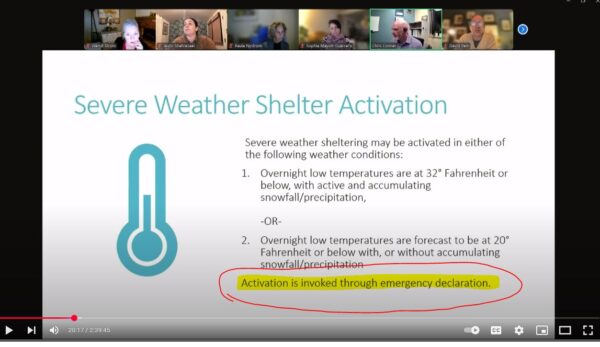
The Center operated as an “emergency” shelter. Emergency was defined by normal, but cold, winter nights. While operating, the Center experienced infrastructure problems such as overloading the plumbing. City staff also admitted that having the center drew more homeless to Lakewood, acting as a magnet, on ongoing but unresolved problem.
Why Change Operators?
What happened to RecoveryWorks? When and why did Lakewood decide not to use them? Why the emergency lease even though there were months of lead up?
During the quiet months April through November, Lakewood put out a Request for Proposals (RFP) to find a new operator of the Navigation Center. Lakewood staff seemed proud of their competitive process but didn’t explain why it was needed.
Lakewood Chief of Housing and Thriving Communities Chris Conner says Lakewood remains partners to RecoveryWorks, which is currently operating the old Mountain View Hotel that Recovery Works bought with another grant. That grant was for transitional housing through the American Rescue Plan Act funding for COVID recovery.
So why the change?
The original operator was a sole-source award — just like how Lakewood awarded Emory Elementary to the Action Center without looking for another partner. If Lakewood learned that a competitive process was valuable, why wasn’t that lesson applied to Emory?
Or perhaps there was no problem with RecoveryWorks but Lakewood had outgrown the need for the quick, local connections the organization offered in order to secure the grant in the first place? James Ginsberg, in charge of RecoveryWorks, did much of the heavy lifting for outreach and promotion of the Navigation Center. Both Jeffco and Lakewood raced to secure these large grants from the state back in 2023.
Volunteers of America
Volunteers of America was chosen using a competitive bid to operate the Navigation Center.
Volunteers of America cite several success stories as references. They currently operate the Theodora Family Hotel, two miles away from the Navigation Center on Colfax, owned by Denver. They also provide food services for their own centers and for other services such as Meals on Wheels.
Volunteers of America will not “make a profit” but will earn 15% “overhead” over the non-personnel and personnel costs.
For comparison, restaurants typically have a 3% profit margin. Profit being defined here as money made after personnel and non-personnel costs are taken.
Lease Known About in SEPTEMBER
According to bid documents, Lakewood knew back in September that Volunteers of America would need a lease.
Why didn’t Lakewood act immediately to get the lease in order?
There was no emergency, except as manufactured by Lakewood’s timing. Even Lakewood’s previous use of the word “emergency” to cover a regular winter season in Colorado did not apply because the Navigation Center will now be opened as a 24/7 transitional shelter. This is different than the previous “cold weather shelter.” Under new operations, the beds will be full all the time and so will not be available for drop-ins during extreme cold.
This emergency is just lack of planning that Volunteers of America would need a lease to operate Lakewood property.
Avoiding Public Scrutiny
Any public discussion of the Navigation Center switch would have brought up these questions during the time of Emory negotiations. All along there were questions on Emory similar to the Navigation Center. For example, is a little, local non-profit (Action Center) capable of a sudden transition to a larger, regional, multi-purpose center?
Lakewood did not answer those questions.
Lakewood resident Lenore Herskovitz asked on Lakewood Speaks, “I am confused about this emergency negotiation and hopefully in tonight’s meeting you can offer a more complete explanation. Is Recovery Works going to be located in the Navigation Center at this address?”
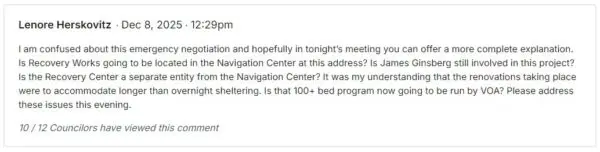
Councilor Isabel Cruz answered the question by saying that she understands that people who don’t attend business district meetings, like she does, may not know what was going on. So she asked Chris Conner to explain.
Unfortunately, the explanation did not explain. Rather, Conner deflected by saying there was a competitive bid to find an operator.
It appears that anyone interested in what’s going on in the city should stop watching council meetings and start attending non-profit community meetings. It also suggests an open meeting violation if city business is being decided to such an extent at these meetings that the public doesn’t need to be informed at all on a decision that all City Council Members already knew about and unofficially approved months previously.