
Resident generated news about Lakewood, Colorado
Resident generated news about Lakewood, Colorado

Zoning- What Hasn’t Been Told
Guest post from Lenore Herskovitz
Correction 3/19/26: Councilor Low has pointed out that if the new zoning is repealed after the April 7 election Lakewood would no longer be in compliance with the state mandate regarding parking minimums in transit zones. However, it should be noted that this could easily be rectified by the Council by calling an Emergency meeting to address the problem as they did with the SGI (Strategic Growth Initiative).
Although the City has touted their 2 year effort to produce and inform the public about the updated zoning code, there remains a large number of residents who are unaware of the upcoming special election challenging the zoning changes that were passed by the City Council at the end of last year. Ballots will be mailed out on March 16 but how many people will know why they are receiving one? Why did communication efforts fail? Did the City ever reach out to its residents and ask what would be the most effective way to notify them about policies, meetings, developments that would affect their lives? Perhaps that is something the City should consider doing moving forward. It should be noted that even for those residents who were following the progress of zoning discussions, there was not a written updated code to examine until mid July, 2025. The public hearings on this lengthy document were scheduled to begin later the following month.
The proposed new zoning, which has been labeled “landmark” by its supporters is a little over 350 pages in length. It is challenging and confusing to read. There was a request from some council members to see a redlined version comparing the old zoning to the new zoning so they could see what exactly was being changed. That was never provided. Although the new zoning code completely replaces the old one, the only redlined revisions provided are solely for the new document. Additionally the City set up a website to address Frequently Asked Questions (FAQ). The site was factual but didn’t always provide all the pertinent information on a topic. As an example, one of the questions raised was “Why is Lakewood updating its zoning code now?” One part of the response is “alignment with the Comprehensive Plan” which was recently updated.
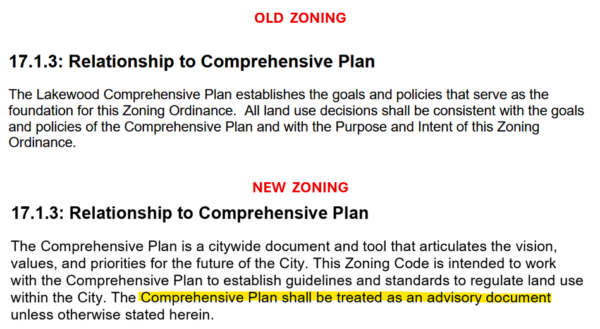
This Comprehensive Plan lays out the community’s vision for housing, transportation, sustainability, parks and more for the next 15 years. “Zoning is how we put that vision into action”. Yet on page 2 of the new zoning it states “The Comprehensive Plan shall be treated as an advisory document unless otherwise stated herein”. Who will determine when to follow the Comprehensive Plan and when not to? Is this another discretionary decision left to the Director (currently Travis Parker)?
The revised code creates 3 new residential zoning districts by consolidating the numerous others that previously existed. Now we have the confusing R-L-A (in earlier revision this was R-L-R) indicating a residential, low density, rural designation; R-L-B (earlier revision R-L-S) indicating residential low density suburban; and finally R -L-C (earlier revision R-L-U) indicating residential low density urban. It is uncertain why the staff chose to change these designations to A, B, and C and no explanation was offered. There are residents that have voiced their concerns that these changes threaten the character of their existing neighborhoods. Although one of the stated goals of the new zoning is protecting the character of existing neighborhoods, that did not occur when Council voted to give the Morse Park area a “B” designation instead of the “A” requested by residents.
The FAQ page has a section devoted to main changes being proposed:
- Neighborhood input near parks: Developers must hold community meetings before submitting plans next to large city parks (10+acres). What is not mentioned is that there was support in the community and by some council members for a smaller acreage requirement.
- Protecting parks. In part, this stated that buildings taller than 40’ must also have bird safe glass to help prevent birds from flying into windows. What is omitted is that birds crashing into windows occur most frequently below 40’ so this is an ineffective solution to the problem.
- Limiting the size of new homes. New homes will be limited in size to prevent “mega-homes of up to 18,000 sq.ft.” that could otherwise house dozens of renters under state law. When have we built an 18,000 sq.ft. home in Lakewood? “McMansions” are one of the latest scapegoats to explain the lack of affordable housing in the city. No definition has been offered to describe these vilified buildings. Is it their size, their cost? They certainly offend the proponents of the new zoning. Evidently, diversity does not include these types of homes.
- Encouraging more housing options. What hasn’t been told is that the new zoning contains no guarantees or mandates regarding affordable housing. Just because we allow for more missing middle structures (duplexes, triplexes, townhomes) and ADUs to be built in all residential zones does not mean they will be affordable or lead to more ownership opportunities. We are all aware that in many areas, older affordable buildings have been demolished and replaced with more expensive housing. This gentrification and the resulting displacement of residents is not mentioned on city sites.
Another FAQ pertains to concerns about density. One of the new state laws HB24-1007 eliminates Lakewood’s limit of 5 unrelated people in a home. The City claims that mega-homes (not defined) have the potential to be occupied by numerous people yet there is no acknowledgment that if you put multiple houses on a property that previously contained one dwelling, the number of residents could also increase dramatically.
The City has listed the state laws that have been passed that affect our City. What is not mentioned is that Lakewood is already in compliance with all these laws whether the new zoning is retained or repealed. The City site does not mention that Lakewood has exceeded state expectations regarding HB24-1152 which requires cities to allow 500-750 sq.ft. accessory dwelling units (ADUs) wherever single-family homes are allowed. Lakewood has increased that to 1400 sq.ft. Perhaps that is one of the reasons that supporters of the new zoning refer to it as ‘landmark’ while opponents call it ‘radical rezoning’.
Unfortunately, as this election quickly approaches, there have been exaggerations, misleading comments and misinformation on both sides of this issue. On March 2, during a Lakewood Reinvestment Authority meeting, Councilor Low was commenting on 2 affordable housing projects. One was on Alameda, the other on Colfax. The councilor claimed that because of the reduction of parking requirements in the new zoning the developer could possibly add a dog park or additional units to his project. Actually, state law HB24-1304 prohibits requiring minimum parking for multifamily complexes built in the future in areas considered a “transit service area”. Councilor Low should be aware that Alameda and Colfax fit that definition and the repeal of the new zoning would not change that status.
On a positive note, there are areas of common ground. We all want more affordability. We all care about the environment and sustainability. We all care about people. Where we differ is which path we take moving forward. The NO vote proposes a ‘landmark’ plan which goes beyond state requirements and blankets the residential areas with changes. The YES vote supports targeted responsible growth. Both sides have presented their cases to the public. It is now up to the voters to decide. A YES means repeal the new zoning, a NO vote supports the new zoning. Last day to vote is April 7.