
Resident generated news about Lakewood, Colorado
Resident generated news about Lakewood, Colorado

Special Use Hearing on June 3 For Navigation Center
The Lakewood Planning Commission is anticipated to approve a Special Use Permit for the Navigation Center on June 3, 2026. Lakewood staff have already made a presentation in favor of the permit. There are no neutral reports or equal opportunities for opposing viewpoints. While public comment is allowed, the way Lakewood interprets the Planning Commission rules means evidence needs to be presented AT THIS HEARING.
Every public comment that was made in previous City Council meetings is meaningless unless repeated at the hearing. Testimony at the hearing that shows problems with the special use could result in the permit being denied.
Zoning Code Requirements
Special Use Permits are discussed in section 17.2.4 of the zoning code. According to the code, the Commission SHALL approve any application that meets the criteria below. No other reasons will be a factor in this decision.
17.2.4.2: Review Criteria– Recommendations and decisions regarding special use permit applications shall be based on the following review criteria. An application for a special use permit shall be approved if it is demonstrated that:
The proposed special use is consistent with the applicable supplemental standards set forth in Article 4 of this Zoning Ordinance; and
The proposed special use is consistent with the applicable dimensional and development standards set forth in Article 5 of this Zoning Ordinance; and
The proposed special use is consistent with the applicable design standards set forth in Articles 6 and 7 of this Zoning Ordinance; and
The proposed special use is consistent with the Comprehensive Plan and other adopted City plans; and
The proposed special use will not substantially impair the appropriate use or development of adjacent property
Evidence Required
According to the last criterion, the applicant must show that the special use “will not substantially impair the appropriate use or development of adjacent property.”
City staff have already decided that neighbors and businesses will not be substantially harmed by the Navigation Center.
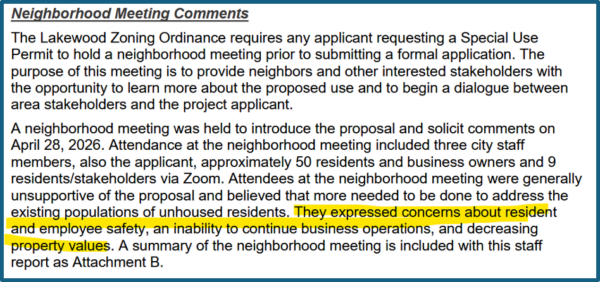
However, a city staff summary of the neighborhood meeting included evidence that contradicted their conclusion. According to the staff report, neighborhood business and residents saw “an inability to continue operations” and “decreasing property values”.
Permit Could Be Denied With Evidence At Hearing
Because Lakewood has been operating a shelter here in one form or another for years, residents can plainly see the effect it will have on the neighborhood. There have been many problems, despite city claims that safety would not decline and that the shelter would not attract more homeless to the area, all of which has happened.
If the neighbors and businesses that have spoken in previous City Council meetings attend the hearing and present evidence of harm, the Planning Commission can deny the permit, because the property would not meet all the necessary criteria. Without testimony, city staff conclusions, even without evidence, will prevail.
Note: Lakewood Informer submitted a public records request for service calls to 8000 W Colfax. The request was never fulfilled. Emails to the system were bounced. Phone calls were not returned.
Different Definitions of Impairment
The Planning Commission has the discretion to decide what is needed to “substantially impair” the use of the property. Resident testimony thus far has been plentiful, including:
- City Council testimony from one struggling business.
- At the neighborhood meeting, a nearby coffee shop said she might have to close her business.
- At same required neighborhood meeting, two realtors said they couldn’t find people to fill vacancies in the area.
- Residents testified about crime in the area at multiple city meetings.
City staff were aware of all this testimony and decided these problems are not substantial enough.

In contrast, consider a different case from a Lakewood Informer reader. Her neighbor made an anonymous complaint about the “junk” in her yard. Although she cleaned her yard, the evidence against her includes pictures taken from an upper story window and another through her fence- in other words, inside her private backyard. But this is such a problem that the city has spent time and money prosecuting her and is seeking thousands of dollars in fines. The city considers junk in a yard as a substantial enough problem that they take action to save neighbors from an ugly site. Personal safety, visible drug use and declining business are not substantial to city staff in the case of the Navigation Center.
Word Games to Continue Operations
As previously reported, Lakewood has a backup plan for if they don’t receive the shelter permit. They may continue operations by saying it is not an overnight shelter.
This makes sense to residents who do not know the use covenant are tied to the beds. That’s because Lakewood still has not discussed this in public meetings.
Per section 20 of the state grant, “this Covenant shall not terminate with respect to the beds or units described.” In other words, no matter what you want to call it, the grant was intended to provide beds for the homeless, which is called a shelter in Lakewood.
Another suggestion was that having only longer term inhabitants means the building is not a shelter. Some people call this “transitional housing.” Transitional housing is not included in Lakewood’s zoning code because the definition of “shelter” still applies.
Per Lakewood’s zoning code, a shelter is not limited by the time used. It is any temporary housing, be it for a night or for six months, for the homeless. However, Lakewood officials may think that applying a new word gives them the discretion to bypass shelter rules.
Per the zoning code definition: “Shelter: A facility established and maintained to provide housing and personal care on a temporary basis for the indigent, homeless, or victims of domestic violence.”
Lakewood has been playing games with the permit for years, inventing new ways to give itself permission to do what it wants despite the rules. The last time was in March of 2026 when the city issued a temporary special use permit, even though there is no provision for a temporary permit in the code.
Now Lakewood seems to be making a new game with the definition of shelter. Neighbors who use plain language definitions are no match against taxpayer-funded lawyers making up new definitions.
No matter what, Lakewood appears committed to operating this shelter. But the Planning Commission could deny this special use permit on the grounds of substantial impairment of business and property use if neighbors present their evidence and the Planning Commission listens.