
Resident generated news about Lakewood, Colorado
Resident generated news about Lakewood, Colorado

Council to Make Resident Petitions More Difficult
City Council is changing petition law, making it harder for residents to take direct democratic action. These changes come after successful citizen petition measures against unpopular City Council laws, such as zoning. The proposal involves many substantive changes, despite city officials saying several times that this was not the case. The overall effect is to make it harder for residents to raise their voice.
City Attorney Alison McKenny Brown says these changes are codifying “current standard practice”. This is somewhat deceptive because “current” practice is different from past practices. Current staff, including the attorney, made new interpretations of law. Therefore, staff have arguably changed the law, leading to the necessity for codifying current standard practice.
Some of the policy changes involved include:
- Limiting time for signatures
- Tougher signature verification
- Different definitions of registered voters
- Confusing ballot language remains
- Moot hearing
Limiting Time for Referendum Signatures
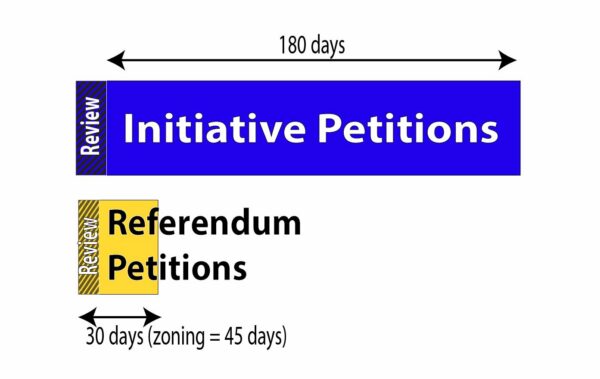
A new interpretation of the referendum law reduces the time to collect signatures by 30%.
The zoning referendum marks the first time that petitioners were required to get City Clerk approval for a referendum petition. In the past, City Clerks did not require this step because it was purposely left out of municipal law. For example, long-term City Clerk Margy Greer did not require review of the successful 2090 Wright St referendum.
Lakewood staff say they added this requirement for referendums because initiatives were required to get City Clerk approval. However, initiatives are different because they are resident initiated laws that require a new summary and title that reads clearly to voters.
Referendums don’t need review time. A referendum calls for the repeal of City Council ordinances, rather than substantive descriptions. Requiring a review of a simple repeal eliminates 10 days off the time allowed for signature gathering.
Lakewood is not extending the time for signature gathering to compensate. All non-zoning referendums have a 30-day time limit to gather signatures, leaving 20 days to reach the goal.
This time issue was made known to Lakewood several times with no resolution.
The new interpretation is buried in the definition section. There is no new section explaining how to go through the title setting and review process for referendums, so many residents are unaware of the change happening, and will not know it is necessary later.
This is a case of a new interpretation of law, and Lakewood is passing it off as “current standard practice” while making a substantive change that makes it harder for residents to take direct democratic action.
Tougher Signature Verification
In Wheat Ridge, 40% of referendum signatures were removed through signature verification. Councilors Low, Shahrezaei and others want that same process for Lakewood. No one could fully describe the process, which seemed unimportant. The important part seemed to be the ability to remove large amounts of signatures.
Th entire signature verification process was misunderstood by City Council and their high-density zoning supporters.
Some people expected “signature verification” to mean comparison to handwritten signatures that are only available in the state confidential database called SCORE. State law describes signature verification as “comparing the information on signature lines against a list of registered electors provided by the county.” That’s it.
The City Clerk looked into this issue thoroughly because it was alleged that the zoning petitions did not verify signatures against the state database. The State of Colorado keeps those signatures confidential. They are available for elections, not for petitions.
To repeat, the confidential signature database is not legally accessible to Lakewood for petition verification.
Despite this information, Mayor Pro Tem Shahrezaei suggests that Lakewood is “unique” for not using it. She further suggested that someone with access to the confidential database could be used as a stepping stone for Lakewood to verify this outside information. The bigger question is, why would someone else have access to confidential information that Lakewood does not.
Different Definitions of Registered Voters
Lakewood will now apply a special interpretation of “registered voters” for the number of signatures needed for a successful petition.
To meet the requirements, citizen-initiated petitions must include a percent of active and inactive voters. This is a higher number than only active voters.
For a signature to count, it must be from an active registered voter – a smaller pool.
Ballots are only sent to active registered voters.
Only active registered voters will count towards a majority approval.
But for a successful petition, the number of signatures required must meet a higher threshold of active and inactive voters.
And it doesn’t matter if City Council approves the change because city staff will continue with this new interpretation regardless.
City Council did not discuss using inactive voters in other applications to make things more even.
Confusing Ballot Language Remains
During the recent zoning referendum, voters were confused by the words “for the ordinance”. These new provisions do not clear that up.
Lakewood is focused on treating referendums and initiatives the same, but they are different.
In the case of a referendum, voters did not understand if voting “for the ordinance”, meant voting for the repeal? Or for the ordinance that could be repealed? It was not clear if “for the ordinance” meant for the old zoning or for the new zoning.
For referendums, it would be clearer to use language such as “for the repeal” – because referendums are a citizen’s repeal. Instead, the confusing “for the ordinance” will remain.
Moot hearing
Protesters can now get a hearing even if the City Clerk has deemed the petition insufficient. If the City Clerk deemed a petition insufficient any protest would be moot because the petition would not be moving on. Even so, a hearing and fine could result from an insufficient petition.
Summary
People nationwide are tired of their elected representatives not listening. This is happening in both red and blue areas – and voters do not like it. As a result, the number of citizen-initiated measures are increasing.
Democrat lawmakers fight against citizen-petitions in Colorado and Lakewood, but Republican states are doing the same thing.
Lakewood City Council did not agree with the last two citizen-initiated measures and acted against them. Now they are openly advocating for ways to eliminate 40% of signatures and searching for ways to cause difficulties for their opponents.
City staff and Council change the game after each election, making it harder for residents to know the rules.
One thought on “Council to Make Resident Petitions More Difficult”
Karen, thank you for exposing this. The very people who were elected to represent the People to our government, in reality represent the government to the People. They have it backwards. Their actions are egregious. They have become enamored with their power and title. What an irony that during our 250th year of celebrating our Constitution and freedoms, this council is taking away our freedoms to redress our government in a non violent manner. Shame on you.
Comments are closed.