Lakewood Informer

Resident generated news about Lakewood, Colorado

Lakewood Informer

Resident generated news about Lakewood, Colorado

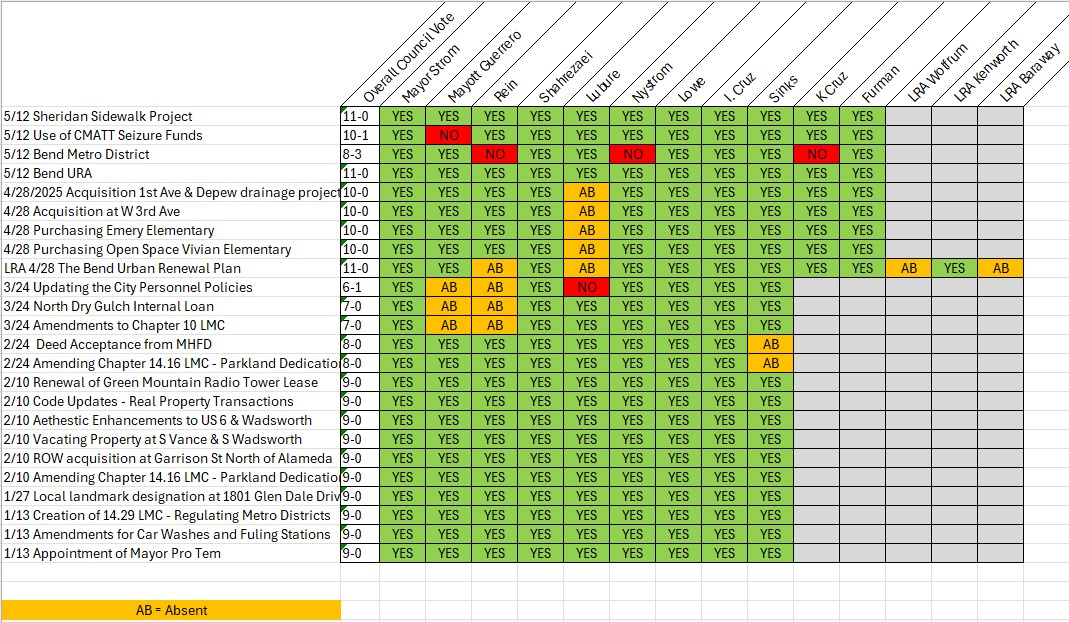
Vote Tally

The Illusion of Debate: How Lakewood’s City Council Rubber-Stamps Policy

By Karen Gordey As you may or may not have heard, Kairoi—the Texas developer behind the 777 S Yarrow Street project—cut down more than 60 mature trees on May 12th. The community response was swift and emotional. That evening, a large group from the Save Belmar Park movement filled the back of Lakewood City Council chambers and voiced their outrage during public comment. Many echoed the same call: every sitting councilor—save perhaps one—needs to be voted out. The next day, I drove to Belmar Park to see the damage for myself. As I pulled up, I noticed two current council members chatting nearby. I spoke with one of them off the record for about 25 minutes. When I said, “Isn’t this what you voted for?” the councilor quickly replied, “No, I didn’t vote for this.” Skeptical, I went home and reviewed voting records for the past two years. And they were right—technically. The 777 S Yarrow project didn’t come before City Council. It went through the Planning Commission and the City’s Planning Department. But that wasn’t the end of the story. When I tried to dig deeper, it became clear how inaccessible the City’s meeting records really are. Minutes from meetings are supposed to be approved during the Consent Agenda at every regular council meeting. But finding the actual minutes? Nearly impossible. For instance, during the May 12, 2025 meeting, Council approved minutes from March 24, April 14, and May 5—but none were linked or attached. On February 24, they approved minutes from December 9, 2024. Again, no actual documents. You can technically find every ordinance and resolution passed by council here: https://www.lakewood.org/Government/Departments/City-Clerks-Office/City-Council-Ordinances-Resolutions. But it’s a list, making it difficult for residents to hold individual councilors accountable. The Consent Agenda, meant for quick approvals of non-controversial items like meeting minutes, ordinances on first reading, or ceremonial resolutions, is often a catch-all for measures that go unscrutinized. Councilors can ask to remove items for discussion—and did so multiple times in 2024. But here’s something you may not know: residents can request that items be removed too. Once passed, the items removed from the consent agenda are discussed and voted on, then the rest of the agenda is addressed in order., And while the Consent Agenda script claims that first-reading ordinances are published in the Denver Post—none have appeared in the last two years. Don’t take my word for it. You can search the Denver Post’s legal notices here: https://marketplace.denverpost.com/marketplace-denver/category/Miscellaneous/Legal%20Notices and on the state’s required public notice database: https://colorado.column.us/search/ (which is moving to: https://www.publicnoticecolorado.com). So how did your councilor vote? Here’s a breakdown of every vote not passed via the Consent Agenda Here’s what I found: Also included in that spreadsheet is a tab for study sessions and workshops. These are arguably more important than council meetings themselves. That’s where councilors hear presentations on major issues—always from city staff or invited parties that support the city’s position. No opposing views. No residents. By the time a topic comes up for public hearing (on second reading), the council has already made up its mind. Is it any wonder residents feel ignored and angry? Let’s talk transparency. The Budget & Audit Committee—tasked with overseeing your tax dollars—hasn’t met once in 2025. Back in January, Ward 5 councilors proposed expanding the committee to represent all five wards. That proposal was shot down. Only three wards are represented. Two wards remain unheard. And all this under a City Manager pulling in over $400,000 a year. When government struggles with the basics—recordkeeping, transparency, fair representation—it often fails on the big things too. Isn’t it time for a better way? If you’re tired of a council that listens to developers more than residents, tired of unanimous votes that ignore dissent, and tired of a system where transparency feels like an afterthought—then do something. Start asking questions. Email your councilor. Demand meeting minutes be posted, ordinances be published, and your ward be represented. Government works best when it’s held accountable. And in Lakewood, it’s time we started holding ours to a higher standard.

Council Passes Metro District Ordinance

Lakewood voted unanimously to pass a new ordinance for metropolitan districts on January 13, 2025. The overwhelming feeling was that Council truly believes that this ordinance is better at regulating metro districts than the basic state law. Almost every City Council Member spoke of the multiple meetings they held to work on the ordinance, which was started years earlier when a metro district was expected. In fact, former City Council Member Dave Skilling was apparently advising current Council Members, according to publicly made comments.   The new ordinance included an underlying assumption that cities had to allow metro districts. This belief was voiced by city attorneys and Councilor Rein. Several other Councilors deferred to Rein’s contributions on crafting this ordinance. Only Councilor Cruz voiced the opinion that Council could still vote “no” on a metro district application, but even she voted to approve this new ordinance. Councilor Rein led the charge to prove Lakewood was not able to “ban” metro districts. He started the discussion by asking city attorney Lauren Stanek about banning metro districts. Although Stanek said that it couldn’t be done, there are several mechanisms other cities have used to “ban” metro districts.  Any of these mechanisms below, or none of them, allow the city to vote against metro district creation. Lakewood staff never presented any of these options, or even just the option of voting no, to City Council. However, Councilor Cruz pointed out that this ordinance does not bind Council to approving new metro districts. As attorney Stanek* advocated, the Lakewood ordinance has some extra provisions that Lakewood hopes will provide extra safety to future residents. However, as Lakewood Informer news pointed out previously, many of those protections are limited. *It is difficult to confirm any Lakewood staff title. In response to a request for an org chart, Lakewood Informer was told that the city didn’t have one because “it is all embedded into our HRIS system and doesn’t print out in a org chart manner“. No substitute was offered. Very few names, titles or phone numbers are located on the website. Most Council Members agreed that these extra provisions made passing the ordinance worthwhile. They all seemed very cognizant of the dangers that metro districts pose. The hope is that future residents will do their own homework and discover anything they might object to before purchasing a home (ex. terms of extra taxes). This is more difficult than Lakewood disallowing objectionable items, but the information will be there. Councilors Shahrezaei and Rein offered changes for additional transparency including: Mayor Strom said she is very supportive of this new ordinance. She says, “This is really an opportunity for the city to make sure that development is paying their own way so that our newer residents are paying and it’s through a financing mechanism that allows a developer to not have to sell a house with an extra $30,000 on top because of the sidewalks that they had to put in.” Strom’s base assumption – that metro district housing is more affordable – has been proved untrue overall by the Anderson Economic Group. They “found that issuing bonds to finance metropolitan district infrastructure costs reduces the typical home buyer’s down payment by an average of 4% relative to a scenario in which that same home is built outside of a metropolitan district. We further projected that a homeowner’s long-term housing costs will be 2% higher over the course of a 30-year mortgage due to the debt service property taxes levied in metropolitan districts. Additionally, we found that a metropolitan district’s housing costs may be even higher…” So they found that a metro district adds at least 2% more total costs than traditional development but developers can say the cost is 4% lower at time of sale. Someone has to pay for the sidewalks but that will ultimately be the homeowners, not the developer. This metro district bill has nothing to do with making developers “pay their own way.” A cheaper alternative would be for the city not to demand improvements like extensive sidewalks and bike lanes. There may be people who would like to have homes with fewer infrastructure amenities in exchange for a lower cost. Or if tens of thousands is the true cost and extensive infrastructure is universally desired, telling people upfront what the cost of total home package is might allow them to finance it themselves at more favorable prices. But those options were not presented either. Councilor LaBure echoed the “affordable housing” narrative by saying that without metro districts, Lakewood would not have any development. Other Councilors have made similar statements in past meetings. This is the official talking point of the developer-run Metro District Education Coalition (MDEC). MDEC was the only outside expert invited to City Council study sessions last year.  Competing grassroots organizations who know the dangers of metro districts were not involved. These statements show that at its base, metro districts help developers and all Lakewood can do is try to minimize the harm to residents. Public comment online was unanimously against the creation of metro districts. Scorecard: Regulating Metropolitan Districts Strom: Aye Shahrezaei: Aye Sinks: Aye Mayott-Guerrero: Aye Cruz: Aye Low: Aye Rein: Aye LaBure: Aye Nystrom: Aye

Scroll to top