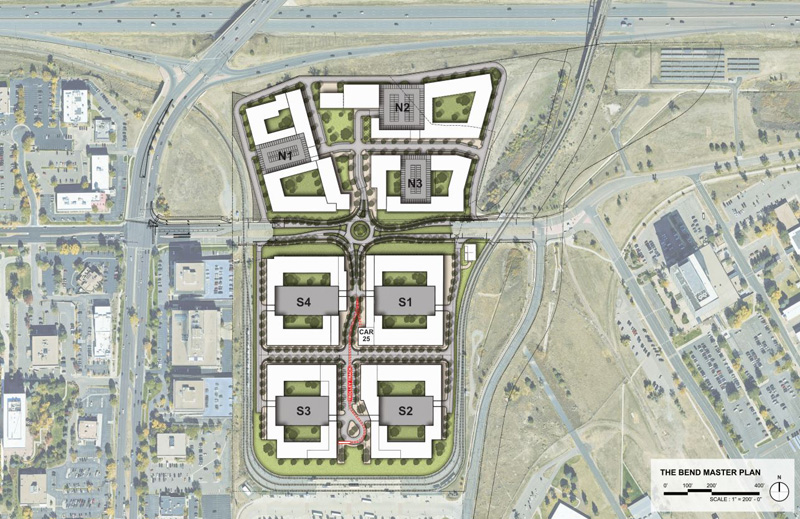
The Bend: A Government Financing Trade Deal
Lakewood may be forcing a property owner to blight their own land in a backroom trade deal wherein staff pledged a positive vote from City Council for a metro district. The deal would give The Bend development city financing in exchange for metro district status. In January 2025, a representative for The Bend developer made the following public comment: “The city is actually only allowing a Metro District to be put in place if the URA (Urban Renewal Area) passes so that it is a vehicle for this infrastructure and tax increment financing. They actually would not pass our Metro District standalone. They’ve made that very clear.” – Allie Meister, Lincoln Properties, at Green Mountain Water Board Meeting, min 40:13. This deal illuminates why Lakewood is rushing through a URA and metro district public hearing on the same night. Staff presentations have repeatedly touted the advantages of doing both the URA and the metro district at the same time. They claim these are complementary structures. But they are not complementary. Rather, these are essentially overlapping structures that could finance the same set of infrastructures. Apparently, financing public infrastructure is a profit center. Overlapping financing is duplicative. Even worse, for The Bend, neither metro district nor URA is appropriate. The Bend is not a “serious and growing menace” to the public health, safety, morals, and welfare, which is the statutory reason for Urban Renewal. The Bend does not provide public services, which is necessary for a metro district. The metro district will only be used for financing. Therefore, the most appropriate government assistance, if any, would be a Business Improvement District (BID). BIDs are the more accountable, less powerful, way to achieve development financing but no one is advocating for its use. Instead, developers prefer to form metro districts. This initially involves the developer loaning money to the new metro district. Then the metro district issues a bond, with interest, to pay back the loan. Since the developer and the metro district are the same people (different legal entity), the developer has now gained itself government immunity, as well as millions of dollars of interest payments. In many cases, the interest payments never end – they only continue to grow. This outcome isn’t possible with a BID. (See Denver Post series “Metro Districts: Debt & Democracy” by David Migoya for more in-depth information on metro district abuses) Therefore, developers generally want that metro district as a profit center, rather than as a way to finance development, since they front the funds in either case. A URA is also meant to fund public infrastructure. Much of the public infrastructure was repeated under both the URA and metro district justification. Only one method is needed to finance infrastructure, and, as noted, the developer will provide the base funds in any event. As Karen Gordey reported in the Lakewood Informer, there was no required financial gap analysis completed to show that city funding was required. Therefore, with a metro district there is no need for a URA. This conclusion is also shared by a report from the Independence Institute. A URA has not required a metro district in the past. However, Lakewood can trade URA financing for affordable housing. Lakewood is not allowed to pay for housing directly. Lakewood is not even supposed to demand any percentage of affordable housing. There is no zoning or ordinance that requires it. The irony is that Lakewood City Council itself sunset the Strategic Growth Initiative ordinance. Under that ordinance, this development would have fallen under the allocation review system wherein Lakewood could have asked for affordable housing to permit this many units in a TRANSPARENT process. Instead, the city is now working behind the scenes to make this same thing happen. So, through the URA, Lakewood will gain affordable housing, aka government housing or government-subsidized housing. Those units can be used to qualify for state grants for even more development in Lakewood. “Without the Urban Renewal plan, in our case, we wouldn’t be able to deliver kind of what they want to see or their vision for this piece of land which includes housing retail and affordable housing they you know both the state and the city and the county do have a desire to have a portion of the site have affordable housing in it.“ Allie Meister, Lincoln Properties, Jan 28 2025, min 35:57 Lakewood residents will pay for The Bend development by giving the developer financing. The new taxes from that development are diverted out of the general fund, which pays for Lakewood resident services like police, and instead will pay for The Bend development responsibilities like streets and pipes. The decision for an Urban Renewal Area is very separate from the decision to approve a metro district. The developer did not originally desire to be in an Urban Renewal Area and Lakewood may not approve a metro district as a standalone decision. But, operating together, the developer and city can trade financial incentives that residents throughout Lakewood will pay for. The developer offers blight and gets metro district status and financing. The city offers URA financing to indirectly offset affordable housing units and gets a basis for more state grant funding. “Municipalities are using a tool (URA) meant only for serious threats to the public as a tool for gaining a competitive advantage in economic development. Which, essentially, is a way to financially reward development partners and a method to force the public into a future desired by government planners.” -From The Empty Promise and Untold Cost of Urban Renewal in Colorado Just like Lakewood’s deal to buy Emory Elementary, residents should know the full plan to leverage this deal for more high-density development using state grant funds from the affordable housing units. Without that knowledge, which has not been disclosed, neither the URA nor the metro district decision makes any sense. There will be a City Council vote on the metro district and URA on Monday, May 12 that is open to