Lakewood Informer

Resident generated news about Lakewood, Colorado

Lakewood Informer

Resident generated news about Lakewood, Colorado

Development

Lakewood Rewriting Zoning Around Race

Some Lakewood City Council Members once again framed zoning decisions through the lens of historic racial injustices. During the October 13, 2025 meeting, Councilors returned to the same narrative seen throughout this rezoning process — that Lakewood must address equity and right racial wrongs through land use. What remains missing is evidence of any current racial barrier or any clear problem residents are actually experiencing under the existing zoning.

The August 25, 2025 meeting was even more explicit. Residents heard lengthy references to racism, equity, and climate change, with little connection to practical planning issues such as traffic, infrastructure, or neighborhood character. On October 13, Council singled out Morse Park for a zoning downgrade on the grounds that it once had racial covenants. No evidence was provided that any current residents are engaging in discrimination.

This is not new. A previous decision tied to a different neighborhood refused to fully honor a historic landmark petition unless the applicant accepted public labeling about past racist covenants unrelated to the current property owners.

Which raises the question:

Is Lakewood City Council making de facto reparations without ever saying so, and without consulting the people impacted today?

Referendum Can Be Signed at 820 Simms #11

For the many residents asking where and how to sign, there is now an ongoing opportunity to sign Zoning Code Referendum Petitions in a suite located at 820 Simms Street, #11, situated behind the 7-11 building.  This venue is open from 10:30 am to 6:00 pm, Monday through Saturday.

There are THREE active grassroots referendums to repeal Lakewood’s recent zoning codes. Signers are asked to keep track of which they have signed in order to reduce duplication.

The volunteer efforts are one way that residents are getting engaged at a rapid rate. Nextdoor is also full of chatter. It’s a rare time in nextdoor history where residents can feel safe in criticizing city efforts. Historically, city supporters attack and drown out those with opposing views so that many have turned away from nextdoor – leading to the creation of alternate sites like the Lakewood Informer.

The office location is staffed with volunteers so please be patient with any unexpected closures, although currently there are numerous people helping. Volunteers span different neighborhoods, different political parties, and different reasons for supporting a repeal. This is truly a grassroots effort with room for everyone.

Final Zoning Map Change Passed But Not Released

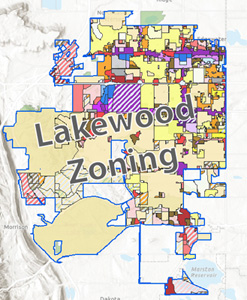
Lakewood City Council approved the final segment of the zoning code overhaul on October 13, 2025. Numerous neighborhoods were changed during the meeting to adopt a lower density zoning than was proposed. Those changes generally reflected high resident turnout with specific requests for their neighborhood. Residents cannot see what the final map looks like because it has not been made available, even though the final ordinance is legally published.

The adopted ordinance, O-2025-30, defines the new zoning map. However, confusion remains over inconsistencies between the map’s legend descriptions and the written code itself. For example, the map legend for R-L-B says “R-L-B – Low-Form Residential B: Traditional suburban housing, mostly single-family homes with potential for accessory dwelling units and duplexes that look housescale.”

Yet the zoning code contains no limit on the number of dwelling units allowed. It only limits the size of the building. The term duplex appears only as part of a general list of housing types—without numerical restriction:

Two More Referendums

Two more referendums were approved to repeal zoning ordinances O-2025-28 and O-2025-29.

Similar to the first referendum, supporters ask for signatures to repeal the ordinance as it was passed. If enough signatures are gathered, the issue will be referred to a ballot vote.

Signatures must be gathered by November 3, 2025 and November 10, respectively.

Opportunities to sign all referendums will be available at the City Council meeting, Monday, October 13, and at the Green Mountain Water and Sanitation District special meeting. Other opportunities are being posted ad hoc on nextdoor.

Your Homework: Zoning Text

Questions abound about what exactly changed in the zoning. Although we have written several articles, typically about negative side effects, there is so much more in the newly passed zoning code.

IT IS INCUMBENT UPON YOU TO DO YOUR OWN HOMEWORK!

If you are interested in signing the referendum to repeal zoning, you will be asked if you have read the full code before you sign. After you sign, your name will be checked, and city officials, including City Councilors, will know you signed and may try to get you to recant your signature.

Referendum Petition to Repeal Zoning Approved

Lakewood residents have a city-approved petition for a referendum to repeal the first zoning code change. This news offers hope to the increasing number of residents who have raised their voices against the zoning changes the city has made.

Lakewood residents have officially taken the first step toward repealing recent city-approved zoning code changes. A petition for referendum has cleared the city’s approval process, giving residents the right to gather signatures. People signing the petition agree that they want to repeal the zoning changes, as if they were never approved.

To succeed, petitioners must collect at least 3,517 valid signatures by October 30, 2025. Organizers say they are aiming for 5,000 to 6,000 signatures, knowing that the city frequently rejects a portion of those submitted. If successful, Council can either repeal the zoning themselves or refer the measure to a ballot vote.

Dismantling the NEW Zoning FAQ Lies

Repost from Regina Hopkins

Lakewood’s leaders keep telling us everything is fine: “No elimination of single-family zones.” “Protecting neighborhoods while planning responsibly for the future.” “No threat to infrastructure.” Sounds nice, right? Too bad it’s all a scrambled spin of words, designed to trick you into thinking there’s no problem while they hand the city to developers. Here’s the truth:

 The Single-Family Lie. Yes, you can still build a single-family house. But the exclusive protection for single-family neighborhoods is gone. No other Front Range city has done this — not even Denver. Developers now have free rein to drop duplexes, triplexes, apartments, warehouses, and more right next door. For all intents and purposes, this is the elimination of single-family zoning as we’ve known it. Don’t let their dressed-up words fool you.

 The McMansion Distraction. The City waves around “new limits on McMansions” like it’s a gift to residents. It’s a classic bait-and-switch: distract you with something that sounds good while quietly removing the rules that keep neighborhood character and open space intact. Meanwhile, developers are encouraged to pack density into every block.

Hearing Dates Changed for Zoning

City Council decided to break up the zoning code into four separate public hearings. There will now be 4 separate ordinances that will have second readings on separate dates. Council expressed the strong desire to have voting completed BEFORE the November elections. These changes are big enough to be an election issue, but City Council is taking that off the table by guaranteeing that residents’ votes will not matter for zoning changes. The new dates for second reading are: The original motion was to delay the second reading and also break up the code into digestible pieces. There was more talk of making the code easier to understand than there was of making changes, but the break-up was mostly agreeable. However, with some Councilors disagreeing with the delay, that was changed to maintain a second reading on the Aug 25 date for the first piece. It is unclear if Council is hearing opposition from residents or whether Council believes people just don’t understand what’s going on. “Education” was mentioned several times. Councilor Low read off many city “touchpoints” that would indicate everyone had been informed enough, and any delay was unjustified. About half the council, including Councilors Mayott-Guerrero and Shahrezaei, argued that people were expecting the second reading on August 25 and may not understand that the dates had changed so that wasn’t an option. In reality, even this first reading was delayed due to pressure against these sweeping changes, so that argument was unconvincing. Several Councilors mentioned that they had to have the final vote before elections. So the final opportunity to vote would be a special meeting November 3. No one seemed willing to let this issue be settled as an election matter or be voted on by new councilors. Deputy City Manager Ben Goldstein said that new maps will be available as of Tuesday, August 12, 2025, on https://www.lakewoodtogether.org/zoningupdates. Until now, there was no map that was clear enough to see individual neighborhoods for people to see how changes would affect them.

Special Zoning Treatment for The Action Center at Emory

Lakewood is adding a new word to the dictionary — an innocuous move that covers up a dedicated zoning change for the Emory-Action Center swap while also shutting down future resident protests. Lakewood is planning on adding a new “Community Resource Facility” use to the zoning code to enable an “Amazon” warehouse-type low-income distribution center to operate anywhere in Lakewood. This new use is necessary for changes to the Emory Elementary property that Lakewood proposes to sell or exchange with the Action Center, which will convert it into a “Community Resource Facility”. That swap is not mentioned in the May 19th meeting on the zoning code change, even though the swap is what prompted the change in the first place. To listen to that meeting, one would think that there has just been a glaring oversight for the past 50 years, and no non-profits have been able to operate food pantries. Taken in isolation, residents could be forgiven for thinking that Lakewood didn’t have the ability to allow what is clearly already allowed in multiple places. Therefore, once again, residents must dig deeper to understand what is going on. In this case, allowing high populations of low-income support services in every zone in the city, including those previously reserved for schools. (For background, read Lakewood news at https://lakewoodinformer.com/springsteen-files-injunction-regarding-emory/) Travis Parker, Chief of Planning and Community Development, says Lakewood hasn’t had a request for something like this during his time with Lakewood, which may give residents an idea of the scale of the facility that is envisioned. The Action Center currently operates in a commercial area and sometimes has customers lined up down the block. The new “Facility” will be much larger. Envision the difference between the local retail shop and the Amazon warehouse. Are residents prepared for the warehouse of low-income services anywhere in the city? *Another word game warning: since places like the Action Center and Recovery Works are paid for by donations, Lakewood claims they are different from commercial activities, so they use the word “guests” instead of “customers”. They say this is a “distribution of goods and services” instead of commercial activity. The medium of exchange might be different, but the underlying intent is the same. The new code discriminates against for-profit businesses that are not eligible to operate everywhere in the city.  Lakewood is a government, not a charity, and this type of special treatment drives out other commercial businesses who cannot compete with special favors granted by the government. It also discriminates against smaller non-profits that currently operate throughout the city but are not getting financial favors from the city to host a “facility” — like the one envisioned by Lakewood for the Action Center. In a city where small businesses are closing everywhere, why give special treatment to organizations that don’t pay taxes? When a City Council member asked how existing operations were allowed, the answer was that they were in a mixed-use zone, but it was unknown under what technical use definition. Historical precedence seems to be pertinent to the discussion. Is it possible the man in charge doesn’t know how this could have been accomplished in the past? Or is the change specific to something that could be pertinent only to the Emory property swap Councilor Isabel Cruz asked what this change would look like outside of the school disposition process. Her question suggests an understanding that the change is driven specifically by the Action Center swap, even if that is not communicated directly. Councilor I. Cruz asks about smaller non-profits, but they are already allowed under existing rules. This change is necessary only to allow the Action Center’s mega-warehouse tied to land swap. Lakewood is making changes behind the scenes to preempt resident objections. Under current zoning, residents would have a chance to protest the Emory Elementary use change later. Adding this definition makes the change happen now, without specific public notice.

It’s Not Just a Housing Shortage. It’s a Rigged System

From Crash Davis You’ll hear it all the time, especially from pundits and politicians: “The solution to the housing crisis is simple. Just build more.” It sounds nice. It fits on a bumper sticker. But it’s not the full story. Not even close. We’re not just short on homes. We’ve built an entire system where housing has become the best way to build wealth, and where insiders control access to that wealth. I was talking to a friend the other day, and he mentioned a few people he knew who were doing very well financially. Every single one of them had made their money in real estate. That says a lot. Here in Colorado, you see the distortion everywhere. In Lakewood, homes are sitting on the market. The “supply” is technically there, but prices still start around $500,000 and go well past $1.4 million. That’s not a starter home. That’s not attainable for most working families. And it’s not just because we didn’t build enough. It’s because we’ve flooded the system with easy money for decades. It didn’t start with the pandemic. That just poured fuel on a fire that had already been burning since the financial crisis, the dot-com bust, and even before. Every time the economy hiccups, we inject liquidity, drop interest rates, and do whatever it takes to prop up asset values. The result is a distorted market where real estate becomes a magnet for cash, speculation, and institutional investment. Now we’re sitting on the flip side. High mortgage rates were needed to fight the very inflation we created, and a generation has been locked out of homeownership. And let’s talk about access. Realtors and brokers often have first shot at listings. Many flip properties before they ever reach the public. Investors buy homes in bulk with cash offers and zero contingencies. It’s not a level playing field. It’s insider baseball, and everyday buyers are the ones striking out. Some might say, “Well, you could become a Realtor too.” Maybe. But that’s not the point. I’m not asking to join the club. I’m asking whether the club should be allowed to set the rules for the entire market. Housing isn’t just another asset class. It’s where people live. And when those licensed to facilitate transactions also get first crack at the inventory, sometimes before the public even knows it exists, we’ve blurred the line between broker and player. In most financial markets, we call that insider trading. It’s illegal. But in real estate, it’s not only legal, it’s standard practice. Realtors can access private “pocket listings,” buy before a home is ever made public, and flip it, all within the rules. There’s no regulation that stops it. No disclosure requirement. No cap. It’s an advantage built into the structure, not earned through risk or innovation. This isn’t about more government control. It’s about a market that actually behaves like one. And here’s where it ties into something even bigger. We protect systems like this because we’re afraid to let them fail. When cracks appear, whether it’s the housing market, the student loan industry, or some part of the financial sector, we inject money, cut rates, float bailouts, or push subsidies to keep it all from collapsing. The result is inflated assets, moral hazard, and even more consolidation of advantage. We say we want affordability. But we prop up prices. We say we support markets. But we rig them to protect insiders. We’re not just creating housing problems. We’re institutionalizing them. Data shows this isn’t fringe theory. In markets like Phoenix, Las Vegas, and Miami, researchers have shown that speculative investor behavior directly drove price spikes and increased default risk during boom cycles. And it’s not just Wall Street firms. Small-scale investors now account for nearly 30 percent of all single-family home purchases nationwide. In California, nearly one in five homes is investor-owned. In some mountain and resort regions, it’s far higher. That’s not building community. That’s extracting profit and boxing out would-be homeowners. You can see it in housing. You can see it in student loans. We’ve created a culture where financial risk is absorbed by the system instead of the individual. Yes, many student loans were predatory, with poor disclosure and complex repayment terms that borrowers barely understood. And here’s the part no one talks about. More student loan debt is held by people over 50 than under 25. That’s not just a youth issue. It’s a long-term debt trap. And when people are carrying that kind of burden, along with auto loans and other monthly obligations, homeownership gets pushed further out of reach. Some expenses are personal choices, sure. But the bottom line is this. Housing affordability depends on more than home prices. It depends on what’s left after the system takes its cut. We’ve also created a generational split. Asset-holders benefit while asset-seekers fall behind. The longer we ignore that, the more brittle the system becomes. Meanwhile, the “just build more” crowd ignores a basic reality. Places like Colorado aren’t limitless. Buildable land is inherently scarce. Water is limited. Infrastructure can only stretch so far. And people want to live here, which means demand is high and growing. When you combine that kind of demand with natural constraints on supply, prices are going to rise. That’s not politics. That’s economics. And when people point out that only high-income households can afford to live in Boulder, the response is usually to push “affordable housing” into surrounding communities like Lakewood. That’s where things like ADUs, lot splits, and small infill units come in. The idea is to add supply by allowing people to subdivide their lots, build small houses, and either rent them out or sell them. On paper, it sounds practical. In reality, it often erodes the very character of the neighborhoods that make these places livable to begin with. Density without planning isn’t affordability. It’s just chaos with good intentions. And here’s another truth we rarely say out loud. Not everyone can or

Scroll to top