Lakewood Informer

Resident generated news about Lakewood, Colorado

Lakewood Informer

Resident generated news about Lakewood, Colorado

Development

Water district in Lakewood says pipes cannot handle more demand laid out in potential zoning changes

Water district in Lakewood says pipes cannot handle more demand laid out in potential zoning changes By Maggie Bryan, denver7.com LAKEWOOD, Colo. — The Green Mountain Water and Sanitation District (GMWSD), which provides water and sewer service to around 48,000 people in Lakewood, said density changes laid out in the City of Lakewood’s new comprehensive plan would put a strain on the district’s pipes. GMWSD sent a letter to the City of Lakewood on August 22 objecting to the city’s plan and requesting mediation to resolve a range of issues the water district said could lead to unexpected fees for residents. The letter requests the city stop proposed zoning changes that could increase density in certain areas until there is a plan for funding and construction to increase water infrastructure. “With the density changes, we don’t know if we’re able to accept a higher demand of water flow, mainly into our sewer system. The pipes are a certain size. You have to plan for storm events and things like that. So you have to have capacity available in the system to accommodate that,” GMWSD Manager Josh Stanley said. “If you exceed that, then you’re backing up into people’s homes, and nobody likes that.” The water district said it objects to certain goals laid out in the comprehensive plan, which was approved unanimously by the Lakewood City Council on July 28. In the letter, the GMWSD said it has concerns about the plan to eliminate some single-family zoning and mix commercial and residential infrastructure. The letter also said the need for new water and sewer lines to support higher density could lead to higher costs for residents. Read the full story here… Disclosure: Karen Morgan, manager of Lakewood Informer, is also the President of the Green Mountain W&S District Board and author of the letter covered in the story above.

Residents Fighting Back Against Zoning Changes

Residents Fighting Back Against Zoning Changes Across the country, cities and states are experimenting with new taxes on so-called “luxury” homes. The pitch is simple: target properties above a certain value, often $1 million or more, and funnel the money into local programs. But the reality is far more complicated—and the impacts often hit ordinary homeowners, not just the wealthy.

How the West Is Being Lost

From Alex at Somebody Should Do Something A note: Originally, the article was published on YourHub at https://yourhub.denverpost.com/blog/2022/09/politics-and-development-in-colorado/296507/ We had hand delivered a copy of of it to Jared Polis, Brittany Pettersen, and Ed Perlmutter at some get-together the progressive thought leaders were having in Lakewood: The “representatives” immediately studied the input from the citizens, and drew up a comprehensive set of policies addressing the input. Just kidding. Polis has doubled down on squashing the local governments’ right to govern (as long as corporate-owned rentals continue to be built), in addition to driving the state to a billion-ish dollar budget shortfall this year, while trying to dog-whistle the public with a bridge to nowhere and that nobody had asked for. Pettersen has been shilling for the real estate industry and Mr. Perlmutter is off to… Not sure what – may or may not have something to do with lobbying. The irony of the latest spat of policies trying to squash the home rule rights of cities and towns around Colorado is that when we had reached out to the governors office in 2018 about the actions of the local governments that were destroying the economic potential of the Rooney Valley, we were told that the governor’s office “does not get involved in local land use decisions.’’ I guess, the times are a changing. On to the origional post. “Mortgage lenders are starting to look at the risks of lending for somewhere that doesn’t have a water supply, as that’s not a good investment. Capital markets are getting wise to this stuff. We are seeing the limits to growth and housing affordability and the impacts of poor-quality decision making of where and how to build. We are paying the price for all that now.” Read https://www.theguardian.com/us-news/2022/jul/20/us-fastest-growing-cities-risk-becoming-unlivable-climate-crisis Despite the “growth is good” mantra, we are faced with closing schools, massive fires within the city limits, rising crime, polluted air, lackluster public transit system, and a slew of other problems, such as the dying Colorado River. To see where we could be heading next, look at the work by a group of MIT scientists called “Limits to Growth.” Numerous city council members and other representatives in Colorado have continuously ignored the citizens’ pleas and suggestions when it comes to development. Instead they cater to the providers of the largest campaign donations, constantly using diversion tactics such as “affordable housing”. Yet, nobody has provided an explanation as to how the high-priced rentals, rising crime, more traffic, lack of true city planning and economic development, along with thousands of dollars (per unit, per year) in metro district fees, are affordable. Affordable housing and other political dog whistles have become doublespeak for privatizing the profits for those who donate the most to the “representatives”, while socializing the costs the citizens have to pay in the form of taxes, fees and their time to: Additionally, millions are spent on city and county unelected bureaucrats (think planning, zoning, legal, “economic development”, and the managers’ offices) who, instead of working for the citizens, spend their time pushing through projects which further contribute to the stress on the already-crumbling infrastructure, limited water resources and do not create localized, well-paying jobs. Perhaps, if the money was not wasted on those proactively working against the public, the public would be more open to lifting some of the TABOR limits to pay for things the public actually needs. In Lakewood and Jefferson County, such failures are unfolding in real time. The majority on the city council and others have ensured that Lakewood has made next to no progress in the areas of: They have corrupted the democratic process, pandering to the one-sided narrative, which is already resulting in financial and ecological impacts on the city and the county. A sea of houses with exorbitant metro district fees and high-density rentals is being built to bolster big money profits, instead of doing actual business development and city planning. Thousands have to drive across the Metro for better paying jobs, while the city has been proactively destroying a local business corridor and making excuses as to why barely any local high-tech/software jobs have been brought to the city in the last decade, especially when compared to other cities in Colorado. The dog whistle of “public transit” has not helped as RTD and Colorado are decades behind Boston and New York in public transit and additional decades behind most cities in Europe and other parts of the world. A trip on a well-planned and well-built-out public transit system should be financially and temporally better than using a car, which is not the case with RTD. We are also constantly reminded how growth is good for us and how we need to conserve water. What good is conservation if, instead of retaining the conserved amounts for real economic development and the day when there is a severe drought or to ensure healthy waterways, that water is, instead, used for more unbridled growth? https://www.nbcnews.com/politics/politics-news/feds-declare-first-colorado-river-shortage-order-water-cuts-2022-n1276934 https://phys.org/news/2022-06-colorado-river-reservoirs-western-states.html You may think that “your” candidate will fix it. There is no “your” candidate. There are those who take large campaign contributions, and a few people who will be pushed out in the next election if they dare to truly stand up for people’s interests. Have a look at who donates to whom; do not presume that those who talk about affordability, fiscal responsibility or climate change intend to address them. The public has already lost in a lot of areas, and what’s left is slipping away rapidly. The degrading quality of life in Colorado along with the ongoing collapse of the Colorado River Basin and Colorado forests is only the beginning. One can only hope that very soon the younger generations will realize what the politicians (and bureaucrats) of all stripes have done to them and will start holding them responsible. Perhaps, that’s what you can do – start campaigns to enact reforms to hold mayors, council people, city staff, and state legislators liable for blatant pandering to those who donate the most to their

Why should habitats including Belmar Park be protected?

From SaveBelmarPark.com Because “biological annihilation” is happening NOW according to Stanford biologists Paul Ehrlich, Rodolfo Dirzo and colleague Gerardo Ceballos.  Key quotes from the paper: “Earth’s sixth mass extinction episode has proceeded further than most assume.” What is Lakewood City Council doing locally to help the planet deal with this crisis? Lakewood’s answer is to ignore science and promote luxury housing that will harm a riparian habitat while citing the fake ‘housing shortage’. Yet the city council wants everyone to think there is not enough housing for a ‘growing’ population.  City council, when does your denial of reality cross the line from being misinformed to being blatantly dishonest? The county has lost 4% of population in 4 years.  The local school district has closed 21 schools since 2021.  School buildings are actually up for sale in Lakewood.   Lakewood’s housing pipeline already has a 10-15 year supply based on the city’s own study!  Zillow shows over 1,500 rentals advertised in Lakewood today including hundreds of units within walking distance of Belmar Park. Council members, if this summation is not correct, then please explain why you refuse to protect habitats including Belmar Park.  Eminent domain is at your service if needed. Yes, the Kairoi Belmar housing project, as planned without a science-based raptor buffer zone, will harm the rare riparian wildlife habitat at Belmar Park. Lakewood City Council cannot fix a global problem.  But they can show leadership and be a model for how cities can play an important role. City Council, please do not take comfort just because you are not alone in participating in the sixth mass extinction event and stealing from the future of our children. Lakewood, this is exactly how to give the children a planet struggling to support human life.  Or worse. Colorado Parks and Wildlife recommends a raptor buffer zone at Belmar park based on ‘best available science’!   Is that too much to ask? Some might say why worry?  There is plenty of wildlife in Africa, so let’s eat, drink and be merry and forget about protecting habitats here.  The planet is too big for humans to ever ruin it. Unfortunately, Dr. Lawrence Frank is quoted above regarding the ‘horrific’ loss of wildlife in Africa over the last 200 years. He spent decades tracking and studying lions in Africa.  He started back before GPS tracking collars for lions were even available.   Back then, once you had a collar on a lion, you had to drive around off road in Kenya to try and get in radio range of the collars using a YAG antenna to track and count the animals.  He told me bouncing around on that terrain was very hard on his back.   He explains during the Q&A at the end of the video that as humans continue to encroach on habitats in Africa, what wildlife still remains has a very uncertain future. Dr. Ehrlich’s paper points out that species extinctions over the last 200 years should have taken 10,000 years! What is happening is a global crisis.  Protecting habitats will be the best and probably the only way out of it. Some might cite the recent example of the dire wolf that was supposedly extinct but brought back to life via genetic engineering by a company called Colossal Biosciences.  The hope the company was claiming is that other species could be resurrected from extinction using the same technology.   But the company’s chief scientist has now admitted just a few weeks ago the animal was not a true dire wolf but simply a grey wolf with a few modified traits to make it resemble the appearance of a dire wolf. Humans make up less than 0.5% of the total biomass of the planet, yet we are responsible for the ongoing 6th extinction event.   Wild mammals make up even less of the total biomass than we do! It is up to us stop it.   The Ehrlich paper explains that ecosystem services essential to civilization are already being eroded and damaged. There are 20 to 30 years at most to stop the mass extinction event. It is time to wake up.  That includes you, City Council.  Wake up.   You are responsible for protecting habitats in Lakewood.  Please do your job for the sake of your own children. Thanks for listening, Steve

Disproportionate Development of MultiFamily

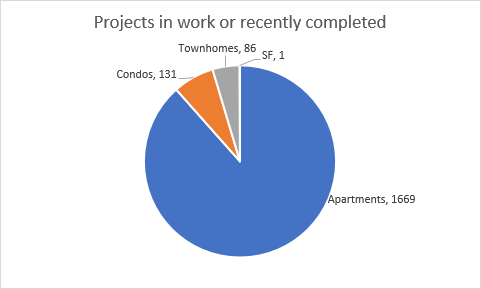
A new analysis shows an overwhelmingly disproportionate amount of new apartment buildings. A Lakewood resident developed the pie chart above by researching Lakewood’s current project list. This is something that has been obvious to resident for awhile but it helps to see the graphic and we at Lakewood Informer appreciate the insight. Thank you. Statistically, 95% of current projects are for high-density, multi-family units. 88% are for apartments and 7% are for condos. Low-density, multi-family townhomes account for 5%. Continuing this projection, this many new multi-family units will quickly change the voting patterns and priorities of Lakewood residents. Lakewood management hopes to accelerate this trend of thousands of new units through the new zoning code that will substantially change neighborhoods. The narrative of “affordable housing” is clashing with the desire to maintain Lakewood’s natural character. This has caused some residents to question the need for government interference in the housing market. This also shows the lack of balance in bringing new jobs to the area with no commercial economic development.

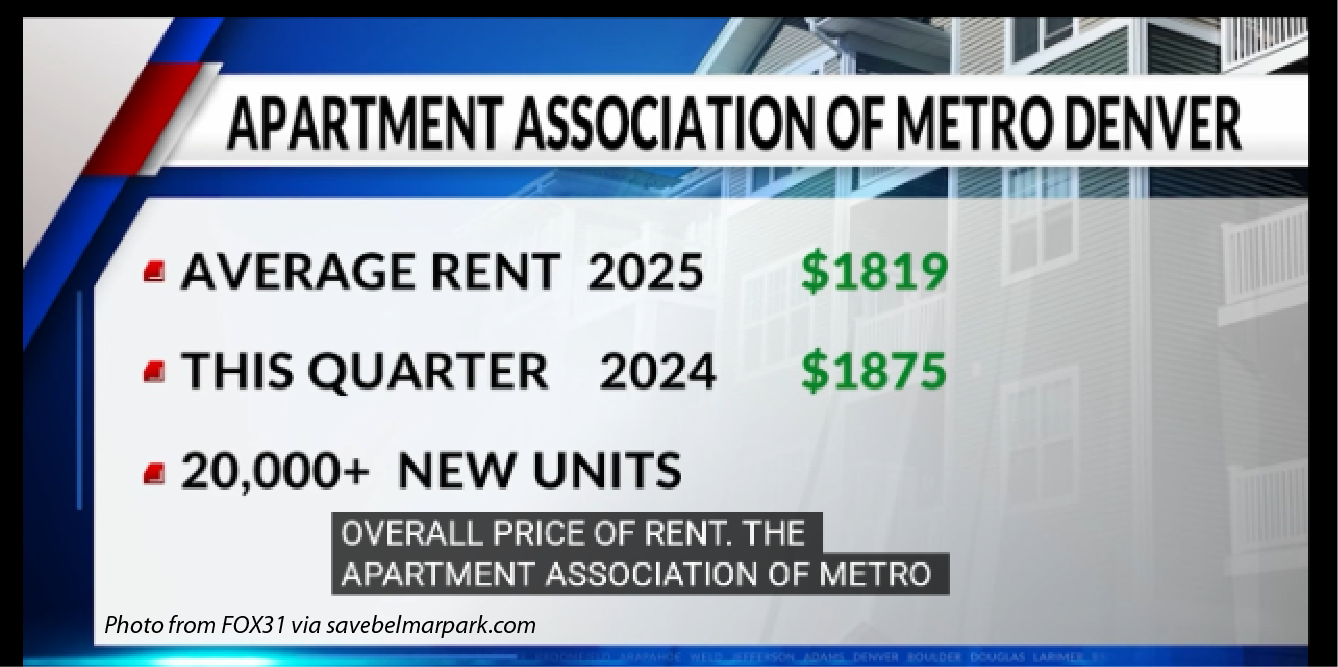
20,000 New Apartments Lowers Rent by (only) $56

From savebelmarpark.com Many of you are aware of the ongoing attack on Front Range habitats including Belmar Park, Chatfield State Park and Bear Creek Lake Park.  Unfortunately, habitats are under pressure globally which threatens the web of life for everyone on the planet. This trend is often justified locally by proclaiming the need to ignore the value of habitats because there is a ‘housing shortage’ and building more housing is necessary above all else. While statistics are not supportive of that argument for the Lakewood area, proponents continue to repeat it for lack of anything better to spout. Some even claim that regardless of whether there is an actual shortage of housing, it is necessary to build more housing in order to reduce the cost of rent.  In other words, if there are enough vacant, unused rental units, THAT will cause rent to come down significantly. Yet that 20,000 units was actually a much larger than average inventory increase. “This growth far exceeds Denver’s average annual construction of 11,400 units over the past five years” according to JP Morgan.  Because adding 20,000 units was such an outsized increase, it should have reduced rents significantly but for many local residents the $56 was not enough relief.   Yes, rents declined but according to the FOX31 report, developers also reduced apartments under construction by over 36% which will exert upward pressure on rents. Proponents of continuously building more and more rental units might say the minimal rent reduction was due to the upward pressure on rents caused by the population increase!   They claim we need to keep building rental units to accommodate the population increase in Lakewood which is causing the so-called ‘housing shortage’. What population increase are they talking about?   Developers don’t seem to agree with the growth argument since they reduced the amount of units under construction by 36%. The US Census Bureau shows Lakewood has experienced a population increase of less than 1,000 people from April 1, 2020 through July 1, 2024.  That is almost zero growth over 4 years! Even Denver has increased only 13,500 which is less than 2% total growth in that extended 4-year time period.  Compare that to the 20,000 units added plus the 11,000 units per year average for earlier years.  It would seem a lot more units are getting built than are needed. Jefferson County has actually lost 4,000 population in that same time period. Neither Lakewood nor Jeffco are in a population growth mode. As you probably know, because the secret is finally out – Jefferson County is closing schools!  Even selling off school buildings. That is not exactly an indication of population growth.  Just the opposite. So let me ask, if I can find this data and you can click and easily verify it, why can’t the Planning Commission or the City Council find these relevant facts to inform their planning horizon and policies?  What is that different drum they are dancing to? Why do we have to sacrifice the habitat quality of Belmar Park to accommodate population growth that does not exist? And as far as the use-by-right argument for private property?  We have previously exposed the fact use-by-right is irrelevant since the developer has to do earth moving in Belmar Park itself and they needed Lakewood to surrender valuable easements to enable their project.   Instead of use-by-right, we should call it use-by-deception. So the question still stands.  What is that different drum? For more info, click here.

2 + 2 = … Or doing math the developer boot-licker’s way

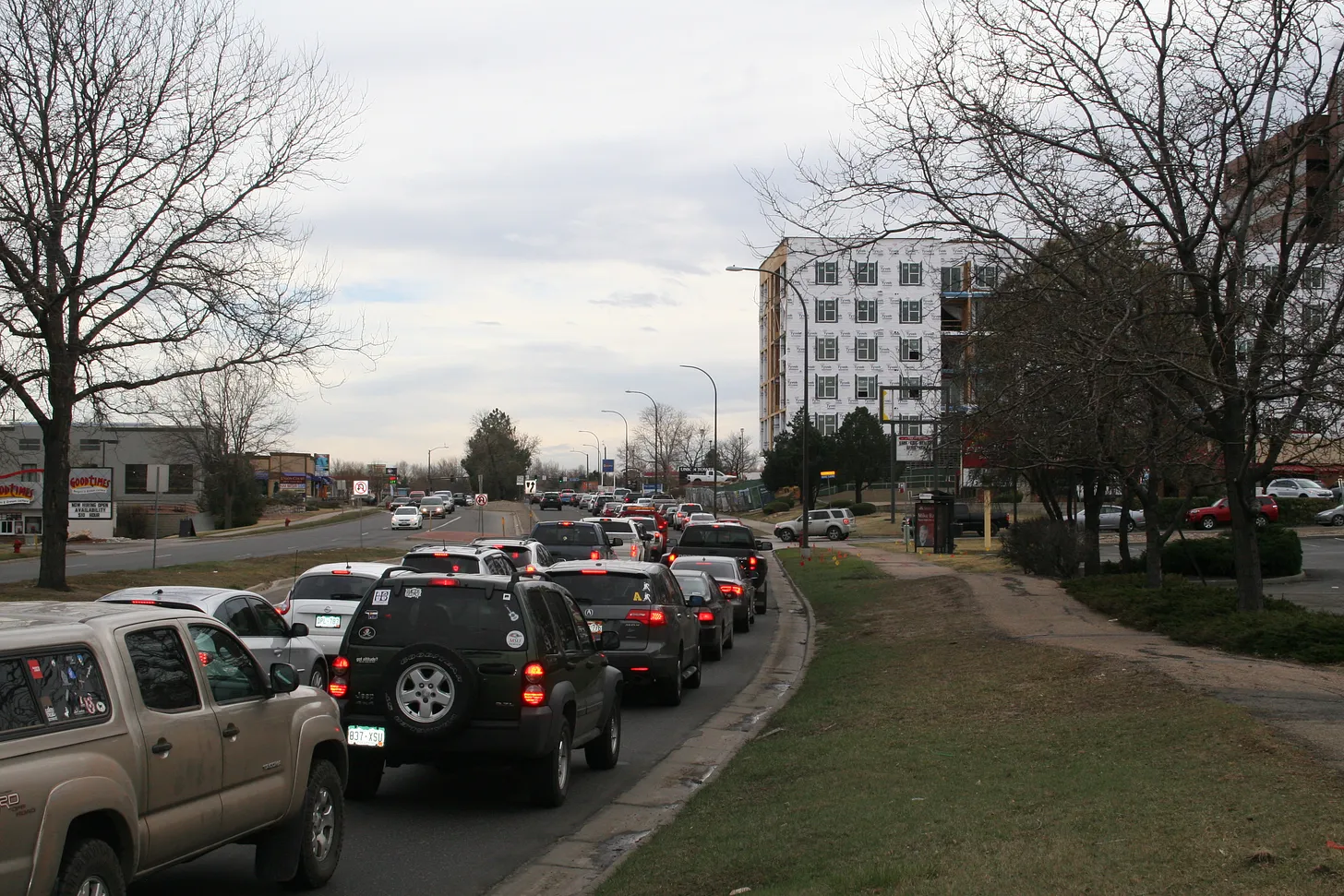
Alex at Somebody Should Do Something posted a lengthy set of articles regarding The Bend development with specific attention to traffic and economic development. Summary: Highlights from Alex at Somebody Should Do Something Part 1 “Environmental injury is often the very definition of irreparable harm — often permanent or at least of long duration,” Arguello wrote. In the latest installment of the “how can a self-proclaimed progressive city council enrich a developer to the detriment of the environment and the community’s well-being”, City of Lakewood is allowing a developer to push forward with a development which will significantly increase traffic on a major thoroughfare, further strain our environment, potentially expose the future residents to toxic hazards AND, again, bring no meaningful economic development to the city. Royal Lakewood Land Partners has made a submission for a development called “The Bend”, situated on the NW corner of the Federal Center, close to the intersection of the 4th Avenue and Union Boulevard, and, just a hop and a skip away from the off and the on-ramp from the 6th Avenue. To add the insult to the many more injuries to come, as shown in the 2007 Master Plan, the site was originally slated for Office Development – a perfect potential use, considering the proximity of the LightRail tracks and the dire need for this city to stoke actual economic development. As usually is the case, the math does not add up. The developer is using the tactic of “here is a traffic study… but it’s only for a part of the development, but we won’t even tell you how many poor souls we want to stuff in to these chicken coops. Then they talk about how this will “hardly” affect traffic, etc. By the time the locals realize just how badly it will have screwed them, the city council and the bureaucrats, who had enabled this environmental and economic disaster, will have moved on to something else, such as being a State Representative, where they continue to shill for the developer profit (ahem, Rebecca Stewart). So, lets see if 2 + 2 equals 4, or, maybe, 17, or maybe a dumpster fire for decades to come. Who knows. The math is very political-contribution-size-dependent these days. Lets look at some of the documents in the submission provided by the developer. 01 – The Bend Minor Subdivision Plat – Traffic Study_2024-10-10 There are only details show for the Southern part of the plat – what about the Northern part of the plat? This is where the math gets hazy, quick. A tactic of piece-mealing the development plans is frequently used (just as is the case with the development near Belmar) to, lets say, omit, the actual impact of the additional car-travel-per-day numbers on the area surrounding the development. Not only will this adversely impact the surrounding area, but also add to the already high total of vehicles having to travel out of Lakewood, since Lakewood has failed to attract localized, high-tech, well-paying employment. Read the rest about environmental and drainage problems at Somebody Should Do Something Part 2 Lakewood (and Colorado at large) are not exactly known for keeping up with building up infrastructure needed to support the additional thousands of people they keep stuffing here. Nor are they known for making the developers pay their fair share for the traffic created, parks overloaded, or the schools needed. However, Lakewood is well known for enabling Metro Districts and the potential resident abuse that comes with them. Of course, there will be a Metro District. Following are some of the snippets from the Metro-District-related documents submitted by the developer for The Bend “The population of the District at build-out is estimated to be approximately 3,350 people, based on a projected number of 2,000 multifamily units and 100,000 square feet of commercial, and a population estimate of 1.5 persons per multifamily unit and 3.5 employees per square foot of commercial property.” So, HOW MANY UNITS WILL THERE BE? And just as was the case with the Red Rocks Ranch, the development might potentially work out as a net negative to the county and the city? The Bend @ Lakewood MD Service Plan Application Memorandum 4875-7617-6597 4 .DOCX “The existing service in the area to be served by the proposed project is inadequate for present and projected needs. There is currently no other jurisdiction or entity, including the City, that considers it feasible or practical to provide the Development with the water, sanitation, street, storm sewer, or other improvements and services described in the Service Plan necessary to serve the anticipated Development. Current services are inadequate, and it is necessary for the District to be organized to provide such Public Improvements and services for the benefit of its future inhabitants.” In fact, there IS sanitation service and fire service and storm-water service. These are all covered by existing city and special districts in which the property is located. However, there is no taxpayer funding for development, and that is what the metro district will provide. And of course, any service provided would have to follow the rules in place, rather than creating their own rules, right? For example – lets look at the Rules and Regulations of one of the nearest Water and Sanitation Districts, Green Mountain Water and Sanitation. Read the rest of Part 2 at Somebody Should Do Something


1221 Wadsworth Update

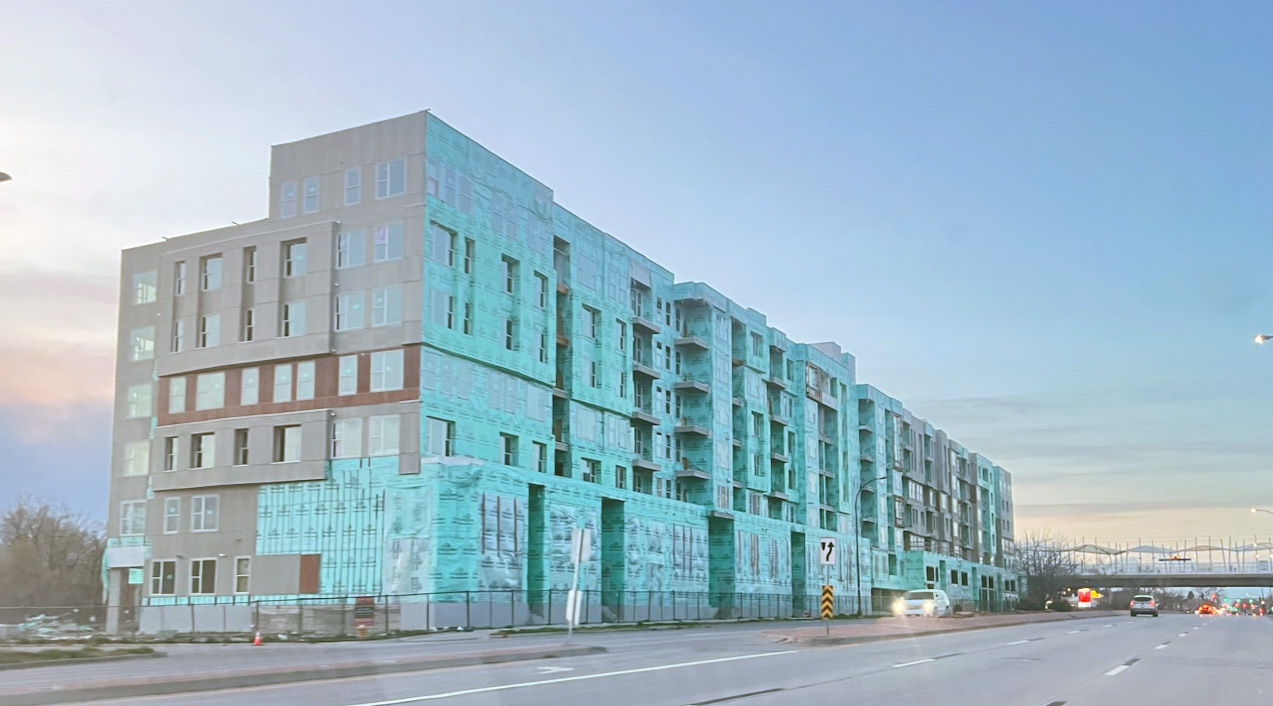
Update from Council Member Isabel Cruz to Lenore Herskovitz The construction at 1221 – 1225 Wadsworth remains an eyesore that residents constantly question. Councilor Isabel Cruz was kind enough to provide a detailed update to resident Lenore Herskovitz, rather than just referring her to the city website, which has not been updated since October 2024. Update: The new contractor has submitted their forensic report to the City Building Department for review. Three building inspectors completed an initial inspection of the project this week. Based on the reports provided to the City and the information observed during the inspection the building is in better condition than was expected. However, major parts of the fire sprinkler system must be removed and reinstalled, all of the doors and the windows must be removed and replaced, and the wrapping on the exterior of the building must be removed and replaced. The new contractor has agreed to submit and follow a construction waste and demolition plan (not required at the time of the initial approval) which needs to be submitted and approved. In addition, the new contractor still needs to submit new collateral prior to full start up. The contractor is already active in the building but the general public will not notice a significant change in construction activity for 30 to 60 days. I expect a meeting with the contractorn next week to discuss Wadsworth lane closures needed to begin working on the east side of the building. I believe that site security is still being maintained. The contractor has also indicated to me that they may not be able to use the parking area on the school property directly across 12th Ave, in which case they are trying to secure other options. On a side note I requested that the contractor install a sign or banner visible on Wadsworth to signal work has resumed. They have indicated that they are willing to do that as full scale work resumes. Sincerely, Isabel Cruz

No Workforce Housing for Lakewood

Another Lakewood misinformation campaign bites the dust. For years Lakewood has been pushing high-density growth in the name of “affordable housing”. They market this narrative to schoolteachers and civil servants. See Lakewood’s recent resolution using these exact words. However, a development presentation to the Lakewood Planning Commission introduced a new term that exposes the lie: Workforce housing Workforce Housing The consultant Lakewood hired to evaluate blight and Lakewood’s Comprehensive Plan pointed out that there was NO PLAN for increasing workforce housing in Lakewood. The emphasis on “affordable housing”, despite what Lakewood says, is different from workforce housing. No matter how poorly teachers and civil servants get paid, they get paid more than anyone living on the streets. Affordable housing in Lakewood will mean a government-run program, similar to what used to be called Section 8. That is not the same as an answer to inflated housing prices for low- to median-income levels. Think about government-run affordable housing like a scholarship system for school. A person may need the financial assistance, and may not be able to go to college without it, but there are others who need it more and not enough to go around. For decades, the people most in need are those with extremely low income. Not low. Not middle-low. Not teachers and civil servants. Extremely low income. Ann Ricker, of Ricker Cunningham, is Lakewood’s blight consultant. She pointed out there was a gap in the Comprehensive Plan. She said the plan talked about affordable housing, and it talked about single-family housing, but she said there was the missing middle. She suggested removing “single-family” and just using the term “housing”. Using the general term “housing” would allow more high-density, market rate apartments to be built in an effort to flood the market and lower prices. Lakewood is already proceeding with this plan. There is no guarantee the low-priced condos or townhomes will be built anywhere. The term “workforce housing” is a more accurate description of how the public perceives the promises from Lakewood. This was an important acknowledgment that “workforce housing” is different than “affordable housing”. The public should be aware of the word games going on, similar to “illegal alien” versus “migrant”. Watch Ann Ricker discuss the Comprehensive Plan here: From Frank Lehnerz, Free State Colorado “If the government tries to wage war against the laws of the market by price control, it undermines the working of the market mechanism and leads to conditions which, from the point of view of the government itself, are less desirable than the previous state of affairs it intended to alter.” — Ludwig Von Mises, Human Action (1949) History has repeatedly shown that price controls—whether on food, housing, or other essentials—create virtually no consumer benefits and only price distortions. By capping what producers or retailers can charge, these controls reduce supply, reduce product or service quality, discourage investment for new, improved, or cheaper products and services, and create market signal distortions.

Whippoorwill Withdrawn

From Jonna Helm, as of November (apologies for the delayed posting) After 18-months of the community sharing concerns surrounding the site suitability and safety issues with the entrance and exit through Youngfield St for the proposed development on Whippoorwill Dr (Williams Pointe apartments), the developer has officially withdrawn their major site plan application and canceled their building permit application with the City of Lakewood.   Over the course of the last year, the development underwent six separate major site plan reviews with the City of Lakewood’s Planning Department. At the time that the developer withdrew the major site plan application, the site plans still had challenges that had not been rectified, and the plans were not approved.  During the last snowstorm, we shared with the developer’s board members and city staff, yet again, multiple incidences of vehicles unable to make it up W. 15th Place, which is the location that the developer chose for the sole entrance and exit for the apartments.      As one resident wrote to the developer’s board members in response to our email: “ Thank you so much for sharing these events which highlight the issues we’re facing in what’s only the beginning of our winter season. It’s blatant negligence at this point for the city to ignore our concerns and move forward with W 15th Pl as the ingress/egress for the Williams Point project and I truly hope they make an impact, before it’s too late”. The following day, we received multiple emails from the developer. The first email in response to sharing the videos: “Thanks you for sending this information. I believe you should continue to work with the city on the lack of safe streets in your neighborhood”. Followed by another email: “I’m writing to inform you that we will not be completing our financing of Williams Pointe this year. We will continue to work on temporary and permanent uses of the property”. At this time, we are unsure what the developer is planning for the site but we can only hope that between the cost and complexity of developing this small, steep hillside and the headwinds and challenges that had not been able to be rectified through six separate review processes, that the land will be kept as open space or used to expand the adjacent Blue Star Memorial Park, which is currently a small road-side park along W. Colfax Ave, that is dedicated to our armed forces.  Blue Star Memorial Park – City of Lakewood At any rate, we thank the community and everyone who has taken the time to share and bring these concerns to the attention of our city and developer.  

Scroll to top