Lakewood Informer

Resident generated news about Lakewood, Colorado

Lakewood Informer

Resident generated news about Lakewood, Colorado

Development

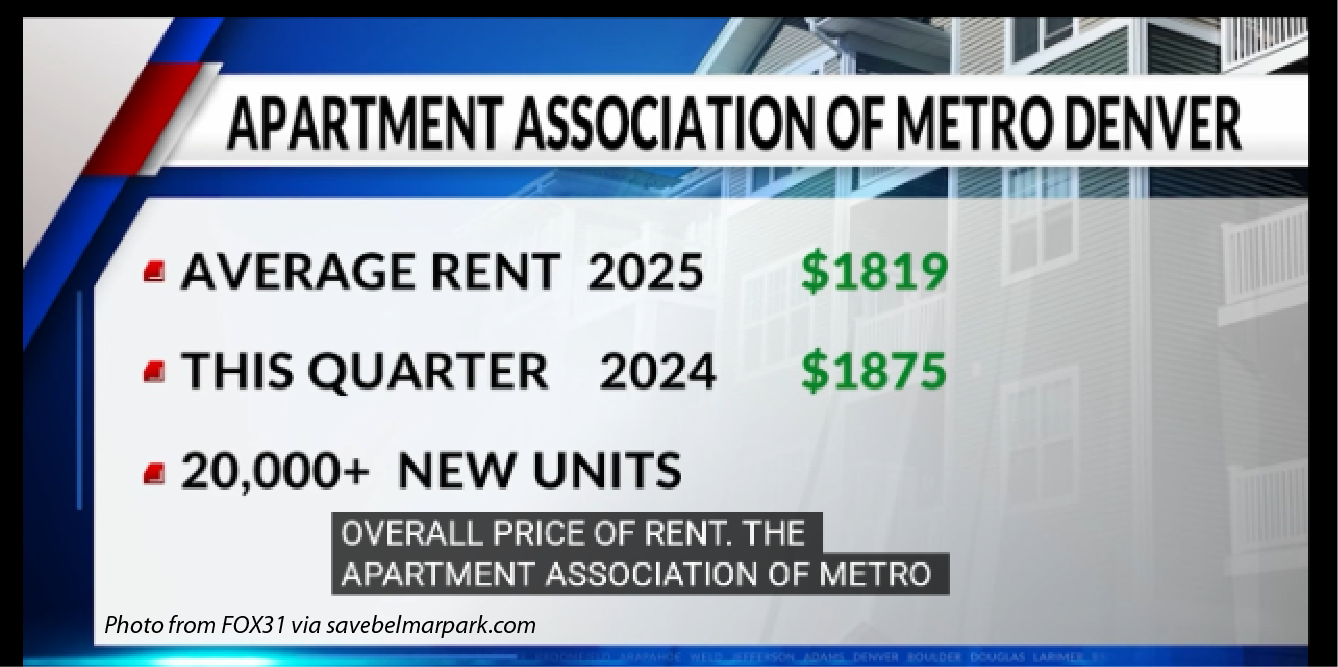
20,000 New Apartments Lowers Rent by (only) $56

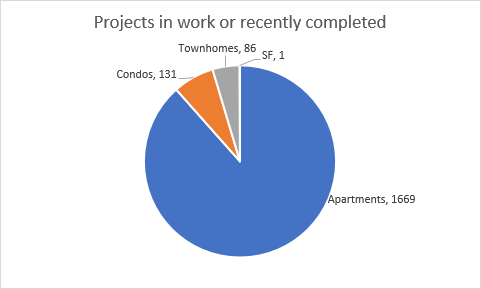
From savebelmarpark.com Many of you are aware of the ongoing attack on Front Range habitats including Belmar Park, Chatfield State Park and Bear Creek Lake Park.  Unfortunately, habitats are under pressure globally which threatens the web of life for everyone on the planet. This trend is often justified locally by proclaiming the need to ignore the value of habitats because there is a ‘housing shortage’ and building more housing is necessary above all else. While statistics are not supportive of that argument for the Lakewood area, proponents continue to repeat it for lack of anything better to spout. Some even claim that regardless of whether there is an actual shortage of housing, it is necessary to build more housing in order to reduce the cost of rent.  In other words, if there are enough vacant, unused rental units, THAT will cause rent to come down significantly. Yet that 20,000 units was actually a much larger than average inventory increase. “This growth far exceeds Denver’s average annual construction of 11,400 units over the past five years” according to JP Morgan.  Because adding 20,000 units was such an outsized increase, it should have reduced rents significantly but for many local residents the $56 was not enough relief.   Yes, rents declined but according to the FOX31 report, developers also reduced apartments under construction by over 36% which will exert upward pressure on rents. Proponents of continuously building more and more rental units might say the minimal rent reduction was due to the upward pressure on rents caused by the population increase!   They claim we need to keep building rental units to accommodate the population increase in Lakewood which is causing the so-called ‘housing shortage’. What population increase are they talking about?   Developers don’t seem to agree with the growth argument since they reduced the amount of units under construction by 36%. The US Census Bureau shows Lakewood has experienced a population increase of less than 1,000 people from April 1, 2020 through July 1, 2024.  That is almost zero growth over 4 years! Even Denver has increased only 13,500 which is less than 2% total growth in that extended 4-year time period.  Compare that to the 20,000 units added plus the 11,000 units per year average for earlier years.  It would seem a lot more units are getting built than are needed. Jefferson County has actually lost 4,000 population in that same time period. Neither Lakewood nor Jeffco are in a population growth mode. As you probably know, because the secret is finally out – Jefferson County is closing schools!  Even selling off school buildings. That is not exactly an indication of population growth.  Just the opposite. So let me ask, if I can find this data and you can click and easily verify it, why can’t the Planning Commission or the City Council find these relevant facts to inform their planning horizon and policies?  What is that different drum they are dancing to? Why do we have to sacrifice the habitat quality of Belmar Park to accommodate population growth that does not exist? And as far as the use-by-right argument for private property?  We have previously exposed the fact use-by-right is irrelevant since the developer has to do earth moving in Belmar Park itself and they needed Lakewood to surrender valuable easements to enable their project.   Instead of use-by-right, we should call it use-by-deception. So the question still stands.  What is that different drum? For more info, click here.

Lakewood is Laughing At Us

The May 7th Planning Commission meeting was a travesty of a public hearing. Lakewood cared enough to give residents an outlet for their grievances. No one cared enough to enact a single change. And sometimes they outright laughed at us. Watch the video below from the end of public comment, starting at min 2:58:25. One resident got up and publicly read an article from the Lakewood Informer. Watch the city staffer seated in the background unsuccessfully hiding her laughter during this reading. All of which was proved to be true. All of which city staff ignored and the entire Planning Commission dismissed — just like so many other valid resident points. The meeting started with Lakewood Chief of Sustainability and Community Developer Travis Parker explaining that he didn’t think this meeting wouldn’t change anything. He said that there were “pretty significant misunderstandings” of what staff could do. He said that “attacks on staff for being, you know, incompetent or malfeasant or acting in bad faith, demonstrate a fundamental misunderstanding of the good and hard work that’s done by people that are experts.” No one doubts city staff work hard. They all deserve thanks. But we also can’t assume they are always right and the residents are wrong about everything. We can’t assume that there is no other way to evaluate base assumptions. But that’s exactly what the Planning Commission decided to do. Ironically, one of the main points of the Belmar Park battle was about cutting down all the trees that could have formed an expanded buffer. Mr Parker himself has been educating residents on new zoning codes from Lakewood that will not increase the setbacks to what they were pre-2012, but will now require RESIDENTS to get a permit to cut down their trees. So the meeting was a pretty show that started and ended with all the well-researched points the residents brought forward being dismissed. Sadly, the best thing to be said is that being dismissed was more respectful than being laughed at. Required Grading Permit – Evidence not reported by city staff The permit pictured above is from Lakewood’s eTRAKit system, showing the grading permit that was applied for and received within one day of the complaint, just as reported by Steve at savebelmarpark.com The permit below is for demolition, which was applied for a month earlier. No malicious intent was implied and the problem was quickly corrected. Thanks to residents who apparently know less than city staff. Grading permit requirements below Actual permit that must be displayed before construction:

UPDATE: Disappointing but Not Surprising – We Need Your Help Now More Than Ever!

From Save Belmar Park, Inc., – a Colorado non-profit What happened at the May 7th Lakewood Planning Commission hearing was deeply disappointing—though sadly, not unexpected. After several speakers delivered well-researched, thoughtful, and heartfelt presentations, the audience erupted in applause. The public’s support for protecting Belmar Park was undeniable. So how does a small group of City officials override the will of the residents? Despite an overwhelming outpouring of public opposition—including emails, social media comments, and a nearly 10-to-1 ratio of anti-this-development comments on Lakewood Speaks—the Commission still voted 5–0 in favor of the 411-unit Kairoi apartment building. And they did so even after being presented with a powerful, evidence-based case showing that the proposed development directly contradicts Lakewood’s own zoning code, comprehensive plan, and parks master plan. This vote was a slap in the face to the community. It disregarded common sense, environmental preservation, and the very planning documents the city is supposed to uphold. The proposed zero-lot-line, six-story building is incompatible with the surrounding two-story Belmar Commons townhomes, overwhelms local infrastructure, and threatens the ecological balance of Belmar Park. The city has rolled out the red carpet for billionaire developers—again—ignoring the public and prioritizing profit over people, parks, and trees. Dozens of mature, century-old trees will be clearcut. Wildlife will be displaced. Belmar Park’s peace and beauty will be irreversibly damaged (if we don’t stop them). But, we have NOT given up—and we’re not stopping now! Our next step is filing a lawsuit under a 106A appeal, which will go before a Jefferson County district court rather than more city insiders. We believe we still have a strong chance at a different outcome—despite the city’s push to bulldoze trees—because the proposed development blatantly contradicts Lakewood’s own zoning laws, comprehensive plan, and parks master plan, giving us solid legal ground to challenge it in court. This is our last real chance to stop this destructive project, and we’re counting on supporters like you to help us make it happen. Legal fees are significant, and this is a fight the community should not have to fund—but we must because the City of Lakewood refuses to listen. Please stand with us—again. If this park means something to you, dig deep—and give as generously as possible (then smile knowing you’re helping to save something irreplaceable). Every dollar helps us hold the line against this destructive plan. Then share our campaign and spread the word. We’re fighting for what’s right: environmental integrity, community character, and the future of Belmar Park. 👉 Donate now: https://www.gofundme.com/f/save-belmar-park Directors Save Belmar Park, Inc. 

The Bend: A Government Financing Trade Deal

Lakewood may be forcing a property owner to blight their own land in a backroom trade deal wherein staff pledged a positive vote from City Council for a metro district. The deal would give The Bend development city financing in exchange for metro district status. In January 2025, a representative for The Bend developer made the following public comment: “The city is actually only allowing a Metro District to be put in place if the URA (Urban Renewal Area) passes so that it is a vehicle for this infrastructure and tax increment financing. They actually would not pass our Metro District standalone. They’ve made that very clear.” – Allie Meister, Lincoln Properties, at Green Mountain Water Board Meeting, min 40:13. This deal illuminates why Lakewood is rushing through a URA and metro district public hearing on the same night. Staff presentations have repeatedly touted the advantages of doing both the URA and the metro district at the same time. They claim these are complementary structures. But they are not complementary. Rather, these are essentially overlapping structures that could finance the same set of infrastructures. Apparently, financing public infrastructure is a profit center. Overlapping financing is duplicative. Even worse, for The Bend, neither metro district nor URA is appropriate. The Bend is not a “serious and growing menace” to the public health, safety, morals, and welfare, which is the statutory reason for Urban Renewal. The Bend does not provide public services, which is necessary for a metro district. The metro district will only be used for financing. Therefore, the most appropriate government assistance, if any, would be a Business Improvement District (BID).  BIDs are the more accountable, less powerful, way to achieve development financing but no one is advocating for its use. Instead, developers prefer to form metro districts. This initially involves the developer loaning money to the new metro district.  Then the metro district issues a bond, with interest, to pay back the loan. Since the developer and the metro district are the same people (different legal entity), the developer has now gained itself government immunity, as well as millions of dollars of interest payments. In many cases, the interest payments never end – they only continue to grow. This outcome isn’t possible with a BID. (See Denver Post series “Metro Districts: Debt & Democracy” by David Migoya for more in-depth information on metro district abuses) Therefore, developers generally want that metro district as a profit center, rather than as a way to finance development, since they front the funds in either case. A URA is also meant to fund public infrastructure. Much of the public infrastructure was repeated under both the URA and metro district justification. Only one method is needed to finance infrastructure, and, as noted, the developer will provide the base funds in any event. As Karen Gordey reported in the Lakewood Informer, there was no required financial gap analysis completed to show that city funding was required. Therefore, with a metro district there is no need for a URA. This conclusion is also shared by a report from the Independence Institute. A URA has not required a metro district in the past. However, Lakewood can trade URA financing for affordable housing. Lakewood is not allowed to pay for housing directly. Lakewood is not even supposed to demand any percentage of affordable housing. There is no zoning or ordinance that requires it.  The irony is that Lakewood City Council itself sunset the Strategic Growth Initiative ordinance. Under that ordinance, this development would have fallen under the allocation review system wherein Lakewood could have asked for affordable housing to permit this many units in a TRANSPARENT process. Instead, the city is now working behind the scenes to make this same thing happen. So, through the URA, Lakewood will gain affordable housing, aka government housing or government-subsidized housing. Those units can be used to qualify for state grants for even more development in Lakewood. “Without the Urban Renewal plan, in our case, we wouldn’t be able to deliver kind of what they want to see or their vision for this piece of land which includes housing retail and affordable housing they you know both the state and the city and the county do have a desire to have a portion of the site have affordable housing in it.“ Allie Meister, Lincoln Properties, Jan 28 2025, min 35:57 Lakewood residents will pay for The Bend development by giving the developer financing. The new taxes from that development are diverted out of the general fund, which pays for Lakewood resident services like police, and instead will pay for The Bend development responsibilities like streets and pipes. The decision for an Urban Renewal Area is very separate from the decision to approve a metro district. The developer did not originally desire to be in an Urban Renewal Area and Lakewood may not approve a metro district as a standalone decision. But, operating together, the developer and city can trade financial incentives that residents throughout Lakewood will pay for.  The developer offers blight and gets metro district status and financing. The city offers URA financing to indirectly offset affordable housing units and gets a basis for more state grant funding. “Municipalities are using a tool (URA) meant only for serious threats to the public as a tool for gaining a competitive advantage in economic development. Which, essentially, is a way to financially reward development partners and a method to force the public into a future desired by government planners.” -From The Empty Promise and Untold Cost of Urban Renewal in Colorado Just like Lakewood’s deal to buy Emory Elementary, residents should know the full plan to leverage this deal for more high-density development using state grant funds from the affordable housing units. Without that knowledge, which has not been disclosed, neither the URA nor the metro district decision makes any sense. There will be a City Council vote on the metro district and URA on Monday, May 12 that is open to

Relevant facts withheld from Planning Commission regarding unpermitted demolition

From SaveBelmarPark.com Greetings Supporters of SaveBelmarPark.com, The 777 S Yarrow project was approved by Lakewood’s Planning Commission by a lockstep vote of 5-0 on May 7, 2025. Despite in-person and online expert testimony and informed and articulate personal testimony from hundreds of citizens who raised a wide range of serious issues and potential violations of the Zoning Ordinance that will never be addressed or mitigated by the current proposal, the commissioners still approved the proposal. If it is possible for a planning commission to be replaced by artificial intelligence software, this might be a good place to start a proof of concept.  Maybe even remote-controlled rubber stamps would suffice. At one point, ‘Mr.’ Buckley asked about the grading in the park.  As you may know, the city claims the park will not be touched.  That is a false claim.  As the city engineer admitted, it is necessary to grade park property so the developer does not have to build a retaining wall.  You are not supposed to build a retaining wall within 10 feet of the property line in Lakewood.  So it would not be feasible to require the developer to stay on their own property since they would have to modify their site plan to build a retaining wall with a proper setback. So Mr. Buckley asked what the grade change difference would be and was told only 2 feet. No big deal, right?  However, the developer’s site plan shows the floor of the building at 5,528.75 feet.  The park path adjacent to the graded area is at 5,518.  Guess what?  That is more than a 10 foot difference in elevation.  Not 2 feet.  The fire road is at 5,524 which is a 6 foot difference.  But none of that matters.  Because facts don’t seem to matter to the Planning Commission.  They can simply be ignored and replaced will false statements such as telling the public that the park won’t be touched.  Problem solved. This type of deceptive behavior is rooted in the history of land development.  Look at Stanford University.  When Leland and Jane Stanford passed away, they left 8,000 acres of land to the university with the provision it could never be sold. Yet visitors to Palo Alto, CA who visit the Stanford campus are amazed at all the development on that 8,000 acres that supposedly could never be sold.  How did developers and the university get around that seemingly ironclad restriction?  Enter the 99 year lease!  Stanford leases their land which has allowed all manner of development including residential, retail, you name it.  Just as if it had been sold.  Maybe Leland Stanford got railroaded on that! Similarly, May Bonfils did not envision the abuse and exploitation that would occur with her property at 777 S Yarrow Street after her passing. (And coincidentally, Planning Commissioner Overall is a Stanford grad.)   In a previous update, I mentioned the possibility the developer would bring attorneys or other advocates to put a positive spin on their proposal.  However, they did not make any attempt to put a positive spin on their project.  But to their credit, they also readily re-confirmed the project plans to provide only market priced rental units with no affordable units other than what the market will bear. Perhaps they already knew there was zero chance of not gaining approval from their supportive anti-science minions on the planning commission. Commissioners warmly welcomed the few supporters they obviously knew who showed up.  Yet addressed an accomplished PhD conservation biologist from Cornell and CSU who visited the site and the park and created an excellent presentation as ‘Mr’ Pardo. And after years of working on this project, who did the commission turn to for the ridiculously obvious question – how much does bird resistant glass cost?  Not the planning staff.  Not the developer.  Such an obvious question was apparently above their pay grade.  They expected Dr. Pardo to have done their homework for them.  He offered to follow-up on that. During the hearing, the commissioners asked specifically whether the demolition of 777 S Yarrow was properly permitted because various citizens were aware it was not and commented to that effect. They were assured by staff with Mr. Parker present that there were no problems with permitting and were not told that demolition began without being properly permitted. In fact, staffers denied that there were any issues with permitting.   I initially reported about the improper permitting and subsequently the Lakewood Informer carried that report and subsequently a portion of the Informer reprint was read back to the commissioners during the hearing.  They disparaged the report as something unreliable from a ‘blog’ and terminated the conversation. The city and Planning Commission should issue a public apology for that disparagement, inability to manage the permitting process and refusal to consider relevant facts on the matter brought to their attention by citizens during the hearing. Instead, they were not told a required grading permit (as shown above) was not issued until a citizen complained that it had not been issued. They were not told even the most minimal erosion control measures such as straw socks and tire shakers were not installed until after a citizen complained via a ticket in Lakewood’s user.govoutreach system. As per the image above, the very FIRST requirement specified by the developer’s own Kimley-Horn engineers is the grading permit which was never even requested until a citizen raised the issue. They were not told demolition continued for a period of time without any erosion control measures in place in contravention of Kimley-Horn recommendations and without a required grading permit as specified in the image above. This happened in early March.  It has been two months and the commissioners apparently were not aware of this breach. But they were at the ready to disparage accurate reports of it that were brought in to the public hearing. We predict no action will be taken regarding the unpermitted start of demolition, lack of even minimal erosion control measures and failure

Likely Defect Identified in Planning Commission Software

From savebelmarpark.com The 777 S Yarrow public hearing is very close on: May 7th at 7:00 PM at 480 S Alison Parkway, Lakewood, CO You may now enter public comments online at: https://lakewoodspeaks.org/meetings/869. You may have to click on item 3. Unfortunately, a likely defect in the Planning Commission’s online file upload process has been identified and was reported via a follow-up public comment.  However, that public comment was rejected by Lakewood for violating comment policy. It appears the comment was rejected out of an assumption that the Planning Commission software could not possibly be broken. The city clerk was also very helpful in providing examples of other comments with attachments that were publicly posted as proof that the upload process is not broken. Notably, NONE of the examples provided by the clerk included the .doc file extension. Therefore, because Lakewood was obviously not going to investigate a reported defect that could potentially have been suppressing public comment file attachments for a long time, perhaps years, I investigated. It turns out that the Planning Commission does NOT accept all of the file extensions specified on the file upload dialogue (which is shown in the image at the top of page). Once I converted the .doc file to a .pdf file, then the upload process was successful! If you upload a file with a supported  .doc file extension, for example, it appears to work properly. However, if your comment is approved for publication, the attachment is never displayed. This is a material error because members of the public may reasonably assume their upload was successful since no error message is ever produced at any point in time during this process.   Nor does the moderation process capture file upload errors and notify users.   Nor are members of the public ever advised that the software may be unreliable and may silently dispose of file uploads. Upon reviewing public comments just this morning, one person who supports approving the Kairoi project referenced his attached letter.  But no attached letter was displayed.  So his attachment may also have been lost by the software. Therefore, members of the public or any parties with a matter to be heard by a quasi-judicial panel could upload files for the official hearing record and discover after the hearing record is closed that their file uploads were rejected.  Then it is too late to re-submit their files. This problem is also complicated by a significant conflict of interest due to the fact that Mr. Parker, Lakewood’s executive in charge of making development recommendations to the Planning Commission and/or City Council, is also and incredibly an advisor on the executive team of the same software company that is at the crux of possibly suppressing public comment by silently rejecting documents intended for quasi-judicial hearings. We suggest the city is indifferent both to the public perception and the risks of this conflict of interest. We also suggest that as a result of enabling this conflict of interest, the city is also indifferent to the requirement for software quality control. Please consider that a quasi-judicial hearing is a legal proceeding.  What if the clerk of a court periodically discarded or lost documents delivered by litigants without telling anyone?  What do you think would happen to that court clerk if this malfeasance came to light after years of discarding court documents? We are not suggesting any Lakewood employees are disposing of these files.  The comparison is being made to the apparently inconsistent software vs what if an employee hypothetically did the same thing?  We doubt that an employee would get off so easily. But in Lakewood, the software does get off easily. And consequences can be significant if a court is not diligent regarding management of important technology used in processing court documents or evidence. Consider the Colorado Bureau of Investigation and the fiasco over their DNA tests.  It was recently revealed that hundreds of DNA tests were allegedly ‘manipulated’ over a 30-year time period and as a result material facts were omitted from official records even though no DNA matches were falsified.  The CBI Director stated: ““Our actions in rectifying this unprecedented breach of trust will be thorough and transparent.”   Will Lakewood be as forthcoming regarding ignored software defects that potentially corrupted public hearing records? Has this defect been suppressing relevant files for years?  It is possible.  Especially considering Lakewood does not seem responsive to any report that the software does not work properly.  Anyone who has previously reported a problem may have received a similar response that it was user error because other people can upload files – but of a different file type. Therefore, we strongly urge that Mr. Parker be required to recuse from any matter that may eventually involve the Planning Commission or City Council where the PeopleSpeak software is used to accept public comments for any quasi-judicial hearings or city council meetings. In the meantime, any past decisions made by the Planning Commission or City Council where online public comments were accepted from the public should be reviewed and new hearings potentially announced once the software is fixed. Stay tuned and thanks for listening, Steve

Springsteen Files Injunction Regarding Emory

Former Lakewood City Councilor and attorney Anita Springsteen is no stranger to Lakewood’s backroom dealing and use of executive sessions. Springsteen has filed two lawsuits against the city for using “negotiations” as the context for an executive session. Allegedly, those meetings were open meetings violations because they didn’t provide enough detail on the “negotiations” involved. Those allegations are playing out about the purchase of Emory school. Even residents living next to Emory had no idea the city was trying to purchase the school for the Action Center.  Springsteen filed an injunction to prevent the city from voting on the property purchase April 28 but Springsteen says “the Court held that the issue was moot when Council held the vote despite being on notice of the request for injunction.” She plans to refile the motion to prevent further actions by the city. She is also communicating with the Jefferson County Schools so they are on notice of breach of fiduciary duty. Councilor Mayott-Guerrero asked for an attorney to explain why residents have not seen open conversations about purchasing Emory before. The attorney for the city said negotiations are protected by executive sessions so there has been no public notice until now. The April 28 meeting, during which this conversation and vote took place, was duly noticed, he advised. Unfortunately, that still left many residents in Lakewood feeling like they were unprepared, not informed and left in the dark. Which is entirely reasonable since, as Lakewood just admitted, they did not tell residents they were working on this until now. Lakewood did not put the address of the property on which they were negotiating in the notice for executive sessions. City Council and staff were very clear that this was only the first step and that the city needed to proceed in this matter so they could progress to formal negotiations. But then what were they doing in previous executive sessions? Lakewood could have been transparent and told residents in September of 2023 that they were interested in buying the school on behalf of the Action Center, as documents show. Instead of fully explaining the plans for Emory, Lakewood cried “misinformation” and only addressed limited misunderstandings. There are also allegations that Jeffco was hiding talks because they were involved in negotiations to sell the property four months before it was officially disposed of. Council and staff still say that no decisions have been made and that they will listen to resident input at future meetings. Of course, that’s a variation of what they have said for the past year and a half while decisions were being made. There is no indication that plans will change based on resident input at the city level but that may be different at the school district level. There is also the possibility that the expanded interests of the Action Center will persuade people that this is the best use of Emory. The purchase of Emory for the Action Center was a priority for Lakewood since the school’s closing. It was the first and only one on the municipal option list to begin in January of 2024. Springsteen was one of four Councilors who demanded transparency before allowing an executive session to proceed. The session involved the City Manager’s contract renegotiation. The four Councilors calling for transparency prevented a super majority vote, which is required for an Executive Session to proceed.  This forced the contract renewal to take place at a public meeting so that the public could see who voted to renew the City Manager’s contract, which increased her benefits. Springsteen has filed three lawsuits regarding open meetings violations, two of which pertain to property negotiations. Springsteen says “the third case was for an Executive Session involving ‘legal advice’ on a CCU issue that had already been resolved upon appeal a year prior, which calls into question the purpose of the meeting.”

Lakewood’s shady Jeffco Schools business deal

By Jimmy Sengenberger, in the Denver Gazette The backroom deal I warned about last year is now playing out in broad daylight. In February 2024, I asked whether Lakewood was eyeing a bargain on the closed Emory Elementary — a deal that could dodge public input and leave Jeffco taxpayers holding the bag. Fifteen months later, the answer is a resounding yes. On Monday, Lakewood’s City Council authorized a $4 million below-market purchase of the school — a site that got $2.6 million in taxpayer-funded upgrades before Jeffco closed it in 2023. It’s now on track to become the new home of the nonprofit Action Center — courtesy of a taxpayer-funded workaround. The Action Center’s mission may be noble, serving vulnerable families and individuals. But the process? Not so much. It reeks of an almost theatrical disregard for transparency and taxpayer interests — with a straight face. In January 2024, Jeffco Schools quietly introduced a new “Municipal Interest” process giving municipalities like Lakewood first dibs on shuttered schools — without competitive bidding or public input. COO Jeff Gatlin confirmed Lakewood’s “interest in the Emory property,” revealing they were already “working through the municipal interest route.” Translation? A backdoor sale — letting Jeffco Schools unload taxpayer-funded property at a loss. A consultant even advised this process empowered the district to skip community feedback entirely. Read the rest of the article….

Mark Your Calendars for May 7 to Speak for Belmar Park

From savebelmar.org At long last the date for the Lakewood Planning Commission to hear the review of the major site plan of 777 S. Yarrow St has been set. MARK YOUR CALENDARS FOR MAY 7. We will need everyone available to pack council chambers. You can: OR Donate your time to a speaker who would need more than 3 minutes It is STRONGLY RECOMMENDED that everyone who has a comment, whether they speak or not, enter their statement on Lakewood Speaks at Lakewood Speaks – May 7, 2025 Planning Commission Meeting. Submit comments before 5 pm day of. It would be beneficial to tie your comments to a section of the zoning code. For example, Article 17.2.7.2: Review Criteria states that: Recommendations and decisions regarding site plan applications shall be based on the following criteria: A. Major site plans shall comply with standards outlined in Articles 3, 4, 5, 6, 7, 8, and 10 of this Zoning Ordinance. B. The Director shall evaluate how well the proposed modifications contribute to the overall performance of the site and how well the proposed changes meet the standards in Articles 3, 4, 5, 6, 7, 8, and 10 of this Zoning Ordinance. Let’s see how well these standards are met: under Article 17.3.1.1: Purpose and Intent This Article describes each zone district established within the City of Lakewood. The purpose of the various districts is to: A. Ensure compatibility of land uses Is this requirement met with a 5-6 story apt complex directly adjacent to the lake? Article 17.3.4.1: Purpose and Intent The mixed-use (M) zone districts are specifically intended to: C. Maintain the integrity and viability of the adjacent residential neighborhoods Is this requirement met with a 5-6 story apt complex adjacent to the 1 and 2-story townhomes at Belmar Commons? Article 17.4.1.3: Determination of Use B., the Director shall consider, among other relevant factors, traffic generation, density of population, and hours of operation of the proposed use as compared to: 3. The goals and policies set forth in the Comprehensive Plan. The Comprehensive Plan states “Through the site plan review process and design guidelines, ensure that new multifamily, mixed-use, and commercial developments adjacent to single-family neighborhoods are compatible by incorporating appropriate design, scale, height transition, and connectivity to seamlessly integrate with the neighborhood.” Is this requirement met with the 5-6 story apt complex? Page 196 of the Comprehensive Plan reads Lakewood Sustains Guiding Principle Lakewood will be a leader in sustainability principles, practices, and education. Lakewood is committed to the well-being and health of its citizens and environment. The city will reduce its impact on natural systems It is the goal of sustainability to achieve balance between the economy, the natural environment, and social values; however, human society depends on the environment first and foremost in order to achieve social and economic sustainability. In other words, without a healthy environment, a community would be unable to achieve economic success and social well-being. Are we promoting sustainability and a healthy environment by cutting down 65 trees and degrading the environment? Declining bird populations will now have to endure noise pollution from construction, window strikes from 6 stories of apartment units, and reduced habitat from tree removal. Article 17.4.1.4 : City Owned Open-Space and Parks City-owned land which is used or held for open-space or park purposes shall not be permitted to be used for any purpose other than open-space or park purposes. Is the developer staging equipment and/or regrading part of the park adjacent to the site? Article 17.6.5.8, 17.7.7.7: Existing Tree Preservation A. Existing trees with trunks greater than 8-inch caliper, measured 1 foot above grade, within a development shall be preserved to the extent reasonably feasible and will help satisfy the landscaping requirements of this Section. Such trees shall be considered “protected” trees within the meaning of this Section. Streets, buildings, and lot layouts shall be designed to minimize the disturbance to protected trees. B. The Director shall determine through consultation with the City Forester when it is not feasible to preserve and retain protected tree(s) or to transplant them to another on site location. If it is determined that it is not feasible to preserve or transplant protected tree(s), the applicant shall replace such tree(s) according to this section. Replacement trees shall be used to satisfy the tree planting standards of this Section. Has this requirement been met? Was the site plan designed to preserve mature trees? Not if the plan is to remove 65 mature trees. Article 17.13.1.1: Purpose and Intent This Article establishes standards for sustainable development in the City of Lakewood. The purpose of these standards is to ensure that development implements the goals articulated in the community’s adopted plans for resilient and efficient development that is adaptable to infrastructure changes in the face of climate change, minimizes its impact on limited resources, contributes to communitywide greenhouse gas emissions targets, and becomes a positive asset within the community. Does extensive tree removal and consequent habitat removal satisfy sustainability standards? Use one or more of these articles in the zoning code to frame your concerns about the 777 S. Yarrow St development. Belmar Park is NOT an amenity for 777 S. Yarrow St! See you on May 7!

Public Hearing for Massive Belmar Park West Housing Project Announced

From savebelmarpark.com May 7th at 7:00 PM at 480 S Alison Parkway, Lakewood, CO You may now enter public comments online at: https://lakewoodspeaks.org/meetings/869. You may have to click on item 3. If you submit a comment online or in-person, we suggest you specify to which specific section in Lakewood’s Zoning Code or Comprehensive Plan your comment is relevant. Simply submitting a general comment without linking it to the Zoning Code or Comprehensive Plan may result in your comment being disregarded or misinterpreted. If you can afford to hire an attorney to help formulate your concerns and possibly submit your concerns on your behalf, that would be excellent.  This is a quasi-judicial hearing which closely resembles a court proceeding rather than a city council meeting. You may also view the hearing online at LakewoodSpeaks.Org Please feel free to attend and comment in-person.  However, since Lakewood is not consistent with transferring oral comments into the public record (other than archived videos), you may want to also submit your comment online which allows you to verify the comment was accepted.   If you attend in-person, keep in mind a quasi-judicial proceeding is similar to a courtroom so applauding comments or cheering comments could get you removed from the chamber or other negative consequences could accrue.  The hearing concerns whether the large housing project at 777 S Yarrow Street adjacent to Belmar Park in Lakewood, Colorado should be approved. If the commission approves the major site plan, there could be a legal challenge to that decision raised in a court of law because some citizens have funded a charity that has retained an attorney and stated its intention to raise such a challenge if necessary. Having comments submitted from informed citizens who explain how the major site plan fails to comply with the zoning ordinance and/or comprehensive plan could possibly be utilized in such an appeal, especially if such comments are researched in advance by your attorney in order to improve the legal impact and clarity of your citizen comments. Assuming there is a future appeal in a court of law, any comments you submit to the Planning Commission could eventually be rebutted by the developer’s lawyers so comments that have been legally vetted by your attorney may be more effective. Because any attempt to introduce additional evidence will likely be rejected at the appeal level, it is important to get all relevant documents and comments into the hearing record on May 7.  You may upload one document per comment. You can rely on the fact that the developer will have top notch legal representation at the hearing.  It is up to the public to debunk the rosy presentation those attorneys may make on behalf of the developer. Some developers find advocates that can make almost any type of project sound like a dream come true.  That could be the type of presentation the public will be up against on May 7th. Therefore, especially if you have a legal background or can afford to enlist legal support, please step up now and prepare to make your best argument to the Lakewood Planning Commission.

Scroll to top