Lakewood Informer

Resident generated news about Lakewood, Colorado

Lakewood Informer

Resident generated news about Lakewood, Colorado

Statewide

Sacrificing Neighborhoods Allows Homeless Funding

Why the big rush to change the zoning code? Follow the money. The money trail leads to state grant funding, which primarily supports homeless and sustainability initiatives. Without that agenda, Lakewood could decide for itself which, if any, of the state initiatives make sense locally. Colorado has decided to override local zoning in a power grab against local home rule. Other cities are fighting back against Colorado with legal cases. But Lakewood will not fight for home rule. They are not only implementing the state law but going further in densification, all while citing the need to comply with state law Lakewood receives millions of dollars in state grants for initiatives like sustainability and the new navigation center. The purchase and renovation of the old Harley Davidson building was done using state grants. To continue funding sustainability and homeless initiatives, Lakewood must either fund it internally (a political impossibility) or comply with state zoning codes. And if the state zoning codes are not what Lakewood residents had in mind when they discussed “affordable housing” solutions, that’s a sacrifice Lakewood is willing to make on your behalf. Note: For the purposes of this article, “Lakewood” means the majority opinion of city officials. It is hard to tell who is speaking in public workshops, there is a lot of backroom personal communications, as well as conflicting explanations given in ward meetings. To establish personal beliefs, please contact your city official with detailed questions that are beyond the scope of this article. Lakewood’s proposed zoning code sacrifices existing neighborhood stability in the hopes of creating affordable housing. Occupancy limits everywhere are eliminated so there can be 20, unrelated, non-owner residents in a house. The house nextdoor may be torn down and replaced with a duplex or a cottage court*. Small retail is now allowed, mixing business with residential. Every property in Lakewood is now a transition zone. *Cottage Court: According to a 2022 report from AARP, cottage courts are defined as a small collection of bungalow-style homes that are “typically 1 to 1½ stories tall and are oriented around a courtyard that serves as an outdoor community space in lieu of rear yards.” – HousingWIre There is no guarantee that any of these changes will achieve their desired goals. Studies abound on both sides. However, Lakewood has already been promised affordable housing since the 2012 zoning rewrite that spawned the term “Soviet-style apartment blocks” with zero new “affordable” units created. Is there any reason to think this big change will be different? Lakewood’s proposed zoning code is not ready for first reading yet, so residents don’t know all the details. The latest redline is from May 19. However, residents do know that know matter what is in there, it is good and necessary because City Council passed a resolution saying so in December of 2024. Lakewood’s navigation center is a contentious issue that hinged largely on the ability to get “free money” from the state. Many homeless and sustainability measures that were supported by the state did not go through a full public policy debate because that wasn’t necessary if Lakewood wasn’t spending its own money. Now that decision is coming back to haunt Lakewood residents, who will be paying for that money by sacrificing their neighborhood stability.

Ramey Johnson on Kim Monson Show

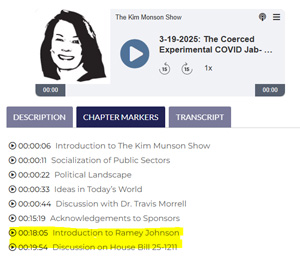
Lakewood’s own Ramey Johnson was on the Kim Monson Show, KLZ 560 AM, Wednesday, March 19, to discuss several statewide bills that could cost taxpayers money. As members of the Colorado Union of Taxpayers (CUT), Monson and Johnson discuss House Bills 25-1211 and 25-1297. Regarding HB25-1211, Monson said, “I think this House Bill 25-1211, tap fees imposed by special districts, this is big government and politicians, to me, it looks like getting in bed together.” Johnson replies, “Yes, it is, Kim. But more than that, this one is a gift to the developers. It’s a developer’s dream come true” HB25-1211 is Rep. Rebekah Stewart’s bill that tries to force special districts to lower fees to accomplish her surplus housing strategy, as reported by Lakewood Informer news HB25-1297 is for a Health Insurance Affordability Enterprise. Monson said, “Whenever you see the word enterprise, that means they’re trying to take money out from the calculations for the TABOR refunds, your money coming back to you.” The bill talks about new fees. Johnson responds, “There’s no such thing as fees. That means a tax.” She explains that the bill authorizes an increase in health insurance affordability fee. Listen to the whole interview, starting around the 18-minute mark.

HB25-1211: Deception to Legislate Litigation

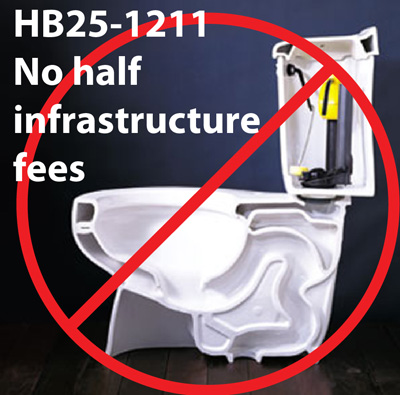
HB25-1211 is a deceptive bill concerning local government’s ability to set fees and it is passing the Colorado House on a party line vote. The most likely outcome of HB25-1211 is a profusion of concrete jungle developments with increased water usage and decreased ability for water districts to pay for costly infrastructure. But what IS NOT written in this bill is even worse because the bill contradicts existing law that is currently in litigation. HB25-1211 is using legislation to go beyond 100 years of case law to side AGAINST local governments in pending and future litigation. At first read, the bill’s title and language read as if the main point is to conserve water by tying lower infrastructure fees to conservation measures. This is deceptive and misleading. Infrastructure has certain fixed costs no matter how much you use it. To make this relatable, think about the appliances in your homes as your water infrastructure. It doesn’t matter if you promise to only use the dishwasher once a week or flush the toilet once a day. You still have to buy the whole appliance to make it work. You can’t buy half the appliance because you promise not to use it often. But that’s exactly the argument HB25-1211 makes. It asks water districts to let people pay less for their infrastructure because they promise to use it less. No matter how you count it, 100 high-density apartments will use A LOT more water than a couple houses, even with yards. No water conservation is happening, none, only water and cost shifting. However, the false talking point about water conservation is just a smokescreen for a larger agenda. The proposed bill stipulates that water districts have “a duty to serve”. The bare bones “duty to serve” provision, HB25-1211 contradicts the district’s ability to make decisions for the good of the whole district based on the current provisions like feasibility (see below). “In addition, if the board finds it infeasible, impracticable, or undesirable for the good of the entire district to extend water or sewer lines and facilities to any part of such district, the board may designate by resolution such area not to be served with water or sanitation service, but such area designated not to be served shall be at least ten acres in extent.” C.R.S. 32-1-1006 (1)(b) Bill sponsors like Representative Rebekah Stewart refused to make the bill conform with current law by accepting amendments to read “a duty to serve INSIDE YOUR DISTRICT”. Without those important distinguished words, “INSIDE YOUR DISTRICT”, special districts could be forced to serve people and developments outside their boundaries, which is not currently true. As a former member of Lakewood City Council, Rep. Stewart has been sponsoring this bill because of one case in Lakewood that she disagrees with. By attempting to change state law on these litigation matters, Rep. Stewart appears to be making a tacit admission that the case she’s familiar with was legally upholding service plan boundaries. This “duty to serve” provision has got districts so upset that one anonymous district said they can’t fight it because even talking through the possibilities may inspire new ideas to compel service that could bankrupt their district. So far, HB25-1211 is mostly a party-line issue.  Exceptions like Rep. Tammy Story (D) offered amendments to strip the duty to serve provision. Most Democrats, the party for the environment and sustainability, are supporting this bill that will turn suburban oases into concrete jungles. They have not realized that this bill encourages taking water out of the environment and putting it into high-density apartment infrastructure which will increase the heat profile and decrease the tree canopy. The bill sponsors have also sold this false argument to conservation groups like Conservation Colorado and Western Resource Advocates. It’s unclear whether these groups and other legislators realize that water pricing generally increases with volume used, which is where the real conservation comes from. There are other problems with the bill. Such as the focus on small government special districts instead of the largest water providers which are municipalities, private and public companies. It gives special privileges to developer metro districts. And it shifts costs from one user to another rather than promoting equality. The sponsors only have a few local examples that they based the bill on and all of them are based on significant false facts. From beginning to end, this bill is deceptive and disruptive to the ability of water districts to provide the infrastructure people need in their daily lives. Disclosure: The author is a Director of the Green Mountain Water and Sanitation District and while the district officially opposes HB25-1211, all opinions expressed are my own.

Scroll to top