Lakewood Informer

Resident generated news about Lakewood, Colorado

Lakewood Informer

Resident generated news about Lakewood, Colorado

Author : Lakewood News from Karen

National organization to honor Lakewood police officer

From the National Association of School Resource Officers (NASRO) The National Association of School Resource Officers (NASRO) announced that it will present a regional Exceptional Service Award to Officer Scott Gillespie, a school resource officer (SRO) with the Castle Rock Police Department and its 2025 SRO Social Award to Det. Jason Ezell, an SRO with the Lakewood Police Department. NASRO will present these awards and others on Monday, July 7, during a ceremony as part of its annual National School Safety Conference in Grapevine Texas, in the Dallas-Fort Worth metro area. The Exceptional Service Award recognizes one recipient in each of NASRO’s 10 regions who demonstrates continuous and sustained service to the school community above and beyond that normally expected of an SRO. Gillespie will receive the award for a region that includes Colorado, Idaho, Montana, Utah and Wyoming. The SRO Social Award recognizes an SRO for effectively utilizing social media to promote the SRO position, school, and agency. During the July awards ceremony, NASRO will also present several other awards, including its Floyd Ledbetter National School Resource Officer of the Year Award. About the NASRO National School Safety Conference NASRO’s 35th annual National School Safety Conference takes place July 6 through July 11 at the Gaylord Texan Convention Center, Grapevine, Texas. The conference provides opportunities for attendees to learn best practices for SRO and other school safety programs. It also provides networking opportunities to SROs and other law enforcement officers, as well as school security and safety officials, school board members, administrators and anyone interested in school safety.  About NASRO NASRO is a nonprofit organization for school-based law enforcement officers, school administrators, and school security and safety professionals working as partners to protect students, school faculty and staff, and the schools they serve. NASRO is headquartered in Hoover, Alabama, and was established in 1991. For more information, visit www.nasro.org.

The Illusion of Debate: How Lakewood’s City Council Rubber-Stamps Policy

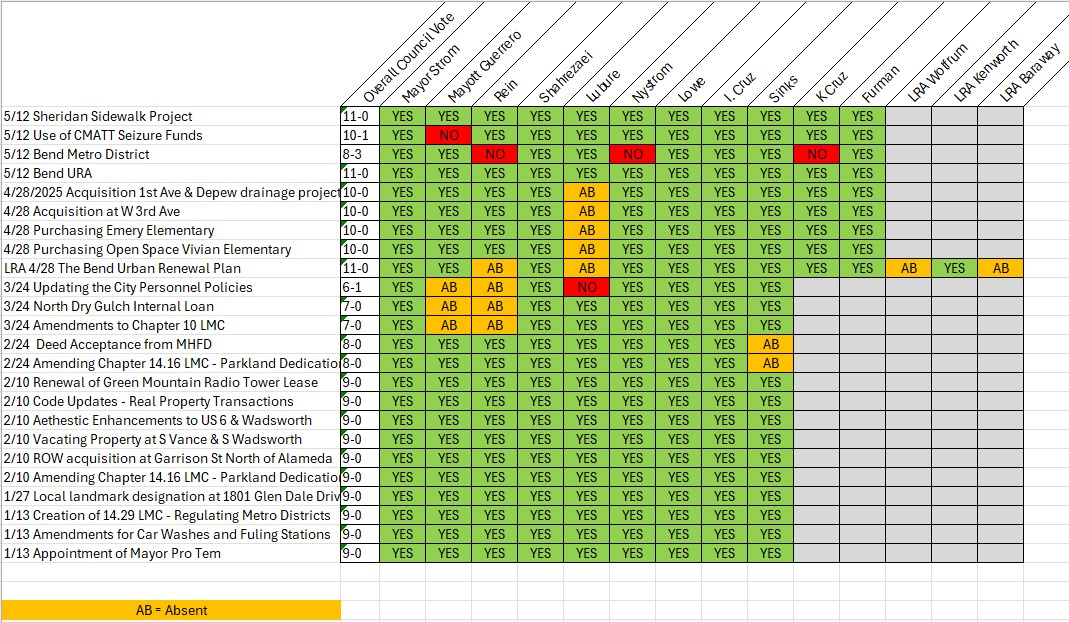
By Karen Gordey As you may or may not have heard, Kairoi—the Texas developer behind the 777 S Yarrow Street project—cut down more than 60 mature trees on May 12th. The community response was swift and emotional. That evening, a large group from the Save Belmar Park movement filled the back of Lakewood City Council chambers and voiced their outrage during public comment. Many echoed the same call: every sitting councilor—save perhaps one—needs to be voted out. The next day, I drove to Belmar Park to see the damage for myself. As I pulled up, I noticed two current council members chatting nearby. I spoke with one of them off the record for about 25 minutes. When I said, “Isn’t this what you voted for?” the councilor quickly replied, “No, I didn’t vote for this.” Skeptical, I went home and reviewed voting records for the past two years. And they were right—technically. The 777 S Yarrow project didn’t come before City Council. It went through the Planning Commission and the City’s Planning Department. But that wasn’t the end of the story. When I tried to dig deeper, it became clear how inaccessible the City’s meeting records really are. Minutes from meetings are supposed to be approved during the Consent Agenda at every regular council meeting. But finding the actual minutes? Nearly impossible. For instance, during the May 12, 2025 meeting, Council approved minutes from March 24, April 14, and May 5—but none were linked or attached. On February 24, they approved minutes from December 9, 2024. Again, no actual documents. You can technically find every ordinance and resolution passed by council here: https://www.lakewood.org/Government/Departments/City-Clerks-Office/City-Council-Ordinances-Resolutions. But it’s a list, making it difficult for residents to hold individual councilors accountable. The Consent Agenda, meant for quick approvals of non-controversial items like meeting minutes, ordinances on first reading, or ceremonial resolutions, is often a catch-all for measures that go unscrutinized. Councilors can ask to remove items for discussion—and did so multiple times in 2024. But here’s something you may not know: residents can request that items be removed too. Once passed, the items removed from the consent agenda are discussed and voted on, then the rest of the agenda is addressed in order., And while the Consent Agenda script claims that first-reading ordinances are published in the Denver Post—none have appeared in the last two years. Don’t take my word for it. You can search the Denver Post’s legal notices here: https://marketplace.denverpost.com/marketplace-denver/category/Miscellaneous/Legal%20Notices and on the state’s required public notice database: https://colorado.column.us/search/ (which is moving to: https://www.publicnoticecolorado.com). So how did your councilor vote? Here’s a breakdown of every vote not passed via the Consent Agenda Here’s what I found: Also included in that spreadsheet is a tab for study sessions and workshops. These are arguably more important than council meetings themselves. That’s where councilors hear presentations on major issues—always from city staff or invited parties that support the city’s position. No opposing views. No residents. By the time a topic comes up for public hearing (on second reading), the council has already made up its mind. Is it any wonder residents feel ignored and angry? Let’s talk transparency. The Budget & Audit Committee—tasked with overseeing your tax dollars—hasn’t met once in 2025. Back in January, Ward 5 councilors proposed expanding the committee to represent all five wards. That proposal was shot down. Only three wards are represented. Two wards remain unheard. And all this under a City Manager pulling in over $400,000 a year. When government struggles with the basics—recordkeeping, transparency, fair representation—it often fails on the big things too. Isn’t it time for a better way? If you’re tired of a council that listens to developers more than residents, tired of unanimous votes that ignore dissent, and tired of a system where transparency feels like an afterthought—then do something. Start asking questions. Email your councilor. Demand meeting minutes be posted, ordinances be published, and your ward be represented. Government works best when it’s held accountable. And in Lakewood, it’s time we started holding ours to a higher standard.

Lakewood is Laughing At Us

The May 7th Planning Commission meeting was a travesty of a public hearing. Lakewood cared enough to give residents an outlet for their grievances. No one cared enough to enact a single change. And sometimes they outright laughed at us. Watch the video below from the end of public comment, starting at min 2:58:25. One resident got up and publicly read an article from the Lakewood Informer. Watch the city staffer seated in the background unsuccessfully hiding her laughter during this reading. All of which was proved to be true. All of which city staff ignored and the entire Planning Commission dismissed — just like so many other valid resident points. The meeting started with Lakewood Chief of Sustainability and Community Developer Travis Parker explaining that he didn’t think this meeting wouldn’t change anything. He said that there were “pretty significant misunderstandings” of what staff could do. He said that “attacks on staff for being, you know, incompetent or malfeasant or acting in bad faith, demonstrate a fundamental misunderstanding of the good and hard work that’s done by people that are experts.” No one doubts city staff work hard. They all deserve thanks. But we also can’t assume they are always right and the residents are wrong about everything. We can’t assume that there is no other way to evaluate base assumptions. But that’s exactly what the Planning Commission decided to do. Ironically, one of the main points of the Belmar Park battle was about cutting down all the trees that could have formed an expanded buffer. Mr Parker himself has been educating residents on new zoning codes from Lakewood that will not increase the setbacks to what they were pre-2012, but will now require RESIDENTS to get a permit to cut down their trees. So the meeting was a pretty show that started and ended with all the well-researched points the residents brought forward being dismissed. Sadly, the best thing to be said is that being dismissed was more respectful than being laughed at. Required Grading Permit – Evidence not reported by city staff The permit pictured above is from Lakewood’s eTRAKit system, showing the grading permit that was applied for and received within one day of the complaint, just as reported by Steve at savebelmarpark.com The permit below is for demolition, which was applied for a month earlier. No malicious intent was implied and the problem was quickly corrected. Thanks to residents who apparently know less than city staff. Grading permit requirements below Actual permit that must be displayed before construction:

UPDATE: Disappointing but Not Surprising – We Need Your Help Now More Than Ever!

From Save Belmar Park, Inc., – a Colorado non-profit What happened at the May 7th Lakewood Planning Commission hearing was deeply disappointing—though sadly, not unexpected. After several speakers delivered well-researched, thoughtful, and heartfelt presentations, the audience erupted in applause. The public’s support for protecting Belmar Park was undeniable. So how does a small group of City officials override the will of the residents? Despite an overwhelming outpouring of public opposition—including emails, social media comments, and a nearly 10-to-1 ratio of anti-this-development comments on Lakewood Speaks—the Commission still voted 5–0 in favor of the 411-unit Kairoi apartment building. And they did so even after being presented with a powerful, evidence-based case showing that the proposed development directly contradicts Lakewood’s own zoning code, comprehensive plan, and parks master plan. This vote was a slap in the face to the community. It disregarded common sense, environmental preservation, and the very planning documents the city is supposed to uphold. The proposed zero-lot-line, six-story building is incompatible with the surrounding two-story Belmar Commons townhomes, overwhelms local infrastructure, and threatens the ecological balance of Belmar Park. The city has rolled out the red carpet for billionaire developers—again—ignoring the public and prioritizing profit over people, parks, and trees. Dozens of mature, century-old trees will be clearcut. Wildlife will be displaced. Belmar Park’s peace and beauty will be irreversibly damaged (if we don’t stop them). But, we have NOT given up—and we’re not stopping now! Our next step is filing a lawsuit under a 106A appeal, which will go before a Jefferson County district court rather than more city insiders. We believe we still have a strong chance at a different outcome—despite the city’s push to bulldoze trees—because the proposed development blatantly contradicts Lakewood’s own zoning laws, comprehensive plan, and parks master plan, giving us solid legal ground to challenge it in court. This is our last real chance to stop this destructive project, and we’re counting on supporters like you to help us make it happen. Legal fees are significant, and this is a fight the community should not have to fund—but we must because the City of Lakewood refuses to listen. Please stand with us—again. If this park means something to you, dig deep—and give as generously as possible (then smile knowing you’re helping to save something irreplaceable). Every dollar helps us hold the line against this destructive plan. Then share our campaign and spread the word. We’re fighting for what’s right: environmental integrity, community character, and the future of Belmar Park. 👉 Donate now: https://www.gofundme.com/f/save-belmar-park Directors Save Belmar Park, Inc. 

The Bend: A Government Financing Trade Deal

Lakewood may be forcing a property owner to blight their own land in a backroom trade deal wherein staff pledged a positive vote from City Council for a metro district. The deal would give The Bend development city financing in exchange for metro district status. In January 2025, a representative for The Bend developer made the following public comment: “The city is actually only allowing a Metro District to be put in place if the URA (Urban Renewal Area) passes so that it is a vehicle for this infrastructure and tax increment financing. They actually would not pass our Metro District standalone. They’ve made that very clear.” – Allie Meister, Lincoln Properties, at Green Mountain Water Board Meeting, min 40:13. This deal illuminates why Lakewood is rushing through a URA and metro district public hearing on the same night. Staff presentations have repeatedly touted the advantages of doing both the URA and the metro district at the same time. They claim these are complementary structures. But they are not complementary. Rather, these are essentially overlapping structures that could finance the same set of infrastructures. Apparently, financing public infrastructure is a profit center. Overlapping financing is duplicative. Even worse, for The Bend, neither metro district nor URA is appropriate. The Bend is not a “serious and growing menace” to the public health, safety, morals, and welfare, which is the statutory reason for Urban Renewal. The Bend does not provide public services, which is necessary for a metro district. The metro district will only be used for financing. Therefore, the most appropriate government assistance, if any, would be a Business Improvement District (BID).  BIDs are the more accountable, less powerful, way to achieve development financing but no one is advocating for its use. Instead, developers prefer to form metro districts. This initially involves the developer loaning money to the new metro district.  Then the metro district issues a bond, with interest, to pay back the loan. Since the developer and the metro district are the same people (different legal entity), the developer has now gained itself government immunity, as well as millions of dollars of interest payments. In many cases, the interest payments never end – they only continue to grow. This outcome isn’t possible with a BID. (See Denver Post series “Metro Districts: Debt & Democracy” by David Migoya for more in-depth information on metro district abuses) Therefore, developers generally want that metro district as a profit center, rather than as a way to finance development, since they front the funds in either case. A URA is also meant to fund public infrastructure. Much of the public infrastructure was repeated under both the URA and metro district justification. Only one method is needed to finance infrastructure, and, as noted, the developer will provide the base funds in any event. As Karen Gordey reported in the Lakewood Informer, there was no required financial gap analysis completed to show that city funding was required. Therefore, with a metro district there is no need for a URA. This conclusion is also shared by a report from the Independence Institute. A URA has not required a metro district in the past. However, Lakewood can trade URA financing for affordable housing. Lakewood is not allowed to pay for housing directly. Lakewood is not even supposed to demand any percentage of affordable housing. There is no zoning or ordinance that requires it.  The irony is that Lakewood City Council itself sunset the Strategic Growth Initiative ordinance. Under that ordinance, this development would have fallen under the allocation review system wherein Lakewood could have asked for affordable housing to permit this many units in a TRANSPARENT process. Instead, the city is now working behind the scenes to make this same thing happen. So, through the URA, Lakewood will gain affordable housing, aka government housing or government-subsidized housing. Those units can be used to qualify for state grants for even more development in Lakewood. “Without the Urban Renewal plan, in our case, we wouldn’t be able to deliver kind of what they want to see or their vision for this piece of land which includes housing retail and affordable housing they you know both the state and the city and the county do have a desire to have a portion of the site have affordable housing in it.“ Allie Meister, Lincoln Properties, Jan 28 2025, min 35:57 Lakewood residents will pay for The Bend development by giving the developer financing. The new taxes from that development are diverted out of the general fund, which pays for Lakewood resident services like police, and instead will pay for The Bend development responsibilities like streets and pipes. The decision for an Urban Renewal Area is very separate from the decision to approve a metro district. The developer did not originally desire to be in an Urban Renewal Area and Lakewood may not approve a metro district as a standalone decision. But, operating together, the developer and city can trade financial incentives that residents throughout Lakewood will pay for.  The developer offers blight and gets metro district status and financing. The city offers URA financing to indirectly offset affordable housing units and gets a basis for more state grant funding. “Municipalities are using a tool (URA) meant only for serious threats to the public as a tool for gaining a competitive advantage in economic development. Which, essentially, is a way to financially reward development partners and a method to force the public into a future desired by government planners.” -From The Empty Promise and Untold Cost of Urban Renewal in Colorado Just like Lakewood’s deal to buy Emory Elementary, residents should know the full plan to leverage this deal for more high-density development using state grant funds from the affordable housing units. Without that knowledge, which has not been disclosed, neither the URA nor the metro district decision makes any sense. There will be a City Council vote on the metro district and URA on Monday, May 12 that is open to

Relevant facts withheld from Planning Commission regarding unpermitted demolition

From SaveBelmarPark.com Greetings Supporters of SaveBelmarPark.com, The 777 S Yarrow project was approved by Lakewood’s Planning Commission by a lockstep vote of 5-0 on May 7, 2025. Despite in-person and online expert testimony and informed and articulate personal testimony from hundreds of citizens who raised a wide range of serious issues and potential violations of the Zoning Ordinance that will never be addressed or mitigated by the current proposal, the commissioners still approved the proposal. If it is possible for a planning commission to be replaced by artificial intelligence software, this might be a good place to start a proof of concept.  Maybe even remote-controlled rubber stamps would suffice. At one point, ‘Mr.’ Buckley asked about the grading in the park.  As you may know, the city claims the park will not be touched.  That is a false claim.  As the city engineer admitted, it is necessary to grade park property so the developer does not have to build a retaining wall.  You are not supposed to build a retaining wall within 10 feet of the property line in Lakewood.  So it would not be feasible to require the developer to stay on their own property since they would have to modify their site plan to build a retaining wall with a proper setback. So Mr. Buckley asked what the grade change difference would be and was told only 2 feet. No big deal, right?  However, the developer’s site plan shows the floor of the building at 5,528.75 feet.  The park path adjacent to the graded area is at 5,518.  Guess what?  That is more than a 10 foot difference in elevation.  Not 2 feet.  The fire road is at 5,524 which is a 6 foot difference.  But none of that matters.  Because facts don’t seem to matter to the Planning Commission.  They can simply be ignored and replaced will false statements such as telling the public that the park won’t be touched.  Problem solved. This type of deceptive behavior is rooted in the history of land development.  Look at Stanford University.  When Leland and Jane Stanford passed away, they left 8,000 acres of land to the university with the provision it could never be sold. Yet visitors to Palo Alto, CA who visit the Stanford campus are amazed at all the development on that 8,000 acres that supposedly could never be sold.  How did developers and the university get around that seemingly ironclad restriction?  Enter the 99 year lease!  Stanford leases their land which has allowed all manner of development including residential, retail, you name it.  Just as if it had been sold.  Maybe Leland Stanford got railroaded on that! Similarly, May Bonfils did not envision the abuse and exploitation that would occur with her property at 777 S Yarrow Street after her passing. (And coincidentally, Planning Commissioner Overall is a Stanford grad.)   In a previous update, I mentioned the possibility the developer would bring attorneys or other advocates to put a positive spin on their proposal.  However, they did not make any attempt to put a positive spin on their project.  But to their credit, they also readily re-confirmed the project plans to provide only market priced rental units with no affordable units other than what the market will bear. Perhaps they already knew there was zero chance of not gaining approval from their supportive anti-science minions on the planning commission. Commissioners warmly welcomed the few supporters they obviously knew who showed up.  Yet addressed an accomplished PhD conservation biologist from Cornell and CSU who visited the site and the park and created an excellent presentation as ‘Mr’ Pardo. And after years of working on this project, who did the commission turn to for the ridiculously obvious question – how much does bird resistant glass cost?  Not the planning staff.  Not the developer.  Such an obvious question was apparently above their pay grade.  They expected Dr. Pardo to have done their homework for them.  He offered to follow-up on that. During the hearing, the commissioners asked specifically whether the demolition of 777 S Yarrow was properly permitted because various citizens were aware it was not and commented to that effect. They were assured by staff with Mr. Parker present that there were no problems with permitting and were not told that demolition began without being properly permitted. In fact, staffers denied that there were any issues with permitting.   I initially reported about the improper permitting and subsequently the Lakewood Informer carried that report and subsequently a portion of the Informer reprint was read back to the commissioners during the hearing.  They disparaged the report as something unreliable from a ‘blog’ and terminated the conversation. The city and Planning Commission should issue a public apology for that disparagement, inability to manage the permitting process and refusal to consider relevant facts on the matter brought to their attention by citizens during the hearing. Instead, they were not told a required grading permit (as shown above) was not issued until a citizen complained that it had not been issued. They were not told even the most minimal erosion control measures such as straw socks and tire shakers were not installed until after a citizen complained via a ticket in Lakewood’s user.govoutreach system. As per the image above, the very FIRST requirement specified by the developer’s own Kimley-Horn engineers is the grading permit which was never even requested until a citizen raised the issue. They were not told demolition continued for a period of time without any erosion control measures in place in contravention of Kimley-Horn recommendations and without a required grading permit as specified in the image above. This happened in early March.  It has been two months and the commissioners apparently were not aware of this breach. But they were at the ready to disparage accurate reports of it that were brought in to the public hearing. We predict no action will be taken regarding the unpermitted start of demolition, lack of even minimal erosion control measures and failure

Omega Psi Phi Fraternity to Host Annual Holmes Omega Scholarship Foundation Golf Tournament in Support of Local Students

From www.HOLMESOMEGA.ORG Denver, CO — April 29, 2025 — The Omega Psi Phi Fraternity, Inc. is proud to announce the return of its annual Holmes Omega Scholarship Foundation Golf Tournament, taking place on Friday, May 30, 2025, at the scenic Greg Mastriano Golf Courses at Hyland Hills Golf Club in Westminster, Colorado. This cherished event raises critical scholarship funds for high school students in the Denver area, continuing the Fraternity’s longstanding commitment to uplifting youth through education and opportunity. Since 1965, the scholarship foundation has provided more than $250K in scholarships to Denver, Aurora, and Lakewood, Colorado, metro-area students. This year, the Foundation is thrilled to partner with First Tee – Colorado, a nonprofit dedicated to introducing young people to the game of golf while also supporting their academic growth and personal development. The 2025 tournament will feature a 2-person Best Ball Scramble, open to golfers of all skill levels. Participants can expect a day filled with camaraderie, competition, and community impact. Registration is $300 per twosome or $150 per individual, which includes golf carts, practice balls, and a delicious lunch. “We invite the community to come out, play a round of golf, and support our mission to invest in the future of our young people,” said James Sykes, Jr., a representative of the Holmes Omega Scholarship Foundation. To register or learn more, visit https://bit.ly/2025OMEGAGOLF

Lakewood Navigation Center Closes for Renovations

The Navigation Center in Lakewood is closed for renovations to make it suitable for a permanent shelter. When this building was purchased, it was supposed to be a resource center that, if feasible and approved for permit, would be used as a shelter. That story changed immediately upon purchase and it started operating as an emergency shelter while facilities were tested and renovations evaluated. The scope of the renovations increased, the plumbing difficulties increased, and the need for a full-time shelter accelerated. Lakewood residents have not yet had a meeting to share public comment or approval on the shelter. Lakewood’s City Manager continues to operate the shelter on an “emergency” basis rather than go through the special use permit process. Lakewood assures residents that they will have time to be heard – later, when it’s irrelevant, because the building was purchased and the renovations will be complete. This is similar to the public comment planned for the purchase of Emory Elementary on behalf of the Action Center. Residents will be heard – later. The following article has a thorough update, including an update on MountainView Flats. That purchase was also funded with ARPA grants that are no longer expected to continue. Homeless navigation center in Colorado closes amid renovations, with goal of creating full-time shelter By Andrew Haubner at cbsnews.com RecoveryWorks in Lakewood has been a central gathering point for the area’s homeless population in need of resources. The navigation center, which sits on the corner of W Colfax Avenue and Allison Street, provides services such as behavioral health aid, medical help or just a hot meal. But, for the next six months, the center is closed as RecoveryWorks renovates the space.  The hope, executive director James Ginsburg says, is a 103-bed, full-time overnight shelter to help get people off the street and provide a more consistent and reliable resource to add in the transition from homelessness to housing.  RecoveryWorks is operating out of MountainView Flats, a transitionary or “bridge” housing community in Lakewood. Registered Nurse Shawn Marzan and his street medical team at STRIDE Community Health Center have set up shop in one of the rooms, planning their day and being a medical resource for those that live there.  “If [people are] in a centralized location where we know where they’re gonna be, you can provide them medical, you can provide them behavioral health,” Marzan told CBS Colorado. “You can provide not just the medical piece but the social piece too.” Read the rest of the article at cbsnews.com

Likely Defect Identified in Planning Commission Software

From savebelmarpark.com The 777 S Yarrow public hearing is very close on: May 7th at 7:00 PM at 480 S Alison Parkway, Lakewood, CO You may now enter public comments online at: https://lakewoodspeaks.org/meetings/869. You may have to click on item 3. Unfortunately, a likely defect in the Planning Commission’s online file upload process has been identified and was reported via a follow-up public comment.  However, that public comment was rejected by Lakewood for violating comment policy. It appears the comment was rejected out of an assumption that the Planning Commission software could not possibly be broken. The city clerk was also very helpful in providing examples of other comments with attachments that were publicly posted as proof that the upload process is not broken. Notably, NONE of the examples provided by the clerk included the .doc file extension. Therefore, because Lakewood was obviously not going to investigate a reported defect that could potentially have been suppressing public comment file attachments for a long time, perhaps years, I investigated. It turns out that the Planning Commission does NOT accept all of the file extensions specified on the file upload dialogue (which is shown in the image at the top of page). Once I converted the .doc file to a .pdf file, then the upload process was successful! If you upload a file with a supported  .doc file extension, for example, it appears to work properly. However, if your comment is approved for publication, the attachment is never displayed. This is a material error because members of the public may reasonably assume their upload was successful since no error message is ever produced at any point in time during this process.   Nor does the moderation process capture file upload errors and notify users.   Nor are members of the public ever advised that the software may be unreliable and may silently dispose of file uploads. Upon reviewing public comments just this morning, one person who supports approving the Kairoi project referenced his attached letter.  But no attached letter was displayed.  So his attachment may also have been lost by the software. Therefore, members of the public or any parties with a matter to be heard by a quasi-judicial panel could upload files for the official hearing record and discover after the hearing record is closed that their file uploads were rejected.  Then it is too late to re-submit their files. This problem is also complicated by a significant conflict of interest due to the fact that Mr. Parker, Lakewood’s executive in charge of making development recommendations to the Planning Commission and/or City Council, is also and incredibly an advisor on the executive team of the same software company that is at the crux of possibly suppressing public comment by silently rejecting documents intended for quasi-judicial hearings. We suggest the city is indifferent both to the public perception and the risks of this conflict of interest. We also suggest that as a result of enabling this conflict of interest, the city is also indifferent to the requirement for software quality control. Please consider that a quasi-judicial hearing is a legal proceeding.  What if the clerk of a court periodically discarded or lost documents delivered by litigants without telling anyone?  What do you think would happen to that court clerk if this malfeasance came to light after years of discarding court documents? We are not suggesting any Lakewood employees are disposing of these files.  The comparison is being made to the apparently inconsistent software vs what if an employee hypothetically did the same thing?  We doubt that an employee would get off so easily. But in Lakewood, the software does get off easily. And consequences can be significant if a court is not diligent regarding management of important technology used in processing court documents or evidence. Consider the Colorado Bureau of Investigation and the fiasco over their DNA tests.  It was recently revealed that hundreds of DNA tests were allegedly ‘manipulated’ over a 30-year time period and as a result material facts were omitted from official records even though no DNA matches were falsified.  The CBI Director stated: ““Our actions in rectifying this unprecedented breach of trust will be thorough and transparent.”   Will Lakewood be as forthcoming regarding ignored software defects that potentially corrupted public hearing records? Has this defect been suppressing relevant files for years?  It is possible.  Especially considering Lakewood does not seem responsive to any report that the software does not work properly.  Anyone who has previously reported a problem may have received a similar response that it was user error because other people can upload files – but of a different file type. Therefore, we strongly urge that Mr. Parker be required to recuse from any matter that may eventually involve the Planning Commission or City Council where the PeopleSpeak software is used to accept public comments for any quasi-judicial hearings or city council meetings. In the meantime, any past decisions made by the Planning Commission or City Council where online public comments were accepted from the public should be reviewed and new hearings potentially announced once the software is fixed. Stay tuned and thanks for listening, Steve

Scroll to top