Lakewood Informer

Resident generated news about Lakewood, Colorado

Lakewood Informer

Resident generated news about Lakewood, Colorado

Lakewood

No Permits For Kairoi Demolition?

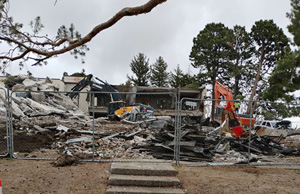
From savebelmarpark.com Update 3/19/25: Permits were straightened out (very quickly) and demolition on track Greetings Supporters of Save Belmar Park, This is an update on the attempted demolition of the Irongate Campus we told you about yesterday. The top image is 777 S Yarrow Street in Lakewood, CO after 24 hours of illegal demolition. We now know that Kairoi Residential had moved forward with the attempted illegal demolition without obtaining proper permits. Kairoi Residential attempted to illegally demolish the Irongate Office Campus at 777 S Yarrow Street. Local activists intervened and the city ultimately had to shut down the illegal project. So please consider this. If you happen to be in the construction business, obtaining permits is standard operating procedure.  At least for any business that intends to obey the law. Even if you want an electrician to install a circuit in a residence, you need a permit. The idea a company that has been involved in the construction industry in Colorado and other states for many years does not know how to properly permit the demolition phase of a project raises some questions. Especially considering that their own civil engineers at Kimley-Horn prepared a large document titled: “EROSION AND SEDIMENT CONTROL REPORT” that included great detail on the topic: “SEQUENCE OF CONSTRUCTION ACTIVITIES” The first listed responsibility in the Kimly-Horn document is: “The city does not authorize any work to be performed until the City Grading, Erosion, and Sediment Control Permit has been issued.” Did Kairoi bother to obtain a grading permit?  NO. Did they plan to intentionally proceed with this illegal major demolition project? Given these facts, it seems quite possible that their bad behavior was intentional. But it also could be that they are so incompetent, they really do not know what they are doing in the first place including not knowing about the permitting process? Because the Planning Department certainly seems that incompetent.  The Planning Department even proclaims today on their website that: “Demolition of the existing building has begun under a demolition permit issued by the city.” Obviously, either the City Of Lakewood has no clue about properly permitting a project or they conspired with the developer to intentionally approve an illegal demolition project. Which is it? And we live in a city that is more likely to arrest citizens for clapping at a city council meeting than they are to slap a fine on Kairoi. And a city where they city attorney tells city council they cannot discuss a proposed ordinance because they are only ‘administrative officers’ and are not even allowed to talk about it. Basically, a city with more clowns than the circus.  To be diplomatic about it. Why would any well-run city want such a rag tag developer doing anything within the city limits? Stay tuned and thanks for listening, Steve View original email here

Terumo Not Liable

The Colorado Sun reports that Terumo will not be held liable for cancer since the company always met federal regulations. From the Sun: “Terumo Blood and Cell Technologies of Lakewood was found not negligent Friday by a Jefferson County jury for alleged releases of toxic ethylene oxide into surrounding neighborhoods from its sterilization process, after four women sued the company for liability in their cancer cases.  The plaintiffs, part of a large group of negligence and liability cases against Terumo and other companies who use ethylene oxide, claimed the Lakewood plant should have done more to stop chemical emissions into neighborhoods. They sought damages in state district court over their extensive medical costs, as well as physical impairment and disfigurement. “ Read the full article..

People catching onto the “affordable housing” scam

A pair of articles in the Denver Post show that Colorado residents are catching onto the fact that “affordable housing” isn’t the universal panacea that is being promised. New housing is not affordable, unless it’s government-backed, while higher densities are killing the very reason that people enjoyed their city in the first place. Pro-development progressives in Boulder won’t solve the housing crisis “Building a lot more housing won’t reduce prices because there’s an unlimited supply of people nationwide who’ll pay whatever it takes to live here. Boulder is a unique blend of access to culture and nature in a small city. There are plenty of people who want to move here and have the means to do so.” This sentiment also applies to Lakewood, revealing the lie to all the promises that more housing will solve problems. Denser housing vs. the ’burbs “While Colorado lawmakers require upzoning and offer incentives in their push for denser housing concentrated at Regional Transportation District bus and train hubs, thousands of metro Denver residents like the Wellners are migrating to suburbs. They give multiple reasons for their moves: affordability, elbow room, quietness, safety and parks — things that transit-oriented development (TOD) often lacks.” Many people moved to Lakewood for exactly this reason – wanting elbow room and safety. But Lakewood aspires to become more like urban Denver, in the name of affordability. Meanwhile, there are plenty of people who will pay “whatever it takes to live here.” Lakewood is planning on changing the zoning code to increase density even more. The Planning Director is already out talking about the change. It was baked into the results of the latest comprehensive plan, whether residents wanted it or not. Those people who do not want increased densification have until the new code is adopted to object.

Out of Control Demolition has started at the Irongate Complex

From savebelmarpark.com Greetings Supporters of Save Belmar Park, The Kairoi Belmar project is moving forward with no active citizen objections.  Will this rogue demolition mess be a wake-up call? The top image is 777 S Yarrow Street in Lakewood, CO after 24 hours of demolition. The Demolition Permit was approved on March 12 by Lakewood so the city is fully aware of what is happening. However, the contractor has not installed any erosion control devices, silt fence, etc. as required by the Kimley-Horn specifications shown in the second image above. They began demolition on March 13 in violation of their own established Sequence Of Construction Activities as specified by Kimley-Horn engineers.   We assume this is OK with the city manager and city council because the city would have approved everything at the REQUIRED MEETING before demolition begins as stated on page 11 of the Erosion and Sediment Control Report : Read the full Savebelmarpark email from the source

No Workforce Housing for Lakewood

Another Lakewood misinformation campaign bites the dust. For years Lakewood has been pushing high-density growth in the name of “affordable housing”. They market this narrative to schoolteachers and civil servants. See Lakewood’s recent resolution using these exact words. However, a development presentation to the Lakewood Planning Commission introduced a new term that exposes the lie: Workforce housing Workforce Housing The consultant Lakewood hired to evaluate blight and Lakewood’s Comprehensive Plan pointed out that there was NO PLAN for increasing workforce housing in Lakewood. The emphasis on “affordable housing”, despite what Lakewood says, is different from workforce housing. No matter how poorly teachers and civil servants get paid, they get paid more than anyone living on the streets. Affordable housing in Lakewood will mean a government-run program, similar to what used to be called Section 8. That is not the same as an answer to inflated housing prices for low- to median-income levels. Think about government-run affordable housing like a scholarship system for school. A person may need the financial assistance, and may not be able to go to college without it, but there are others who need it more and not enough to go around. For decades, the people most in need are those with extremely low income. Not low. Not middle-low. Not teachers and civil servants. Extremely low income. Ann Ricker, of Ricker Cunningham, is Lakewood’s blight consultant. She pointed out there was a gap in the Comprehensive Plan. She said the plan talked about affordable housing, and it talked about single-family housing, but she said there was the missing middle. She suggested removing “single-family” and just using the term “housing”. Using the general term “housing” would allow more high-density, market rate apartments to be built in an effort to flood the market and lower prices. Lakewood is already proceeding with this plan. There is no guarantee the low-priced condos or townhomes will be built anywhere. The term “workforce housing” is a more accurate description of how the public perceives the promises from Lakewood. This was an important acknowledgment that “workforce housing” is different than “affordable housing”. The public should be aware of the word games going on, similar to “illegal alien” versus “migrant”. Watch Ann Ricker discuss the Comprehensive Plan here: From Frank Lehnerz, Free State Colorado “If the government tries to wage war against the laws of the market by price control, it undermines the working of the market mechanism and leads to conditions which, from the point of view of the government itself, are less desirable than the previous state of affairs it intended to alter.” — Ludwig Von Mises, Human Action (1949) History has repeatedly shown that price controls—whether on food, housing, or other essentials—create virtually no consumer benefits and only price distortions. By capping what producers or retailers can charge, these controls reduce supply, reduce product or service quality, discourage investment for new, improved, or cheaper products and services, and create market signal distortions.

Lakewood Demands Fee for Impossible Sustainability Goals

Lakewood requires such high sustainability standards that they are almost impossible for large developments to meet. The standards are meant to eliminate greenhouse gas emissions.  For those developments, Lakewood accepts a fee in lieu of sustainability amenities. Lakewood is currently arguing that parkland dedication is illegal or amoral because it asks too much from developers. But Lakewood makes the same sort of demands to further its sustainability agenda. In both cases, the desire is to have development offset the environmental cost of development. The question is at what point is there so much development that the city says money is an acceptable substitute for direct environmental offsets. Note that these city mandates will continue despite any possible changes to federal funding for climate change initiatives. Achievable Goals or Ideology Lowering emissions is expensive so most people have not done it or have only done it by using rebates and subsidies. Achieving net zero emissions is even more expensive and is sometimes not achievable. For example, the city of Lakewood admits its new maintenance facility will not meet LEED standards let alone be net zero. Lakewood has set its own standards and requires that new buildings meet those standards by earning sustainability points. “net zero standards require reducing emissions to more than 90% and then only offsetting [with purchased carbon credits] the remaining 10% or less to fall in line with 1.5 °C targets.” –Wikipedia For large developments, the city admits it is almost impossible to achieve enough points. Therefore, developers are forced to pay a fee so that Lakewood can fund other sustainability projects. This is similar to other carbon credit purchasing schemes but in this case, it is authorized, administered, and required by Lakewood.  There is currently no discussion that Lakewood will require credits or fees from existing residents. Lakewood City Council was scheduled to discuss new ways to generate revenue, as well as how to spend the revenue generated from existing fees, at the February planning retreat. The planning retreat has historically been an in-person only meeting where staff takes direction from Council on items that do not require an official vote. No recording is available online for review. “For some [developments] that the [sustainability] targets are just too high to meet, they pitch in so that the city can spend that money to further achieve our goals.” Travis Parker, Director of Sustainability and Community Development during staff sustainability update (min 1:17:52). Increasing UNAFFORDABLE Housing Since 2019 Lakewood has demanded buildings meet climate sustainability goals. This was estimated to add 2-3% to building costs but actual costs have not been collected or analyzed. Building costs are passed on to the consumer, which makes Lakewood even more expensive to live and work in than in the surrounding areas. The additional sustainability measures will add 1-10% to building costs for things like EV charging stations. Would you like all new apartments to have a few charging stations at an increased overall cost for everyone or would you like some buildings to not have those amenities at a lower cost? Lakewood’s demands have resulted in a reduction in emissions to meet a target of 20% less than 2007 levels. With the new demands of 2022, some large construction projects cannot meet Lakewood’s demands, resulting in the project paying a fee to Lakewood that will be used for other climate goals. Lakewood city staff acknowledged that it was almost impossible for large projects to meet demands, making the fee-in-lieu necessary. Money Making Machine Lakewood has already generated $221,000 from various sustainability fees. They anticipate generating over $250,000 per year on these fees. Lakewood made over $600,000 on the statewide plastic bag mandate. One could say Lakewood is getting into the business of selling emission offsets. For more information on what Lakewood’s sustainability measures have achieved so far, watch the full video update at https://www.youtube.com/watch?v=IYbpkr1Gm24&t=150s Consequences The extra expense of building in Lakewood limits the possibility of new businesses coming into Lakewood. Even sustainability businesses, whose goals align with Lakewood’s, find it difficult to make a profit when required to meet high sustainability standards.  Councilor Rein specifically remarked that he would like Lakewood to attract new businesses that would develop sustainability technologies.  At the same time, businesses nationwide are rethinking their sustainability goals amidst high demands such as Lakewood’s. The enhanced development fee was first approved in 2019. Now the city is asking for more and some projects are not even possible to achieve what Lakewood wants. All projects must meet a base emission efficiency level. After meeting that base level, projects are eligible to pay a fee because even Lakewood staff admit it is not possible to achieve what they are asking for. “Fee-in-lieu is for those super large projects that have really large point totals that may not even be able to find enough points in the [standards] list to meet their point total, they still have to achieve at least 50 [base level efficiency] and they can achieve the rest as well or they can pay a fee in lieu for some of those higher points.” – Travis Parker, sustainability update (min 1:34), emphasis added What do the fees go towards? They could go towards every basic city service besides police. Per Councilor Sophia Mayott-Guerrero, these fees could be used for sidewalks, bike lanes, lighting, park maintenance, road maintenance, climate impact and water impact. Councilors asked about tree preservation and housing. Public art was part of the original goal. Tree canopy health. Food access. Household wages. Even subscriptions to city communications and trips to the rec center count towards “sustainability goals”. Other people have to fight to earn business advantages like that. The dates below are from the staff presentation, detailing future meetings where Lakewood will be implementing more robust sustainability measures for Lakewood.

Equal Representation on Budget Board Denied

City Council Members Jacob Labure and Paula Nystrom asked for equal representation on the Budget and Audit Board, January 27, 2025. They were denied. Only three wards will be represented on the Board. The Budget and Audit Board is vitally important for accountability. Many policies and programs that staff originate are never disclosed to the public. They only show up in funding requests. And as evidenced by the 2024 vote to de-TABOR, city staff is not often turned down. Councilor LaBure was involved in the last rewrite of the Budget Board. LaBure fought hard to get each ward representation on the Board, saying it was common practice to not only have five Councilors on the Board but to allow any Council Member to come and make comments. Now the current Board doesn’t even allow comments. Councilors Shahrezaei and Mayott-Guerrero both said that allowing that many Councilors, as worked for years, would now be unmanageable. Shahrezaei pointed out that at one point, a single councilor made 37 questions to staff and that amount of work was too hard. There is no general rule for how many questions the paid city staff should answer as part of being publicly accountable for a multi-million-dollar budget. In 2024, when Mayor Strom downsized committee sizes, then-Councilor Rich Olver was upset to be removed. Strom explained that she thought she was doing him a favor because he often didn’t have time. Olver was not present at the meeting for the initial appointments to protest. But his argument resonated with Councilor Dave Rein who supported increasing representation. Councilor Low also supported the proposal saying, “Budget is one of the most important things we do. Ward 3 should have representation.” 2025 Council Members on the Budget Board are: Scorecard: Allow Equal Representation Strom: Nay Shahrezaei: Nay Sinks: Nay Mayott-Guerrero: Nay Cruz: Nay Low: Aye Rein: Aye LaBure: Aye Nystrom: Aye

Fire in Lakewood Raises Policy Concerns

As reported by CBS News, a fire in an abandoned gas station on February 3 endangered 20-30 homeless people who were using the building as a shelter. The situation underscores the need to re-examine several ongoing strategies, such as: Which of these policies were effective in de-escalating the ongoing safety situation? From CBS News, by Karen Morfitt Fire in vacant Colorado gas station doubling as shelter for unhoused highlights concerns of neighbors At around 10 p.m. on Monday night a fire tore through a vacant Colorado building that was once used as a gas station. The building at the corner of Alameda Avenue and Harlan Street in Lakewood was being used as a shelter. A resident of the apartment building next door captured video of flames shooting out of the building’s windows. “Thank God the response was quick,” Victor Garibay said. Garibay didn’t take the video, but he lives in the same apartment building. He and his neighbors raised concerns about people coming and going from the building several times. “A lot of people have gone to the police have gone to the fire department and told them about the issues here — people coming in and out. The drug use, of course. The police have come, the fire department has come but they never seem to really be able to do anything about it,” he said. Read article from CBS…

Lakewood residents push to intervene in Belmar Park lawsuit

From the Jeffco Transcript, by Suzie Glassman, February 5, 2025 The fight over a controversial proposed apartment complex near Belmar Park is escalating as frustrated residents have reached out to the city council, and parkland advocate Cathy Kentner has moved to formally intervene in a lawsuit filed by developers against the city last December.  Members of Save Belmar Park, a citizen-led group advocating for the preservation of open space, argue the City of Lakewood has failed to defend a citizen-led ordinance the council adopted after the group submitted the required number of signatures, leaving residents in opposition to the move no choice but to step in. The lawsuit began when Kairoi Residential, developers of a planned 412-unit luxury apartment building at Belmar Park, sued the city, claiming the 2024 ordinance, which prevents developers from paying fees instead of dedicating land for parks, violates state law.  On Jan. 14, a Jefferson County judge granted Kairoi a preliminary injunction, allowing the apartment project to proceed while the case progresses. Lakewood didn’t oppose Kairoi’s request for the injunction, leading some residents to believe this inaction signaled to the court that the ordinance had little legal standing.  Read more including the backlash over Lakewood’s legal strategy

Scroll to top