Lakewood Informer

Resident generated news about Lakewood, Colorado

Lakewood Informer

Resident generated news about Lakewood, Colorado

Lakewood

National organization to honor Lakewood police officer

From the National Association of School Resource Officers (NASRO) The National Association of School Resource Officers (NASRO) announced that it will present a regional Exceptional Service Award to Officer Scott Gillespie, a school resource officer (SRO) with the Castle Rock Police Department and its 2025 SRO Social Award to Det. Jason Ezell, an SRO with the Lakewood Police Department. NASRO will present these awards and others on Monday, July 7, during a ceremony as part of its annual National School Safety Conference in Grapevine Texas, in the Dallas-Fort Worth metro area. The Exceptional Service Award recognizes one recipient in each of NASRO’s 10 regions who demonstrates continuous and sustained service to the school community above and beyond that normally expected of an SRO. Gillespie will receive the award for a region that includes Colorado, Idaho, Montana, Utah and Wyoming. The SRO Social Award recognizes an SRO for effectively utilizing social media to promote the SRO position, school, and agency. During the July awards ceremony, NASRO will also present several other awards, including its Floyd Ledbetter National School Resource Officer of the Year Award. About the NASRO National School Safety Conference NASRO’s 35th annual National School Safety Conference takes place July 6 through July 11 at the Gaylord Texan Convention Center, Grapevine, Texas. The conference provides opportunities for attendees to learn best practices for SRO and other school safety programs. It also provides networking opportunities to SROs and other law enforcement officers, as well as school security and safety officials, school board members, administrators and anyone interested in school safety.  About NASRO NASRO is a nonprofit organization for school-based law enforcement officers, school administrators, and school security and safety professionals working as partners to protect students, school faculty and staff, and the schools they serve. NASRO is headquartered in Hoover, Alabama, and was established in 1991. For more information, visit www.nasro.org.

The Bend: A Government Financing Trade Deal

Lakewood may be forcing a property owner to blight their own land in a backroom trade deal wherein staff pledged a positive vote from City Council for a metro district. The deal would give The Bend development city financing in exchange for metro district status. In January 2025, a representative for The Bend developer made the following public comment: “The city is actually only allowing a Metro District to be put in place if the URA (Urban Renewal Area) passes so that it is a vehicle for this infrastructure and tax increment financing. They actually would not pass our Metro District standalone. They’ve made that very clear.” – Allie Meister, Lincoln Properties, at Green Mountain Water Board Meeting, min 40:13. This deal illuminates why Lakewood is rushing through a URA and metro district public hearing on the same night. Staff presentations have repeatedly touted the advantages of doing both the URA and the metro district at the same time. They claim these are complementary structures. But they are not complementary. Rather, these are essentially overlapping structures that could finance the same set of infrastructures. Apparently, financing public infrastructure is a profit center. Overlapping financing is duplicative. Even worse, for The Bend, neither metro district nor URA is appropriate. The Bend is not a “serious and growing menace” to the public health, safety, morals, and welfare, which is the statutory reason for Urban Renewal. The Bend does not provide public services, which is necessary for a metro district. The metro district will only be used for financing. Therefore, the most appropriate government assistance, if any, would be a Business Improvement District (BID).  BIDs are the more accountable, less powerful, way to achieve development financing but no one is advocating for its use. Instead, developers prefer to form metro districts. This initially involves the developer loaning money to the new metro district.  Then the metro district issues a bond, with interest, to pay back the loan. Since the developer and the metro district are the same people (different legal entity), the developer has now gained itself government immunity, as well as millions of dollars of interest payments. In many cases, the interest payments never end – they only continue to grow. This outcome isn’t possible with a BID. (See Denver Post series “Metro Districts: Debt & Democracy” by David Migoya for more in-depth information on metro district abuses) Therefore, developers generally want that metro district as a profit center, rather than as a way to finance development, since they front the funds in either case. A URA is also meant to fund public infrastructure. Much of the public infrastructure was repeated under both the URA and metro district justification. Only one method is needed to finance infrastructure, and, as noted, the developer will provide the base funds in any event. As Karen Gordey reported in the Lakewood Informer, there was no required financial gap analysis completed to show that city funding was required. Therefore, with a metro district there is no need for a URA. This conclusion is also shared by a report from the Independence Institute. A URA has not required a metro district in the past. However, Lakewood can trade URA financing for affordable housing. Lakewood is not allowed to pay for housing directly. Lakewood is not even supposed to demand any percentage of affordable housing. There is no zoning or ordinance that requires it.  The irony is that Lakewood City Council itself sunset the Strategic Growth Initiative ordinance. Under that ordinance, this development would have fallen under the allocation review system wherein Lakewood could have asked for affordable housing to permit this many units in a TRANSPARENT process. Instead, the city is now working behind the scenes to make this same thing happen. So, through the URA, Lakewood will gain affordable housing, aka government housing or government-subsidized housing. Those units can be used to qualify for state grants for even more development in Lakewood. “Without the Urban Renewal plan, in our case, we wouldn’t be able to deliver kind of what they want to see or their vision for this piece of land which includes housing retail and affordable housing they you know both the state and the city and the county do have a desire to have a portion of the site have affordable housing in it.“ Allie Meister, Lincoln Properties, Jan 28 2025, min 35:57 Lakewood residents will pay for The Bend development by giving the developer financing. The new taxes from that development are diverted out of the general fund, which pays for Lakewood resident services like police, and instead will pay for The Bend development responsibilities like streets and pipes. The decision for an Urban Renewal Area is very separate from the decision to approve a metro district. The developer did not originally desire to be in an Urban Renewal Area and Lakewood may not approve a metro district as a standalone decision. But, operating together, the developer and city can trade financial incentives that residents throughout Lakewood will pay for.  The developer offers blight and gets metro district status and financing. The city offers URA financing to indirectly offset affordable housing units and gets a basis for more state grant funding. “Municipalities are using a tool (URA) meant only for serious threats to the public as a tool for gaining a competitive advantage in economic development. Which, essentially, is a way to financially reward development partners and a method to force the public into a future desired by government planners.” -From The Empty Promise and Untold Cost of Urban Renewal in Colorado Just like Lakewood’s deal to buy Emory Elementary, residents should know the full plan to leverage this deal for more high-density development using state grant funds from the affordable housing units. Without that knowledge, which has not been disclosed, neither the URA nor the metro district decision makes any sense. There will be a City Council vote on the metro district and URA on Monday, May 12 that is open to

Lakewood Navigation Center Closes for Renovations

The Navigation Center in Lakewood is closed for renovations to make it suitable for a permanent shelter. When this building was purchased, it was supposed to be a resource center that, if feasible and approved for permit, would be used as a shelter. That story changed immediately upon purchase and it started operating as an emergency shelter while facilities were tested and renovations evaluated. The scope of the renovations increased, the plumbing difficulties increased, and the need for a full-time shelter accelerated. Lakewood residents have not yet had a meeting to share public comment or approval on the shelter. Lakewood’s City Manager continues to operate the shelter on an “emergency” basis rather than go through the special use permit process. Lakewood assures residents that they will have time to be heard – later, when it’s irrelevant, because the building was purchased and the renovations will be complete. This is similar to the public comment planned for the purchase of Emory Elementary on behalf of the Action Center. Residents will be heard – later. The following article has a thorough update, including an update on MountainView Flats. That purchase was also funded with ARPA grants that are no longer expected to continue. Homeless navigation center in Colorado closes amid renovations, with goal of creating full-time shelter By Andrew Haubner at cbsnews.com RecoveryWorks in Lakewood has been a central gathering point for the area’s homeless population in need of resources. The navigation center, which sits on the corner of W Colfax Avenue and Allison Street, provides services such as behavioral health aid, medical help or just a hot meal. But, for the next six months, the center is closed as RecoveryWorks renovates the space.  The hope, executive director James Ginsburg says, is a 103-bed, full-time overnight shelter to help get people off the street and provide a more consistent and reliable resource to add in the transition from homelessness to housing.  RecoveryWorks is operating out of MountainView Flats, a transitionary or “bridge” housing community in Lakewood. Registered Nurse Shawn Marzan and his street medical team at STRIDE Community Health Center have set up shop in one of the rooms, planning their day and being a medical resource for those that live there.  “If [people are] in a centralized location where we know where they’re gonna be, you can provide them medical, you can provide them behavioral health,” Marzan told CBS Colorado. “You can provide not just the medical piece but the social piece too.” Read the rest of the article at cbsnews.com

Rezoning affects Milestone Property

By Russha Knauer, Cross-post with permission from nextdoor.com, The upcoming Rezoning Ordinance meeting is being held on Wednesday evening at 7pm at 480 S Allison Pkwy. This meeting will cover several rezoning issues. If you live in the area of Kipling and Alameda or Alameda and Garrison, this meeting will be especially important for you to submit public comments or attend and make your voices heard. Find information about the meeting and how to submit public comment here: https://lakewoodspeaks.org/items/4256. Specifically, the zoning ordinance updates will allow for the land along Alameda and Kipling informally known as the Milestone Property to be rezoned to allow for high-density, mixed use urban development. That means that high-rise, high-density development up to 96′ can be developed. This will go against the current zoning and surrounding development of the area. There are several things that are important to know about this rezoning proposal. First, the rezoning proposal was included in the non-residential zoning map, so many people are unaware that this could happen and how it could directly affect them. Second, this is one of two properties slated for rezoning in this manner; the second is already developed and the rezoning ensures the current development is allowable within zoning regulations. Third, the city stated that the Milestone property is one of 10 “difficult to develop within current zoning regulations” pieces of property. To be clear, this land is currently zoned to be developed as single family homes with mixed commercial use on the corner of Alameda and Kipling. However, the developers have fought the neighborhood for two decades to rezone the property to allow for high-density development. The only thing difficult about developing this land is the developers, not the zoning. Fourth, the city planning department recently told the Planning Commission in a meeting on 4/9 that the implementation of “Envision 2040” is the “city’s”, meaning there is no duty for the City to engage neighborhoods when development or re-development is proposed. Further, the city’s planning department stated in a presentation on 4/18 that going forward, developers will be the ones who have the option to engage neighborhoods when development is proposed, further abdicating the City of their role in engaging neighborhoods. Finally, the City has made this information difficult to understand and find when it comes to identifying nuanced information and how it will affect specific areas and neighborhoods. Please come and make your voices heard! Make sure the City knows that developers should not be valued more than tax-paying residents; that the City has a duty to engage neighborhoods when development is proposed; and that rezoning should not be allowable in plans that are difficult to understand and provide no clear forewarning to affected areas.

Swarm Season for Bees – Protect Them

The president of a local beekeepers club reminds us all that it is swarm season for honeybees. From the Colorado Beekeepers Association: “Bees swarm in the spring. In Colorado, bees swarm from approximately April 1st until the end of the summer with May and June being the busiest months. A swarm occurs when a hive, wild or managed, becomes overcrowded and the old queen and approximately half of the original hive leaves to find a new home. Swarms are generally quite docile but they can be disconcerting due to the sheer numbers of bees within the swarm. It is still a good idea to keep your distance so as to not make the bees feel threatened. Swarms will eventually leave on their own, once the scout bees have returned to inform the group that they have found a suitable new home. Where it may have taken an hour or more for the swarm to collect, they can be gone in less than a minute once they get word it is time to go. However, beekeepers prefer to catch the bees as a swarm in case their new home–is yours!” Call Doug Rush at (303)-910-3137 to protect these treasures, as seen on Nextdoor.com

Toxic Legacy: Uncovering the Chemical Contamination at the Denver Federal Center – Part 2: Blight or Oversight? The Bend, the LRA, and Lakewood’s Shortcut

By Karen Gordey “Transparency isn’t optional when taxpayer dollars and contaminated land are involved.” A New Name, A Familiar Pattern Most Lakewood residents haven’t heard of “The Bend.” That’s because it was previously known in city discussions as the 6th & Union, 4th & Union, or simply part of the Denver Federal Center redevelopment. To longtime residents of Lakewood, it is known as the Horseshoe Property. It quietly rebranded, and with it came an expedited process that skirted public scrutiny. I attended a West Metro Fire Protection District Board meeting on January 21, 2025, out of concern for wildfire readiness. What I stumbled into instead was a vote on tax increment financing (TIFs) for a development I’d never heard of—The Bend—on land I knew all too well. As a result of hearing this, I went out to the Lakewood website to refresh my memory on the Lakewood Reinvestment Authority (LRA). From the Lakewood website: “The fundamental mission of the Lakewood Reinvestment Authority (LRA) is to encourage private reinvestment within targeted areas of Lakewood. The LRA has been created by citizens to enhance the City’s ability to preserve and restore the vitality and quality of life in the community.” So let’s first look at how the Lakewood Reinvestment Authority (LRA) process is supposed to work. (Below is a bullet point version. However if you are interested in seeing the full presentation it is on Lakewood Speaks and you can search for the LRA meeting from March 4, 2024.) Lakewood’s Reinvestment Authority (LRA) process, aligned with Colorado state law, outlines a clear and deliberate path for redevelopment: What Actually Happened with The Bend Sidebar: Past Precedents Lakewood has a documented pattern of fast-tracking redevelopment by combining steps for blight designation and plan approval. For example, consider these past projects: Developer Negotiating TIFs? At the January 21, 2025 West Metro Fire Department Board of Directors meeting, officials explained that they were approached, not by the City but rather by the developer regarding a new urban renewal agreement for the near 6th Avenue and Simms/Union. This land lies within West Metro’s boundaries, but not currently in their response area. The meeting minutes show active negotiations over TIF revenue shares, which should raise eyebrows because the developer has no role in negotiating government taxes. This raises a critical question. Was the developer acting as an agent of Lakewood? Was the developer acting on behalf of a presumed new metropolitan district?  Just weeks later, at the February 18 meeting, the Fire Department approved the TIF Sharing Agreement with the City of Lakewood for the Bend project, again detailing the revenue splits. While both of these documents can be found on the West Metro Fire Department website, both meeting minutes have been downloaded and can be found here on our google drive:  https://drive.google.com/drive/folders/1O0eNIOLdCo833C0xGKrvvRAeH9sUeVez Here’s the problem: under the Colorado Urban Renewal statute  https://colorado.public.law/statutes/crs_31-25-107 developers are not authorized to negotiate Tax Increment Financing (TIF) agreements. That duty lies exclusively with the Urban Renewal Authority (URA) in this case, the Lakewood Reinvestment Authority (LRA) or the City itself, acting in that capacity.  The minutes of West Metro make no mention of negotiating directly with Lakewood. Under the statute section (9.5)(a), the taxing agreements must be worked out with the appropriate entities before the plan is approved but there is no new metropolitan district approved, unless one was promised behind closed doors. Even if a new metro district was granted, there should be a meeting and A VOTE of that Board of Directors, with conflict of interest disclosures filed. In this case, the property owners and developers will likely be the only board members so they will act as their own government. They will negotiate deals as a government that will enrich their personal property in a direct conflict of interest. They will be able to do this legally if Lakewood City  Council approves their service plan in May.  Why It Matters The LRA has extraordinary powers: it can borrow money, sue and be sued, condemn property, and distribute public financing to developers. When oversight is minimized or skipped, or in this case handed over to the developer; transparency, accountability, and public trust suffer. And when that’s happening on top of a Superfund site, it’s not just a process problem, it’s a public health issue and fiscal irresponsibility. Article 3 will dive into the specifics of what’s in the blight report/conditions survey, the gap analysis,  what the city has currently approved for this property, and the lawsuit filed by Lincoln Properties against the Green Mountain Water Board. Please Note, the author did send an email  on April 7th to the Mayor and City Council requesting to talk about this project.  No one has yet to respond. Important Upcoming dates: April 21st at 7 pm – Virtual Study Session with City Council and the Lakewood Reinvestment Authority (LRA) May 8th at 6:30 pm – Screening of the movie “Half Life of Memory, Rockleys Event Center 8555 W Colfax Ave, Lakewood, CO 80215.  This event is free! May 12th at 7 pm – City Council Meeting, 400 S. Allison Parkway, Lakewood, CO, 80226.  7pm  Public Hearing for the 1.) Creation of Urban Renewal District 2.) Creation of Metro District 3.) Approval of parkland dedication, including improvements in-lieu of a site greater than 15 acres.

2 + 2 = … Or doing math the developer boot-licker’s way

Alex at Somebody Should Do Something posted a lengthy set of articles regarding The Bend development with specific attention to traffic and economic development. Summary: Highlights from Alex at Somebody Should Do Something Part 1 “Environmental injury is often the very definition of irreparable harm — often permanent or at least of long duration,” Arguello wrote. In the latest installment of the “how can a self-proclaimed progressive city council enrich a developer to the detriment of the environment and the community’s well-being”, City of Lakewood is allowing a developer to push forward with a development which will significantly increase traffic on a major thoroughfare, further strain our environment, potentially expose the future residents to toxic hazards AND, again, bring no meaningful economic development to the city. Royal Lakewood Land Partners has made a submission for a development called “The Bend”, situated on the NW corner of the Federal Center, close to the intersection of the 4th Avenue and Union Boulevard, and, just a hop and a skip away from the off and the on-ramp from the 6th Avenue. To add the insult to the many more injuries to come, as shown in the 2007 Master Plan, the site was originally slated for Office Development – a perfect potential use, considering the proximity of the LightRail tracks and the dire need for this city to stoke actual economic development. As usually is the case, the math does not add up. The developer is using the tactic of “here is a traffic study… but it’s only for a part of the development, but we won’t even tell you how many poor souls we want to stuff in to these chicken coops. Then they talk about how this will “hardly” affect traffic, etc. By the time the locals realize just how badly it will have screwed them, the city council and the bureaucrats, who had enabled this environmental and economic disaster, will have moved on to something else, such as being a State Representative, where they continue to shill for the developer profit (ahem, Rebecca Stewart). So, lets see if 2 + 2 equals 4, or, maybe, 17, or maybe a dumpster fire for decades to come. Who knows. The math is very political-contribution-size-dependent these days. Lets look at some of the documents in the submission provided by the developer. 01 – The Bend Minor Subdivision Plat – Traffic Study_2024-10-10 There are only details show for the Southern part of the plat – what about the Northern part of the plat? This is where the math gets hazy, quick. A tactic of piece-mealing the development plans is frequently used (just as is the case with the development near Belmar) to, lets say, omit, the actual impact of the additional car-travel-per-day numbers on the area surrounding the development. Not only will this adversely impact the surrounding area, but also add to the already high total of vehicles having to travel out of Lakewood, since Lakewood has failed to attract localized, high-tech, well-paying employment. Read the rest about environmental and drainage problems at Somebody Should Do Something Part 2 Lakewood (and Colorado at large) are not exactly known for keeping up with building up infrastructure needed to support the additional thousands of people they keep stuffing here. Nor are they known for making the developers pay their fair share for the traffic created, parks overloaded, or the schools needed. However, Lakewood is well known for enabling Metro Districts and the potential resident abuse that comes with them. Of course, there will be a Metro District. Following are some of the snippets from the Metro-District-related documents submitted by the developer for The Bend “The population of the District at build-out is estimated to be approximately 3,350 people, based on a projected number of 2,000 multifamily units and 100,000 square feet of commercial, and a population estimate of 1.5 persons per multifamily unit and 3.5 employees per square foot of commercial property.” So, HOW MANY UNITS WILL THERE BE? And just as was the case with the Red Rocks Ranch, the development might potentially work out as a net negative to the county and the city? The Bend @ Lakewood MD Service Plan Application Memorandum 4875-7617-6597 4 .DOCX “The existing service in the area to be served by the proposed project is inadequate for present and projected needs. There is currently no other jurisdiction or entity, including the City, that considers it feasible or practical to provide the Development with the water, sanitation, street, storm sewer, or other improvements and services described in the Service Plan necessary to serve the anticipated Development. Current services are inadequate, and it is necessary for the District to be organized to provide such Public Improvements and services for the benefit of its future inhabitants.” In fact, there IS sanitation service and fire service and storm-water service. These are all covered by existing city and special districts in which the property is located. However, there is no taxpayer funding for development, and that is what the metro district will provide. And of course, any service provided would have to follow the rules in place, rather than creating their own rules, right? For example – lets look at the Rules and Regulations of one of the nearest Water and Sanitation Districts, Green Mountain Water and Sanitation. Read the rest of Part 2 at Somebody Should Do Something


Kentner on Mandy Connell for Belmar

From Mandy Connell’s blog WHAT DO YOU DO WHEN GOVERNMENT WON’T LISTEN? That is the situation that many Lakewood residents find themselves in when it comes to the conflict over green space vs. development. This time it’s Belmar Park, where developers want to build right up the boundaries and pay dispensation money instead of actually honoring green space that is required. I’ve got Cathy Kentner with Save Belmar Park on at 1 to chat about it. Find out more about their cause by clicking here. Lakewood’s Cathy Kentner did a great job of explaining how this goes beyond growth arguments and into honoring plans to maintain community standards. Thank you Cathy and Mandy for highlighting this issue! Listen to the interview here

City Manager’s Annual Review

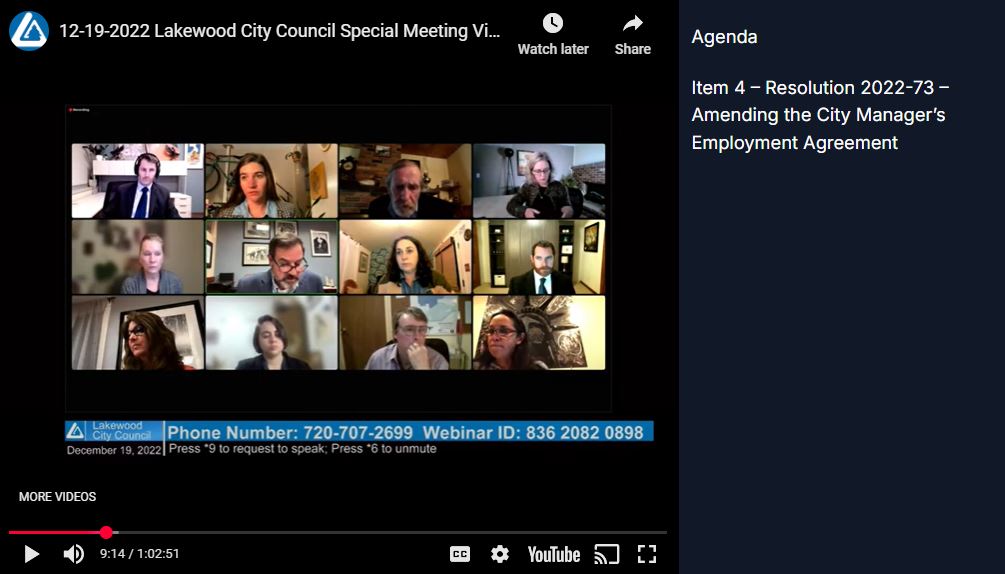
By Lenore Herskovitz On Monday, March 24 the City Council will hold the first of 2 Special Meetings regarding the Annual Review of the City Manager, Kathy Hodgson. Residents are not privy to the standards or metrics that are used to evaluate the job performance of our most powerful and most highly compensated city officials. At one time, the City of Lakewood Community Survey was issued every 2 to 3 years which included approval ratings for the city’s performance. In 2010, when Kathy Hodgson took office this approval rating was 67%. By 2022, this had dropped to 38%. Since then, this survey has not circulated. Until 2022 these survey results were included in the evaluation process (See Lakewood Informer news report from 2022). On Dec. 19, 2022, the City Council met to amend the City Manager’s 2014 Employment Agreement and establish the 2022 Employment Agreement. This was supposed to be discussed on Dec. 5 in an Executive session but 4 Councillors (Able, Springsteen, Olver, and Janssen) opposed the session because they felt they had not been provided enough information in advance of the meeting. At the Dec. 19 meeting there was confusion about whether the representatives were voting solely on the amendments or on the new contract because the packet that was presented only included a staff memo and the resolution containing the proposed amendments. There was no redlined version showing what had been removed from the 2014 contract or any copy of what the new contract would be in its entirety. One thing that had been eliminated was any use of the community survey results when determining the City Manager’s compensation. Only City Council would make that determination moving forward. In spite of the fact that no complete copy of the 2022 contract was provided, the majority of council members voted to pass it. Those voting in favor included our present mayor then Councilor Strom, Mayor Pro Tem  (then Councilor) Shahrezaei, and Councilor Mayott-Guerrero. Those opposed were the same 4 who voted against the Dec. 5 executive session which forced the public hearing on the 19th. As a result, the determination regarding the City Manager’s review and compensation rests in the hands of our elected council members. How often do these individuals hold the City Manager accountable? Is there really any oversight when department heads fail to comply with city codes or ordinances? For example, when the previous Director of Community Resources failed to evaluate fees-in-lieu on an annual basis from 2018 to 2023 as required by ordinance, were there any consequences? The City Manager appoints this and other directorial positions and is responsible for supervising them. Recently, it was discovered that perhaps the Chief of Sustainability and Community Development and his staff had not been following the 2018 Parkland Dedication ordinance, which can be seen in a letter dated October 23, 2024 on page 2 of this document under Item 11 Parkland Dedication, the developer, who had not yet been issued a building permit, was being charged the old fee of $254,545 an acre as opposed to the $432,727 fee that went into effect on June 1, 2024. Are ordinances mere suggestions rather than laws to be followed under this City Manager? Is discretion to reinterpret the law acceptable now? Who, if anyone, is providing oversight and accountability from department heads, or do mistakes just get scapegoated or buried altogether? After years of complaints, meetings are still posted on the wrong site. There still is no consolidated, easily accessible City Directory to identify employees by department and their city contact information. At the annual planning session, councilors have requested better communication between themselves and staff. The City Manager was supposed to provide in-person quarterly updates on goals set at the retreat. Instead, there are updates on the city dashboard in addition to a workshop that was held in person (with no recording available to the public who couldn’t attend). For years, City Council has seemed willing to overlook these shortfalls. If you wish to share your views about the City Manager’s performance feel free to contact: CityCouncilMembers@Lakewood.orgYou can also contact your individual councilors through the link provided (https://www.lakewood.org/Government/City-Council/City-Council-Members)

Scroll to top