Lakewood Informer

Resident generated news about Lakewood, Colorado

Lakewood Informer

Resident generated news about Lakewood, Colorado

Entrenched Bureaucracy

Residents Accused of Spreading “Misinformation”

Word games and a lack of trust have led city staff to accuse residents of “misinformation.” This time, the issue involves the plans to eliminate or reduce physical printed editions of the Lakewood newspaper, Looking@Lakewood. The plans for this switch are still being formed and testing is currently underway — starting with the July edition, which is digital only. Although Lakewood says this is only a test, the city will only commit to one future, printed edition, which substantiates concerns for a permanent elimination. Full elimination may only be conjecture, but according to a response from Lakewood, some city staff believes that mistake is purposeful “misinformation.” This situation is a good example of the word games Lakewood plays and demonstrates the reason that residents continually struggle to make sense of changing policy. The May edition of Looking@Lakewood (below) announced that the July edition would be digital only. When asked about future plans for printed editions, the city responded that the October election edition will be printed and distributed to everyone. This edition is important not only to voters, but to the City Council members campaigning. However, the city response shows no commitment to future printed editions. Rather, they reiterate the cost and sustainability issues the city is concerned about. As the response shows, not even Lakewood can say that printed editions will stay; they can only say they “understand that some residents prefer” a physical copy. They have also said there is no CURRENT plan to FULLY stop mailing. Both of those statements are political word games that make no commitments. Given that evidence, it is easy to see why some residents may mistakenly believe Lakewood has already decided to stop printing completely. Sharing that belief is not “misinformation” but rather “speculation” or, at worst, an honest error. It may also be based on actual experience dealing with Lakewood because historically, the first step Lakewood takes when making a change has been to form a tentative plan, then take a resident survey, and very often to then proceed with the original plan. As long as a printed version is possible in the future, the city can rightly say “Any information you’ve seen or shared that Looking@Lakewood is going completely digital and won’t be mailed ever again is misinformation,” (bold added). Meanwhile, if you are interested in receiving news from the city, you should sign up for the electronic version because, for good or bad, you may not receive a printed version. Resident input is still being taken through the signup below.

Sacrificing Neighborhoods Allows Homeless Funding

Why the big rush to change the zoning code? Follow the money. The money trail leads to state grant funding, which primarily supports homeless and sustainability initiatives. Without that agenda, Lakewood could decide for itself which, if any, of the state initiatives make sense locally. Colorado has decided to override local zoning in a power grab against local home rule. Other cities are fighting back against Colorado with legal cases. But Lakewood will not fight for home rule. They are not only implementing the state law but going further in densification, all while citing the need to comply with state law Lakewood receives millions of dollars in state grants for initiatives like sustainability and the new navigation center. The purchase and renovation of the old Harley Davidson building was done using state grants. To continue funding sustainability and homeless initiatives, Lakewood must either fund it internally (a political impossibility) or comply with state zoning codes. And if the state zoning codes are not what Lakewood residents had in mind when they discussed “affordable housing” solutions, that’s a sacrifice Lakewood is willing to make on your behalf. Note: For the purposes of this article, “Lakewood” means the majority opinion of city officials. It is hard to tell who is speaking in public workshops, there is a lot of backroom personal communications, as well as conflicting explanations given in ward meetings. To establish personal beliefs, please contact your city official with detailed questions that are beyond the scope of this article. Lakewood’s proposed zoning code sacrifices existing neighborhood stability in the hopes of creating affordable housing. Occupancy limits everywhere are eliminated so there can be 20, unrelated, non-owner residents in a house. The house nextdoor may be torn down and replaced with a duplex or a cottage court*. Small retail is now allowed, mixing business with residential. Every property in Lakewood is now a transition zone. *Cottage Court: According to a 2022 report from AARP, cottage courts are defined as a small collection of bungalow-style homes that are “typically 1 to 1½ stories tall and are oriented around a courtyard that serves as an outdoor community space in lieu of rear yards.” – HousingWIre There is no guarantee that any of these changes will achieve their desired goals. Studies abound on both sides. However, Lakewood has already been promised affordable housing since the 2012 zoning rewrite that spawned the term “Soviet-style apartment blocks” with zero new “affordable” units created. Is there any reason to think this big change will be different? Lakewood’s proposed zoning code is not ready for first reading yet, so residents don’t know all the details. The latest redline is from May 19. However, residents do know that know matter what is in there, it is good and necessary because City Council passed a resolution saying so in December of 2024. Lakewood’s navigation center is a contentious issue that hinged largely on the ability to get “free money” from the state. Many homeless and sustainability measures that were supported by the state did not go through a full public policy debate because that wasn’t necessary if Lakewood wasn’t spending its own money. Now that decision is coming back to haunt Lakewood residents, who will be paying for that money by sacrificing their neighborhood stability.

The Comprehensive Plan Bait and Switch

Comprehensive plans are easily readable documents that explain a vision for the future of the city in a moment of time. It speaks in plain English to what the zoning code describes in technical detail. The problem is that the zoning code details are what carry the force of law and because technical details are harder to read, it is easy for residents to overlook inconsistencies in proposed zoning compared to plans. This is otherwise known as a bait and switch. For instance, in the comprehensive plan, Lakewood promises to maintain neighborhood character; while in the zoning code, Lakewood implements high-density urbanization which resulted in the destruction of Belmar Park-adjacent property. Pieces of Lakewood’s Comprehensive Plan were used as evidence to fight against the Belmar Park development. Lakewood officials discounted all such arguments. Now that residents have caught on to the inconsistencies, Lakewood staff argues against using the Comprehensive Plan to guide zoning. Instead, Lakewood proposes changing the ordinance so that the zoning code is no longer tied to the comprehensive plan. With this change, residents could not form legal challenges based on compliance with the comprehensive plan and there is less room to fight against maximum buildout in adjacent properties. Do Residents Need a “Vision” Document Why have a comprehensive plan at all? This is a long-term plan that locks in the vision for this moment in time. It includes aspirational goals with no implementation details. Therefore, the details are filled in by staff using their discretion to interpret the zoning code. Technically, one government cannot bind future governments to its decisions. If tomorrow’s City Council wanted to change the vision of Lakewood, it could choose to do so. However, having a long-range plan laid down by yesterday’s Council is a roadblock that is not easily overcome. Residents would better understand the zoning code if each change had to be justified with open debate. Instead, as is currently occurring, the entire zoning code can be changed by saying the code matches the ambiguous goals of the comprehensive plan. For example, the as-yet unapproved Comprehensive Plan seeks affordable housing. Therefore, City Council reasons that ANY CHANGE to the zoning code will be acceptable as long as affordable housing is the intent, not necessarily the outcome. There is no need for an updated 100-page vision plan document to update 300 pages of zoning code. Why not just introduce one little change at a time that is easily understood by the residents, and easily tested for effectiveness? The proposed zoning changes are still being discussed and changed. City Council have taken months to understand these detailed changes. Residents will have a couple weeks. However, residents did spend months providing input into the comprehensive plan, that will no longer have much meaning. The Proposed Change Lakewood intends to remove the binding zoning code connection to the Comprehensive Plan. As first noted by savebelmarpark.com: Lakewood zoning code currently states that the Comprehensive Plan is the foundation for the Zoning Ordinance. However, the proposed redline removes the “consistency with the goals and policies of the Comprehensive Plan”. When the new zoning passes, all the aspirational goals laid out in the plan can be disregarded at will. Which really is no different than today, as shown by the Belmar Park debate except that today such a decision could be legally challenged and tomorrow it can’t. This specific change to the zoning code was not discussed at any public meeting. Comprehensive Plan Goals Not Followed The Comprehensive Plan states (pg 4-10): “Through the site plan review process and design guidelines, ensure that new multifamily, mixed use, and commercial developments adjacent to single-family neighborhoods are compatible by incorporating appropriate design, scale, height transition, and connectivity to seamlessly integrate with the neighborhood.” Residents compiled argument after argument to show that 777 S Yarrow St does not integrate with the neighborhood and does not meet environmental goals from the plan. Residents can clearly see that the Comprehensive Plan promises integration with the neighborhood. Residents can also clearly see that is not what staff implemented be allowing trees cut down to develop to the lot line near Belmar Park and new high-density apartments that don’t match the nearby buildings. . 15-minute Cities In other communities, residents are also waking up to this bait and switch. An opinion piece in the Boulder Daily Camera highlights this problem by examining Boulder’s 15-minute cities. This is particularly relevant since Lakewood leadership constantly mentions their desire for 15-minute city amenities. The proposed zoning code allows retail in residential zones for 15-minute planning.   Steve Pomerance, in the Boulder Daily Camera, addresses this issue: “The underlying problem with this whole conceptual framework is the self-contradictory assumption that we can have commercial centers in neighborhoods that provide an adequate variety of goods, services and transit, all within 15 minutes of where people live, but still keep our relatively low-density neighborhoods intact. This is simply not supported by the economics or the geography.” – Steve Pomerance Read the rest of that article to understand the same sense of contrasting values Lakewood is “selling” to residents. The new development at The Bend is promising 15-minute city amenities. “Selling” is the appropriate term used here because the zoning was contracted before the comprehensive plan was finalized. In another eerie coincidence with Boulder, Pomerance wrote, “It’s as if those who wrote these objectives had already decided that the results of the cost/benefit study would support implementing this concept, and thus support the massive densification required to create such neighborhoods. Community Input Into Zoning Up to this point, residents have had no input. It was not a resident-driven development.   Lakewood’s Chief of Sustainability and Community Development, Travis Parker, has been attending ward meetings to educate and also to promote the good points of the new zoning code — as if there are no other options. No one has addressed the dissatisfaction with the current densification in Lakewood. Does a desire for affordable housing mean automatic agreement to sacrifice current neighborhoods? More

Lakewood Does Provide Sanctuary

Lakewood has reason to be concerned about being placed on the Department of Homeland Security (DHS) list of sanctuary cities. Email records show they do not comply with federal immigration law, nor do they plan to. Sanctuary was not granted through official vote of City Council; however, sanctuary from federal immigration law was undertaken behind the scenes while using word games to muddy the issue. From the emails, it appears that some Lakewood City Council Members do not appear to know the full extent of Lakewood’s defiance of federal law. On the other hand, DHS knows more than is publicly apparent – which makes sense because they are the ones that have been stonewalled for years. So although Lakewood does not pay for migrant support, it is clear that there is good reason for Lakewood to be placed on a sanctuary list, no matter the word games Lakewood plays. Lakewood City Council has repeatedly denied being a sanctuary city – which is true if defined by formal vote. However, it is not true that Lakewood does not provide sanctuary for illegals. Lakewood DOES provide sanctuary by not verifying immigration status or cooperating with DHS. In the beginning of the sanctuary city debate, the general public understood that a sanctuary city was just that – a safe place where your immigration status wouldn’t be questioned or held against you. Lakewood never made a public motion or official policy stating that they are a sanctuary city but it is apparent that they fully embrace and enable the state’s sanctuary status rather than federal immigration enforcement. No emails asking for removal When Lakewood was placed on the sanctuary city list, Lakewood did not issue a denial. There are no emails to DHS asking to be removed. That would be the first, honest, response from a city that was NOT acting as a sanctuary and was complying with federal immigration law. That’s what Aurora did. There is no email evidence that occurred in Lakewood. There are no emails asking why Lakewood is on the list. This is despite the fact that there is email from Senator Bennet’s office showing that jurisdictions with questions should reach out via email to SanctuaryJurisdictions@hq.dhs.gov. The official response to City Council was a bland email stating that Lakewood staff didn’t know why they were on the list or that they were concerned. Again, parsing the words carefully, staff “didn’t know why they were on the list” is different than “we have no idea why we are on the list.” Lakewood management may not have known the exact reason DHS was citing, but Lakewood would have known what internal procedural changes have been made over the years. Or perhaps Lakewood assumed they wouldn’t be singled out from other cities in Colorado who may have adopted similar, pro-sanctuary polices. Probably, they could rely on not having an official vote cast for sanctuary, which appears to be the case for some Councilors. Someone must have known there is a reason to be concerned, or they would have asked questions openly and honestly. Instead, Lakewood proceeded by investigating “delicately” (see email below). Lakewood declined to comment to the Denver Gazette and Denver 7 inquiries. A quick Google search could find no comment in any press coverage on the subject although Mayor Strom did reply to an msn.com inquiry. Official Response to City Council Don’t Draw Attention to Sanctuary Policies Nowhere anywhere did our investigation turn up evidence that Lakewood cooperates with DHS and ICE on immigration matters. There was never a suggestion that the situation was a misunderstanding. There was no proof emailed to DHS that Lakewood is indeed cooperating with federal immigration. There was one email showing that a Lakewood employee signed up for e-verify for the first time on Monday, June 2, in what may be a coincidence or a panicked response. In this case, Lakewood appears to have taken the approach that the less said the better because Lakewood cooperates with state law. Colorado sanctuary law is obviously intended to conflict with federal law. Lakewood’s cooperation with the state may be seen in multiple subversive actions, rather than one blanket vote by city council for “sanctuary”. And in fact, Ben Goldstein wrote: “Overall, I think the best strategy is to keep our heads down on this one, but perhaps the cat is out of the bag now” (see below). Lakewood Does Not Cooperate With Federal Immigration Proof that Lakewood provides sanctuary by not cooperating with DHS is shown in several ways besides being unable to deny the charge: There are also a couple things conspicuously missing: Complying with Colorado Law Over Federal Law As one example of City Council opinions, Councilor Jacob LaBure believes being placed on the sanctuary city list is “baseless” (see email below). LaBure’s response is the strong denial of an innocent man – which stands in stark contrast to the “keep your head down approach” from Lakewood management. However, strong beliefs or rewriting definitions of sanctuary does not change Lakewood’s support of migrant polices in 2024 or Lakewood’s vote to help Denver with its influx of migrants or Lakewood’s policy to lessen migrants deportation fears. As previously reported, such support is the original definition of a sanctuary city. In 2024 Lakewood Informer filed CORAs regarding immigration policy and did not receive any answers as to enforcement actions. The responding supervisor said the public information officer would be reaching out – an action that didn’t happen. Verbal responses in public meetings align with Jeffco’s response. They say that checking immigration status, which used to be a routine practice, was not the job of local jurisdictions. There is no federal law that says a home rule police department must check immigration status. This was just a matter of routine, like checking to see if you had an out-of-state drivers license. Lakewood no longer regularly does these routine checks. No Use of DHS Database Colorado law requires Lakewood to NOT share personally identifiable information with DHS non-public databases.

Zoned Out: How Lakewood is Selling Out its Neighborhoods

By Karen Gordey You’d be forgiven if you missed it — after all, the City didn’t exactly roll out the red carpet for public input — but Lakewood is in the middle of completely rewriting its zoning code. And on May 21st, the Planning Commission passed 16 amendments in one night. Sixteen. Because who doesn’t want to restructure the entire city with the speed and clarity of a late-night city hall cram session? Here’s the kicker: Lakewood is a home rule city, meaning we have the power to make our own land use decisions. But instead of using that power to protect neighborhoods or push back on one-size-fits-all state mandates, the City Council passed a resolution last year (Resolution 2024-62) that basically says, “Tell us what you want, Colorado — we’ll make it happen.” Meanwhile, six other cities are suing the state to protect their local control. Lakewood? We’re sending engraved invitations to the bulldozers. If you’re not paying attention yet, you should be. Because staff expects these changes to take effect in September and if residents don’t start showing up and speaking up, we’ll be stuck with zoning we didn’t ask for, can’t undo, and won’t recognize. “Home Rule vs Statutory Rule” Before we go any further, it is important to understand the difference between statutory rule and home rule.  So that there is no confusion, I went to the Colorado Municipal League’s website (www.cml.org).  The following is their explanation of the two:  “Colorado cities and towns operate under provisions of Colorado state statutes (and are referred to as “statutory” cities and towns) unless voters adopt a municipal charter to become a “home rule” city or town. Home rule is based on the theory that the citizens of a municipality should have the right to decide how their local government is to be organized and how their local problems should be solved. Municipal home rule derives its authority directly from the Colorado Constitution. It affords residents of cities and towns that adopt a local charter freedom from the need for state-enabling legislation and protection from state interference in “both local and municipal matters.”  The Lakewood City Charter was established on November 1, 1983.  While it has been modified by the voters 5 times (the latest on November 2, 2004, we are still a home rule city.  Lakewood City Charter and Lakewood Together Page 27 of the City Charter talks about planning and zoning.  According to the charter, the city council could have established Ward Advisory Committees to try to corral all these changes but instead are using Lakewood Together for community input.  In fact, I attended the Ward 5 meeting on June 14th and Councilman LaBure said that he tried to create committees last year and did not have support for this.  Let’s take a look at the Lakewood Together site.  On the front page of the zoning updates section (Lakewood Together Zoning Updates), it clearly references the state law requirements and again we are a home rule city so we are allowed to do what is best for our community. This will be important to remember when I talk about the 16 amendments. The 2024 City Council Resolution: Pre-Commitment to State Zoning Goals The City Council passed a resolution Resolution 2024-62 that sounds harmless — values like affordability, walkability, and sustainability — but when you read the details, it’s a blueprint for surrendering home rule. The resolution adopts state-level zoning goals before zoning code revisions or public feedback were complete. That includes: Bottom line: Lakewood didn’t just “revise” its zoning goals; it absorbed the state’s playbook wholesale.  This was covered briefly by the Lakewood Informer: Jedi Mind Tricks – The New Zoning Code WILL BE Good Why Didn’t Lakewood Join the Lawsuit with Other Home Rule Cities?  Good question! Recently, six Colorado cities banded together to sue the state over its new zoning mandates — arguing that the laws violate their constitutional rights as home rule municipalities. (6 Front Range cities sue over housing laws, governor’s threat to withhold state funds) Lakewood? We sat that one out. At the Ward 5 meeting on Saturday, June 14th, I asked our Councilors a simple question: Was our absence because of Resolution 2024-62, which essentially pre-commits Lakewood to implementing state zoning goals? And if the lawsuit is successful, meaning those cities win back their rights to local control, won’t we be stuck with sweeping zoning changes we didn’t have to make? Councilman LaBure responded: “We are a home ruled city but we are also a state entity. The state passes things all the time that encroach on local control. The argument has been historically well zoning and parking issues and all those things are matters of local concern and not the state concern. And Judiciary had tended to draw a line there. However, the state has increasingly been making the argument that there is a housing crisis statewide so we need more and more control over local zoning issues because it is actually a matter of state concern. I would have been happy to have jumped on that lawsuit however, other cities already did it and we are part of the Colorado Municipal League (CML). And CML has supported that lawsuit and in that sense we are member and if not the largest so in some sense we are part of that because of our CML affiliation. And it is a fair question to ask about if the lawsuit is successful, then we would be stuck with zoning changes that were not needed.” Translation: we could have stood up for home rule; but we’ll just let other cities take the heat and hope our dues to the Colorado Municipal League somehow cover us by association. Councilor Nystrom added that she did ask the City Attorney the same question but didn’t get a clear answer. She also pointed out that HOAs aren’t safe from this zoning overhaul either. While HOA covenants are seen as contracts between homeowners and their associations, local

Lakewood and Jeffco Called a Sanctuary

The Department of Homeland Security (DHS) published a list of sanctuary cities on Thursday, May 29. Lakewood and Jefferson County were on the list. By Sunday, DHS had taken the list down because of objections by the named jurisdictions. Cities like Lakewood never voted on the issue, just quickly enacted deprioritization policies behind the scenes and then told residents that the increased migrant population is not their problem. Now, DHS is calling out places like Lakewood and Jeffco that hide behind an unofficial policy of not cooperating, while other places do their best to balance a state law that acts against federal law. Lakewood has been through these word games with its residents already. No – Lakewood never formally voted to be a sanctuary city – but only because the state approved sanctuary status so Lakewood politicians didn’t have to take the political risk. At the time, it was apparent that Council would have approved sanctuary status if needed. At that time, around 2018, sanctuary meant being welcoming, resisting ICE cooperation and providing cover for migrant activity. Today, it seems to mean paying for housing and benefits… Because the bar has already been raised! People EXPECT welcoming and resistance to federal immigration. However, DHS is working from the original definition of any jurisdiction not cooperating with ICE. According to the original statement, DHS defined these sanctuary cities as: NOTE: This author seems to remember former Mayor Adam Paul talking about migrants taking refuge in a Lakewood church basement and the need for more placements. Does that sound right to anyone else? Lakewood has still been playing these word games, using “migrant” or “newcomer” instead of “illegal alien”.  They would not guarantee that new homeless shelters would not be used for migrants. Instead, some Councilors insisted that all would be welcome. According to an article in The Guardian, the president of the National Sheriffs’ Association, Sheriff Kieran Donahue, “said the list was created without input from sheriffs and ‘violated the core principles of trust, cooperation, and partnership with fellow law enforcement’”. Lakewood still “deprioritizes” crime instead of admitting they will not enforce certain crimes or cooperate with certain agencies. Both Lakewood and Jeffco claim that immigration enforcement is not their jurisdiction so no cooperation is necessary. Neither government has any problem cooperating with other federal agencies, such as the FBI. Therefore, according to Lakewood and Jeffco principles, the National Sheriffs’ Association’s objection is without merit because local jurisdictions shouldn’t be cooperating anyway. Note that the DHS list is more granular than others that just highlight the entire state as a sanctuary. DHS did not respond to requests for more information on how the list was compiled, but there were clearly some cities and counties singled out around the state. Lakewood’s Police Chief has described Venezuelan gang activity in Lakewood in a rare Ward 4 appearance. Lakewood thinks residents are so ignorant that they can’t see the deteriorating conditions brought on by “de-prioritizing” crimes. They seem to think that if they don’t use the word “sanctuary,” they can act defy federal law and be fine. And so far, they are right. During the last discussion about Lakewood’s sanctuary city status, Lakewood Informer news noted that the word games continued with a change from “sanctuary” to “being a good neighbor”.

The Illusion of Debate: How Lakewood’s City Council Rubber-Stamps Policy

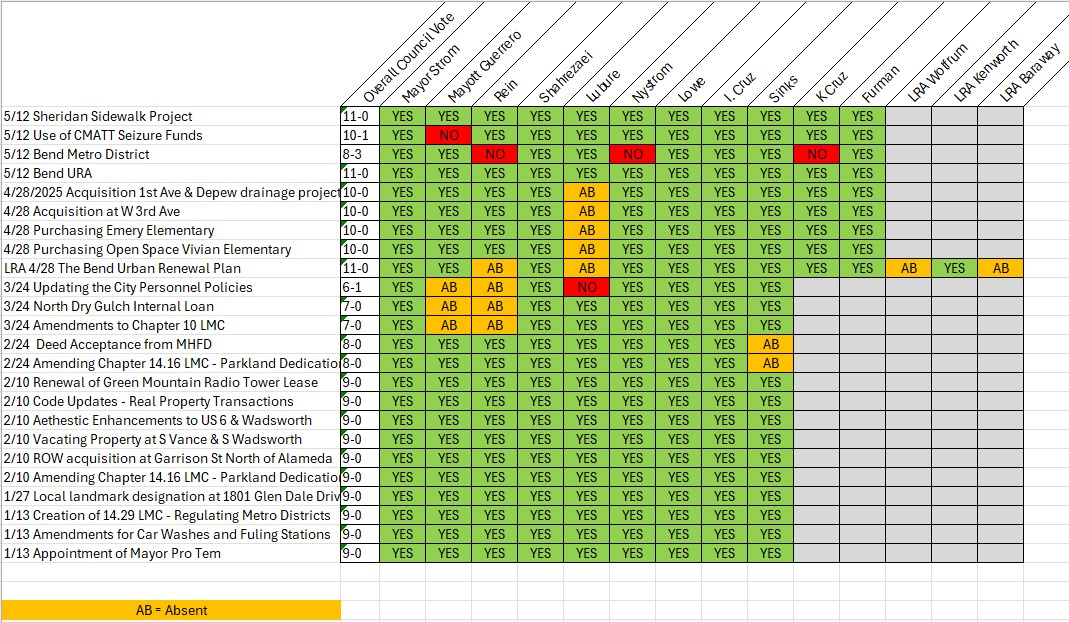
By Karen Gordey As you may or may not have heard, Kairoi—the Texas developer behind the 777 S Yarrow Street project—cut down more than 60 mature trees on May 12th. The community response was swift and emotional. That evening, a large group from the Save Belmar Park movement filled the back of Lakewood City Council chambers and voiced their outrage during public comment. Many echoed the same call: every sitting councilor—save perhaps one—needs to be voted out. The next day, I drove to Belmar Park to see the damage for myself. As I pulled up, I noticed two current council members chatting nearby. I spoke with one of them off the record for about 25 minutes. When I said, “Isn’t this what you voted for?” the councilor quickly replied, “No, I didn’t vote for this.” Skeptical, I went home and reviewed voting records for the past two years. And they were right—technically. The 777 S Yarrow project didn’t come before City Council. It went through the Planning Commission and the City’s Planning Department. But that wasn’t the end of the story. When I tried to dig deeper, it became clear how inaccessible the City’s meeting records really are. Minutes from meetings are supposed to be approved during the Consent Agenda at every regular council meeting. But finding the actual minutes? Nearly impossible. For instance, during the May 12, 2025 meeting, Council approved minutes from March 24, April 14, and May 5—but none were linked or attached. On February 24, they approved minutes from December 9, 2024. Again, no actual documents. You can technically find every ordinance and resolution passed by council here: https://www.lakewood.org/Government/Departments/City-Clerks-Office/City-Council-Ordinances-Resolutions. But it’s a list, making it difficult for residents to hold individual councilors accountable. The Consent Agenda, meant for quick approvals of non-controversial items like meeting minutes, ordinances on first reading, or ceremonial resolutions, is often a catch-all for measures that go unscrutinized. Councilors can ask to remove items for discussion—and did so multiple times in 2024. But here’s something you may not know: residents can request that items be removed too. Once passed, the items removed from the consent agenda are discussed and voted on, then the rest of the agenda is addressed in order., And while the Consent Agenda script claims that first-reading ordinances are published in the Denver Post—none have appeared in the last two years. Don’t take my word for it. You can search the Denver Post’s legal notices here: https://marketplace.denverpost.com/marketplace-denver/category/Miscellaneous/Legal%20Notices and on the state’s required public notice database: https://colorado.column.us/search/ (which is moving to: https://www.publicnoticecolorado.com). So how did your councilor vote? Here’s a breakdown of every vote not passed via the Consent Agenda Here’s what I found: Also included in that spreadsheet is a tab for study sessions and workshops. These are arguably more important than council meetings themselves. That’s where councilors hear presentations on major issues—always from city staff or invited parties that support the city’s position. No opposing views. No residents. By the time a topic comes up for public hearing (on second reading), the council has already made up its mind. Is it any wonder residents feel ignored and angry? Let’s talk transparency. The Budget & Audit Committee—tasked with overseeing your tax dollars—hasn’t met once in 2025. Back in January, Ward 5 councilors proposed expanding the committee to represent all five wards. That proposal was shot down. Only three wards are represented. Two wards remain unheard. And all this under a City Manager pulling in over $400,000 a year. When government struggles with the basics—recordkeeping, transparency, fair representation—it often fails on the big things too. Isn’t it time for a better way? If you’re tired of a council that listens to developers more than residents, tired of unanimous votes that ignore dissent, and tired of a system where transparency feels like an afterthought—then do something. Start asking questions. Email your councilor. Demand meeting minutes be posted, ordinances be published, and your ward be represented. Government works best when it’s held accountable. And in Lakewood, it’s time we started holding ours to a higher standard.

Lakewood is Laughing At Us

The May 7th Planning Commission meeting was a travesty of a public hearing. Lakewood cared enough to give residents an outlet for their grievances. No one cared enough to enact a single change. And sometimes they outright laughed at us. Watch the video below from the end of public comment, starting at min 2:58:25. One resident got up and publicly read an article from the Lakewood Informer. Watch the city staffer seated in the background unsuccessfully hiding her laughter during this reading. All of which was proved to be true. All of which city staff ignored and the entire Planning Commission dismissed — just like so many other valid resident points. The meeting started with Lakewood Chief of Sustainability and Community Developer Travis Parker explaining that he didn’t think this meeting wouldn’t change anything. He said that there were “pretty significant misunderstandings” of what staff could do. He said that “attacks on staff for being, you know, incompetent or malfeasant or acting in bad faith, demonstrate a fundamental misunderstanding of the good and hard work that’s done by people that are experts.” No one doubts city staff work hard. They all deserve thanks. But we also can’t assume they are always right and the residents are wrong about everything. We can’t assume that there is no other way to evaluate base assumptions. But that’s exactly what the Planning Commission decided to do. Ironically, one of the main points of the Belmar Park battle was about cutting down all the trees that could have formed an expanded buffer. Mr Parker himself has been educating residents on new zoning codes from Lakewood that will not increase the setbacks to what they were pre-2012, but will now require RESIDENTS to get a permit to cut down their trees. So the meeting was a pretty show that started and ended with all the well-researched points the residents brought forward being dismissed. Sadly, the best thing to be said is that being dismissed was more respectful than being laughed at. Required Grading Permit – Evidence not reported by city staff The permit pictured above is from Lakewood’s eTRAKit system, showing the grading permit that was applied for and received within one day of the complaint, just as reported by Steve at savebelmarpark.com The permit below is for demolition, which was applied for a month earlier. No malicious intent was implied and the problem was quickly corrected. Thanks to residents who apparently know less than city staff. Grading permit requirements below Actual permit that must be displayed before construction:

UPDATE: Disappointing but Not Surprising – We Need Your Help Now More Than Ever!

From Save Belmar Park, Inc., – a Colorado non-profit What happened at the May 7th Lakewood Planning Commission hearing was deeply disappointing—though sadly, not unexpected. After several speakers delivered well-researched, thoughtful, and heartfelt presentations, the audience erupted in applause. The public’s support for protecting Belmar Park was undeniable. So how does a small group of City officials override the will of the residents? Despite an overwhelming outpouring of public opposition—including emails, social media comments, and a nearly 10-to-1 ratio of anti-this-development comments on Lakewood Speaks—the Commission still voted 5–0 in favor of the 411-unit Kairoi apartment building. And they did so even after being presented with a powerful, evidence-based case showing that the proposed development directly contradicts Lakewood’s own zoning code, comprehensive plan, and parks master plan. This vote was a slap in the face to the community. It disregarded common sense, environmental preservation, and the very planning documents the city is supposed to uphold. The proposed zero-lot-line, six-story building is incompatible with the surrounding two-story Belmar Commons townhomes, overwhelms local infrastructure, and threatens the ecological balance of Belmar Park. The city has rolled out the red carpet for billionaire developers—again—ignoring the public and prioritizing profit over people, parks, and trees. Dozens of mature, century-old trees will be clearcut. Wildlife will be displaced. Belmar Park’s peace and beauty will be irreversibly damaged (if we don’t stop them). But, we have NOT given up—and we’re not stopping now! Our next step is filing a lawsuit under a 106A appeal, which will go before a Jefferson County district court rather than more city insiders. We believe we still have a strong chance at a different outcome—despite the city’s push to bulldoze trees—because the proposed development blatantly contradicts Lakewood’s own zoning laws, comprehensive plan, and parks master plan, giving us solid legal ground to challenge it in court. This is our last real chance to stop this destructive project, and we’re counting on supporters like you to help us make it happen. Legal fees are significant, and this is a fight the community should not have to fund—but we must because the City of Lakewood refuses to listen. Please stand with us—again. If this park means something to you, dig deep—and give as generously as possible (then smile knowing you’re helping to save something irreplaceable). Every dollar helps us hold the line against this destructive plan. Then share our campaign and spread the word. We’re fighting for what’s right: environmental integrity, community character, and the future of Belmar Park. 👉 Donate now: https://www.gofundme.com/f/save-belmar-park Directors Save Belmar Park, Inc. 

The Bend: A Government Financing Trade Deal

Lakewood may be forcing a property owner to blight their own land in a backroom trade deal wherein staff pledged a positive vote from City Council for a metro district. The deal would give The Bend development city financing in exchange for metro district status. In January 2025, a representative for The Bend developer made the following public comment: “The city is actually only allowing a Metro District to be put in place if the URA (Urban Renewal Area) passes so that it is a vehicle for this infrastructure and tax increment financing. They actually would not pass our Metro District standalone. They’ve made that very clear.” – Allie Meister, Lincoln Properties, at Green Mountain Water Board Meeting, min 40:13. This deal illuminates why Lakewood is rushing through a URA and metro district public hearing on the same night. Staff presentations have repeatedly touted the advantages of doing both the URA and the metro district at the same time. They claim these are complementary structures. But they are not complementary. Rather, these are essentially overlapping structures that could finance the same set of infrastructures. Apparently, financing public infrastructure is a profit center. Overlapping financing is duplicative. Even worse, for The Bend, neither metro district nor URA is appropriate. The Bend is not a “serious and growing menace” to the public health, safety, morals, and welfare, which is the statutory reason for Urban Renewal. The Bend does not provide public services, which is necessary for a metro district. The metro district will only be used for financing. Therefore, the most appropriate government assistance, if any, would be a Business Improvement District (BID).  BIDs are the more accountable, less powerful, way to achieve development financing but no one is advocating for its use. Instead, developers prefer to form metro districts. This initially involves the developer loaning money to the new metro district.  Then the metro district issues a bond, with interest, to pay back the loan. Since the developer and the metro district are the same people (different legal entity), the developer has now gained itself government immunity, as well as millions of dollars of interest payments. In many cases, the interest payments never end – they only continue to grow. This outcome isn’t possible with a BID. (See Denver Post series “Metro Districts: Debt & Democracy” by David Migoya for more in-depth information on metro district abuses) Therefore, developers generally want that metro district as a profit center, rather than as a way to finance development, since they front the funds in either case. A URA is also meant to fund public infrastructure. Much of the public infrastructure was repeated under both the URA and metro district justification. Only one method is needed to finance infrastructure, and, as noted, the developer will provide the base funds in any event. As Karen Gordey reported in the Lakewood Informer, there was no required financial gap analysis completed to show that city funding was required. Therefore, with a metro district there is no need for a URA. This conclusion is also shared by a report from the Independence Institute. A URA has not required a metro district in the past. However, Lakewood can trade URA financing for affordable housing. Lakewood is not allowed to pay for housing directly. Lakewood is not even supposed to demand any percentage of affordable housing. There is no zoning or ordinance that requires it.  The irony is that Lakewood City Council itself sunset the Strategic Growth Initiative ordinance. Under that ordinance, this development would have fallen under the allocation review system wherein Lakewood could have asked for affordable housing to permit this many units in a TRANSPARENT process. Instead, the city is now working behind the scenes to make this same thing happen. So, through the URA, Lakewood will gain affordable housing, aka government housing or government-subsidized housing. Those units can be used to qualify for state grants for even more development in Lakewood. “Without the Urban Renewal plan, in our case, we wouldn’t be able to deliver kind of what they want to see or their vision for this piece of land which includes housing retail and affordable housing they you know both the state and the city and the county do have a desire to have a portion of the site have affordable housing in it.“ Allie Meister, Lincoln Properties, Jan 28 2025, min 35:57 Lakewood residents will pay for The Bend development by giving the developer financing. The new taxes from that development are diverted out of the general fund, which pays for Lakewood resident services like police, and instead will pay for The Bend development responsibilities like streets and pipes. The decision for an Urban Renewal Area is very separate from the decision to approve a metro district. The developer did not originally desire to be in an Urban Renewal Area and Lakewood may not approve a metro district as a standalone decision. But, operating together, the developer and city can trade financial incentives that residents throughout Lakewood will pay for.  The developer offers blight and gets metro district status and financing. The city offers URA financing to indirectly offset affordable housing units and gets a basis for more state grant funding. “Municipalities are using a tool (URA) meant only for serious threats to the public as a tool for gaining a competitive advantage in economic development. Which, essentially, is a way to financially reward development partners and a method to force the public into a future desired by government planners.” -From The Empty Promise and Untold Cost of Urban Renewal in Colorado Just like Lakewood’s deal to buy Emory Elementary, residents should know the full plan to leverage this deal for more high-density development using state grant funds from the affordable housing units. Without that knowledge, which has not been disclosed, neither the URA nor the metro district decision makes any sense. There will be a City Council vote on the metro district and URA on Monday, May 12 that is open to

Scroll to top